Sterilization
A central bank monetary operation that neutralizes the impact of foreign exchange intervention on the domestic money supply through offsetting open market sales or purchases of domestic government securities.
What Is Sterilization?
In international macroeconomics and monetary policy, sterilization describes a deliberate, coordinated operation conducted by a central bank to insulate its domestic money supply and short-term interest rates from the side effects of its foreign exchange market interventions.
When a central bank intervenes in currency markets to weaken an overvalued national currency, it sells newly created domestic currency to purchase foreign exchange (such as U.S. Dollars or Euros). If left unaddressed, this newly injected domestic currency expands the commercial banking system’s reserves, swelling the domestic monetary base ($M_0$), lowering interbank interest rates, and generating dangerous inflationary pressures.
To “sterilize” this intervention, the central bank immediately conducts an equal and opposite transaction in the domestic debt market: it sells domestic treasury bonds or central bank bills to commercial banks, absorbing the excess domestic liquidity it previously injected. Consequently, the central bank achieves its foreign exchange objective while leaving the domestic money supply completely neutral.
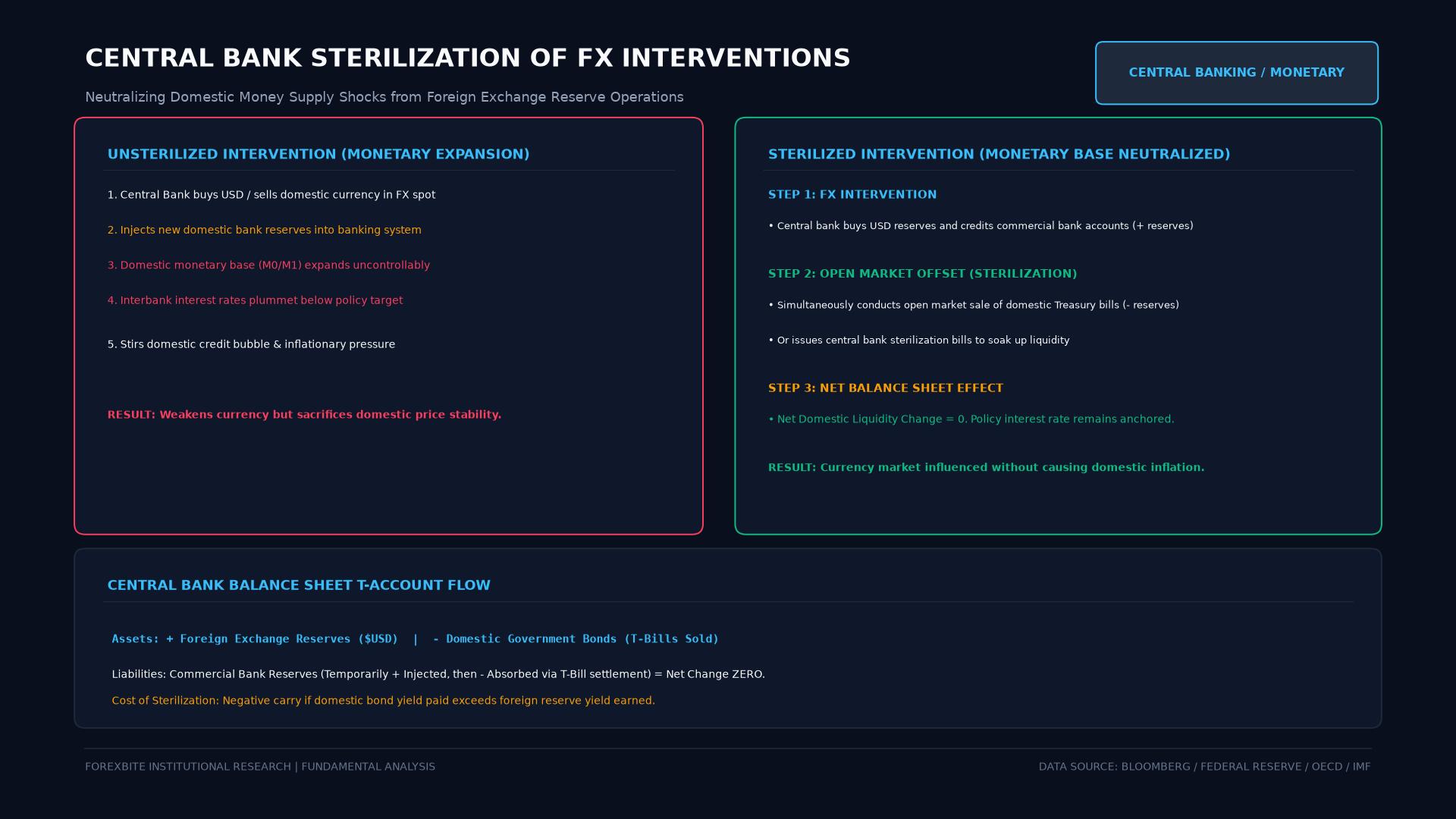 Figure: Structural comparison of central bank foreign exchange interventions, contrasting unsterilized operations with sterilized interventions using domestic open market operations to neutralize the monetary base.
Central Bank Balance Sheet Accounting
The mechanics of sterilization are transparently illustrated through the standard central bank balance sheet equation:
$$\Delta \text{Monetary Base } (\Delta M_0) = \Delta \text{Net Foreign Assets } (\Delta \text{NFA}) + \Delta \text{Net Domestic Assets } (\Delta \text{NDA})$$
Where:
- $\text{NFA}$: Foreign currency reserves and gold held by the central bank.
- $\text{NDA}$: Domestic government bonds and loans to commercial banks.
- $M_0$: Currency in circulation plus commercial bank reserve balances.
During a fully sterilized currency intervention:
$$\Delta \text{NFA} = +$10,000,000,000 \quad \text{and} \quad \Delta \text{NDA} = -$10,000,000,000$$
$$\Delta M_0 = +$10\text{B} + (-$10\text{B}) = \mathbf{$0.00}$$
The central bank successfully changes the composition of its assets (holding more foreign reserves and fewer domestic bonds) while leaving its monetary liabilities ($M_0$) and domestic interest rate targets unaffected.
Sterilized vs. Unsterilized Foreign Exchange Intervention
| Dimension | Sterilized Intervention | Unsterilized Intervention |
|---|---|---|
| Domestic Money Supply ($M_0$) | Unchanged (Completely neutralized) | Expands or Contracts significantly |
| Domestic Interest Rates | Held stable at target policy rate | Driven higher (if selling FX) or lower (if buying FX) |
| Inflationary Impact | Zero direct inflationary pressure | Elevated inflation risk if injecting domestic currency |
| Exchange Rate Longevity | Moderate to weak (Works mainly via signaling) | Powerful and durable (Changes monetary fundamentals) |
| Operational Complexity | High (Requires deep, liquid domestic bond market) | Low (Single-step foreign exchange market trade) |
The Limits of Sterilization: The Mundell-Fleming Trilemma
The economic viability of sterilization is fundamentally constrained by the Impossible Trinity (Mundell-Fleming Trilemma), which dictates that a country cannot simultaneously maintain:
- A fixed or managed foreign exchange rate.
- Free, open cross-border capital mobility.
- An independent domestic monetary policy.
                      THE IMPOSSIBLE TRINITY TRILEMMA

                           [ Fixed Exchange Rate ]
                                   /\
                                  /  \
                                 /    \
                                /      \
  [ Free Capital Mobility ] ───'────────'─── [ Sovereign Monetary Autonomy ]

  Rule: A nation can select any TWO corners, but CANNOT achieve all three.
The Quasi-Fiscal Carrying Cost of Sterilization
When an emerging market central bank conducts prolonged sterilization to prevent currency appreciation, it incurs substantial structural financial losses:
- It issues domestic sterilization bonds paying high local interest rates (e.g., 8% to 12%).
- It invests the acquired foreign currency in developed sovereign treasuries paying low foreign yields (e.g., 2% to 4%).
- This negative yield spread imposes a chronic fiscal drain on the central bank’s balance sheet, eventually forcing the abandonment of the sterilization program.
Real-World Institutional Case Study: The People’s Bank of China (2003–2014)
The largest and most sustained sterilization campaign in economic history was executed by the People’s Bank of China (PBOC) between 2003 and 2014:
       PBOC FOREIGN EXCHANGE RESERVES EXPLOSION (2003–2014)

 $4.0 Trillion ──┐                                         ┌─── Peak: $3.99T (2014)
                 │                                        /│
 $3.0 Trillion ──┼                                _..-''`/ │
                 │                         _.-''`          │
 $2.0 Trillion ──┼                  _.-''`                 │
                 │           _..-''`                       │
 $1.0 Trillion ──┼─-.._.-''`                               │
                 └─────────────────────────────────────────┴───────────────────
2003 2005 2007 2009 2011 2014- The Trade Boom: Fuelled by rapid export growth following its WTO accession, China experienced massive foreign capital inflows.
- The Currency Peg: To maintain the competitiveness of Chinese manufacturing, the PBOC bought billions of U.S. Dollars daily, pegging the Chinese Yuan (CNY).
- The Sterilization Arsenal: To prevent this avalanche of liquidity from causing hyperinflation, the PBOC deployed aggressive sterilization tools:
- Issued trillions in specialized Central Bank Bills.
- Skyrocketed the Reserve Requirement Ratio (RRR) on commercial banks from 6% to an unprecedented 21.5%, legally locking trillions of Yuan inside bank vaults.
- The Outcome: The PBOC accumulated nearly $4 trillion in foreign reserves while successfully containing domestic consumer price inflation, demonstrating the unprecedented scale of sovereign sterilization.
Does Sterilized Intervention Actually Work?
Financial economists recognize two primary transmission channels through which sterilized intervention influences exchange rates:
- The Signaling Channel: Even though domestic money supply remains unchanged, the central bank’s public intervention signals its future policy intentions. If the market believes the central bank is committed to defending a price level, speculative capital retreats, causing the exchange rate to stabilize.
- The Portfolio Balance Channel: By altering the relative market supply of domestic bonds versus foreign bonds, large-scale intervention forces international investors to rebalance their multi-currency portfolios, applying subtle pressure toward the central bank’s desired exchange rate.
Frequently Asked Questions
Why don’t central banks use unsterilized intervention all the time?
Unsterilized intervention directly compromises the central bank’s primary constitutional mandate: domestic price stability and inflation targeting. If a central bank continuously sells domestic currency to devalue its exchange rate without sterilizing, the resulting surge in money supply sparks rampant domestic inflation, asset bubbles, and economic destabilization.
What is “reverse sterilization”?
Reverse sterilization occurs when a central bank intervenes to defend a depreciating currency. The central bank sells foreign reserves to buy back domestic currency (which shrinks the domestic money supply). It then sterilizes this contraction by conducting open market bond purchases or lowering bank reserve requirements, injecting liquidity back into commercial banks to prevent an unwanted credit crunch.
Can small developing nations sterilize foreign capital inflows effectively?
Small developing nations struggle with sterilization because their domestic debt markets lack depth. If a central bank sells domestic bonds in a small, illiquid market, bond prices collapse and domestic interest rates surge dramatically, attracting even larger waves of speculative foreign capital and defeating the original purpose of the intervention.
Ready to trade forex?
Open a free demo account with a regulated broker. Practice with virtual funds before risking real money.