TZS
The ISO 4217 currency code for the Tanzanian Shilling, the official legal tender of the United Republic of Tanzania, issued and managed by the Bank of Tanzania.
TZS (Tanzanian Shilling)
The Tanzanian Shilling (ISO code: TZS, symbol: TSh) is the official sovereign currency of the United Republic of Tanzania, which includes both the East African mainland and the semi-autonomous Zanzibar archipelago. Subdivided into 100 senti (cents), the currency is issued, supervised, and defended by the central monetary authority, the Bank of Tanzania (Benki Kuu ya Tanzania, or BoT), established under the Bank of Tanzania Act of 1965.
In international macroeconomics and regional African development finance, the Tanzanian shilling represents an expanding frontier market currency anchored by significant mineral wealth, an agricultural export base, tourism receipts, and sovereign infrastructure projects. Tanzania is one of Africa’s primary gold producers and a founding pillar of the East African Community (EAC), giving the TZS strategic importance in regional cross-border commerce.
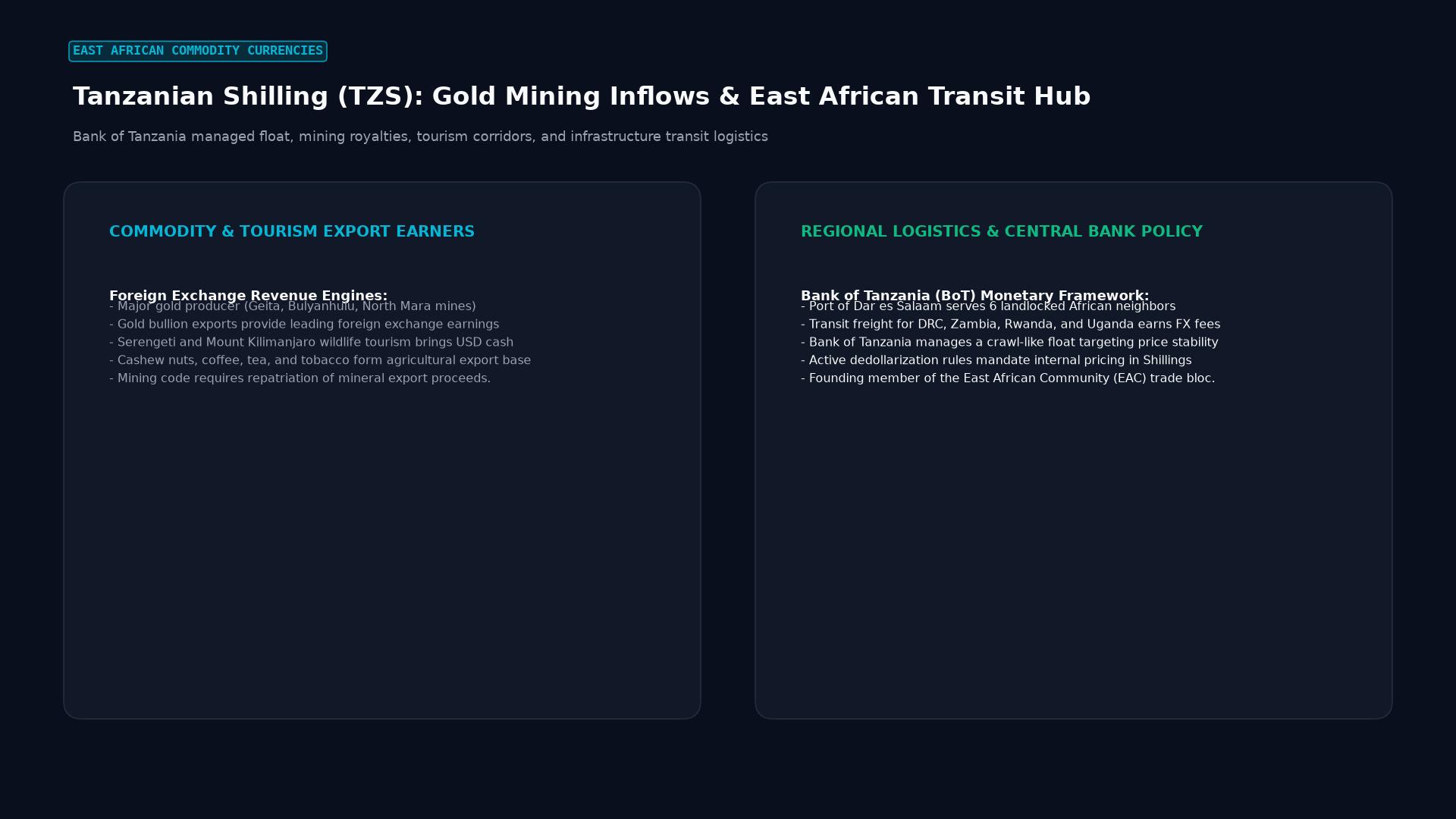 Figure: Bank of Tanzania managed float, mining royalties, tourism corridors, and infrastructure transit logistics
Historical Context and Currency Genesis
Tanzania’s modern monetary architecture emerged from the dismantling of colonial-era regional currency boards:
- The East African Shilling (1921–1966): Prior to independence, Tanganyika and Zanzibar utilized the East African shilling, administered by the British East African Currency Board (EACB). The currency circulated throughout Kenya, Uganda, and Tanzania at a fixed 1:1 parity with the British shilling (20 shillings to 1 pound sterling).
- Breakup and National Sovereignty (1966): Following the unification of Tanganyika and Zanzibar in 1964 to form the United Republic of Tanzania, regional negotiations to preserve a common central bank failed. In June 1966, the Bank of Tanzania commenced operations and issued the Tanzanian Shilling, replacing the East African shilling at 1:1 parity.
- The Socialist Era and Foreign Exchange Rationing (1967–1985): Under the Ujamaa socialist policies established by the Arusha Declaration, Tanzania nationalized commercial banks and instituted stringent price controls and foreign currency rationing. The shilling was officially pegged at overvalued rates, resulting in chronic consumer goods shortages and an illicit black market.
- Economic Liberalization (Post-1986): Under IMF and World Bank economic recovery programs, Tanzania abolished state import monopolies, dismantled price controls, and legalized private commercial banking. In 1993, the Interbank Foreign Exchange Market (IFEM) was launched, establishing market-determined exchange rates.
Monetary Policy Framework of the Bank of Tanzania
The Bank of Tanzania operates under a revised legislative framework designed to maintain low and stable inflation while facilitating economic growth. In early 2024, the BoT completed a transition from reserve-money targeting to an interest-rate-based monetary policy framework:
The Central Bank Rate (CBR)
The BoT introduced the Central Bank Rate (CBR) as its benchmark policy rate to signal its monetary stance. The CBR is used in open market operations, repo auctions, and reverse repos to guide the 7-day interbank cash market rate within an operational corridor.
The Exchange Rate Regime: Managed Float
Tanzania officially operates a managed floating exchange rate regime. The value of the TZS is primarily determined by supply and demand in the Interbank Foreign Exchange Market (IFEM):
- BoT Market Role: The central bank participates in the IFEM primarily to smooth out excessive, disorderly short-term exchange rate volatility and to accumulate foreign exchange reserves, rather than defending an administratively predetermined parity.
- Import Reserve Benchmark: The BoT is legally mandated to maintain official gross foreign exchange reserves sufficient to cover at least 4.0 months of projected merchandise imports (and adheres to the East African Community convergence criterion of 4.5 months of import cover).
       BoT Foreign Reserve Target Condition:

       FX_Reserves >= 4.0 * (Projected Annual Imports / 12)

       If Import Bill = $15,000,000,000:
       Minimum Statutory Reserve Floor = 4.0 * $1,250,000,000 = $5,000,000,000
Macroeconomic Drivers of the Tanzanian Shilling
1. Gold Mining and Mineral Exports
Gold is Tanzania’s single largest merchandise export, accounting for over 30% of total export receipts:
- Major commercial mining concessions (including the Geita Gold Mine operated by AngloGold Ashanti and North Mara and Bulyanhulu operated by Barrick Gold) generate foreign currency receipts.
- Rising global gold prices provide an automatic buffer to the current account, strengthening the TZS. Conversely, slumping gold markets depress export revenues.
- Tanzania also holds significant deposits of tanzanite (a unique blue-purple gemstone mined exclusively in the Mererani hills), diamonds, coal, and nickel.
2. Tourism Receipts
Tourism is a primary hard-currency earner, generating over $2.5 billion annually:
- Wildlife safaris in northern circuits (Serengeti National Park, Ngorongoro Crater, Mount Kilimanjaro).
- Tropical beach resort tourism in Zanzibar.
- Tourism inflows are seasonal, peaking between July and October and during the European winter holiday season, creating recurring quarterly liquidity patterns in domestic foreign exchange bureaus.
3. Agricultural Commodities
Agriculture employs over 65% of the domestic workforce, producing cash crops that generate cyclical foreign currency:
- Cashew Nuts: Exported predominantly in raw form to processing facilities in India and Vietnam.
- Coffee and Tea: High-grade Arabica coffee from the Kilimanjaro and Mbeya highlands.
- Cotton and Tobacco: Exported to regional and international textile and consumer hubs.
4. Capital Expenditure and Infrastructure Programs
Tanzania has engaged in massive state-directed infrastructure investments:
- The Standard Gauge Railway (SGR): Modern electrified rail linking Dar es Salaam with interior manufacturing and mining centers.
- The Julius Nyerere Hydropower Project (JNHPP): A 2,115 MW dam on the Rufiji River.
- Because these projects require imported locomotives, steel, turbines, and specialized foreign engineering services, they place structural demand on foreign exchange reserves.
+------------------------------------------------------------------------+
|          Comparison of East African Community (EAC) Currencies         |
+------------------------------------------------------------------------+
| Currency | Country   | Central Bank      | Core FX Export Anchor       |
| TZS      | Tanzania  | Bank of Tanzania  | Gold, Tourism, Cashews      |
| KES      | Kenya     | Central Bank Kenya| Tea, Horticulture, FinTech  |
| UGX      | Uganda    | Bank of Uganda    | Coffee, Gold, Future Oil    |
| RWF      | Rwanda    | Nat. Bank Rwanda  | Mining (Coltan/Tin), Coffee |
+------------------------------------------------------------------------+
Anti-Dollarization Policies and Banking Regulations
To preserve the sovereign integrity and domestic purchasing power of the shilling, the Bank of Tanzania and the Ministry of Finance enforce strict anti-dollarization measures:
- Prohibition of Domestic Foreign Currency Pricing: Tanzanian law mandates that all domestic commercial transactions, consumer prices, tourist services, school tuitions, and residential rents must be priced and settled in Tanzanian shillings. Foreign currency may only be used for legitimate cross-border international trade settlements.
- Foreign Exchange Bureau Licensing: The BoT maintains strict capital adequacy and operational oversight over retail foreign exchange bureaus (bureau de change), requiring real-time biometric identification and transaction reporting to prevent illicit capital flight.
- Capital Account Liberalization: While transactions within the East African Community have been progressively liberalized to encourage regional integration, capital movements involving non-EAC residents remain subject to regulatory reporting to curb speculative attacks.
Practical Case Study: Agricultural Exporter Forward Contract
Consider Serengeti Cashew Processors (SCP), a commercial agro-industrial exporter located in Mtwara, southern Tanzania.
Business Exposure
- SCP signs an export agreement on October 1 with an Indian trading firm to deliver 1,000 metric tons of raw cashew nuts.
- The contract is valued at USD 1,500,000, with payment due in 90 days (December 31).
- SCP incurs local operational expenses (purchasing cashews from smallholder farmers, transport, and local warehouse labor) denominated entirely in TZS.
Hedging Analysis
- Spot Exchange Rate on October 1: USD/TZS = 2,600
- Expected revenue at spot: $$1,500,000 \times 2,600 = \text{TZS } 3,900,000,000$$
- SCP enters an onshore deliverable forward contract with CRDB Bank or NMB Bank in Dar es Salaam:
- 90-day USD/TZS forward quote: 2,625
- By locking in the forward contract: $$\text{Guaranteed Revenue} = 1,500,000 \times 2,625 = \text{TZS } 3,937,500,000$$
- Even if global events or unexpected central bank interventions cause the spot rate to drop to 2,550 by December 31, SCP’s domestic profit margin remains fully protected from foreign exchange erosion.
Frequently Asked Questions
What is the relationship between the Tanzanian Shilling and the East African Monetary Union?
Tanzania is a signatory to the East African Community (EAC) Monetary Union Protocol, which envisions the phased introduction of a single common regional currency (tentatively referred to as the East African Shilling). However, convergence criteria (including fiscal deficit caps, inflation targets below 5%, and foreign exchange reserve minimums) require ongoing institutional alignment among member states.
Can travelers use credit cards and foreign currencies in Tanzania?
Major credit cards (Visa and Mastercard) are accepted at international hotels, safari lodges, and upscale restaurants in Dar es Salaam, Arusha, and Zanzibar. However, for local transport, street markets, and rural regions, cash in Tanzanian shillings is mandatory. US dollars are often accepted for safari park entry fees, but notes issued prior to 2009 are routinely rejected by domestic banks due to counterfeiting concerns.
Is the Tanzanian Shilling freely convertible globally?
No. The Tanzanian shilling is not traded on international derivative exchanges or available for deliverable trading outside East Africa. It is an onshore, frontier currency managed under central bank prudential controls. International investors typically engage with the currency via local custodian banks or authorized commercial dealers in Dar es Salaam.
Ready to trade forex?
Open a free demo account with a regulated broker. Practice with virtual funds before risking real money.