Uncovered Position
An uncovered position, commonly known as a naked position, is an active market holding that is not hedged by an offsetting transaction, physical asset, or protective derivative, leaving the trader exposed to unmitigated market risk and directional price swings.
What Is an Uncovered Position?
In financial market trading and risk management, an uncovered position (frequently termed a naked position or unhedged exposure) is an open asset or derivative holding that lacks any corresponding compensatory hedge. When an investor holds an uncovered position, the entire notional value of the exposure is vulnerable to adverse directional price movements, volatility expansions, or macro liquidity shocks without a protective floor.
While virtually all basic directional speculation begins as an uncovered position (such as buying spot EUR/USD without buying a protective put), the term carries acute regulatory and institutional significance in derivatives trading. Specifically, writing (selling) uncovered options exposes the seller to theoretically unlimited capital losses if the underlying market trends sharply against the contract, prompting prime brokers and exchange clearing houses to impose punitive initial margin requirements.
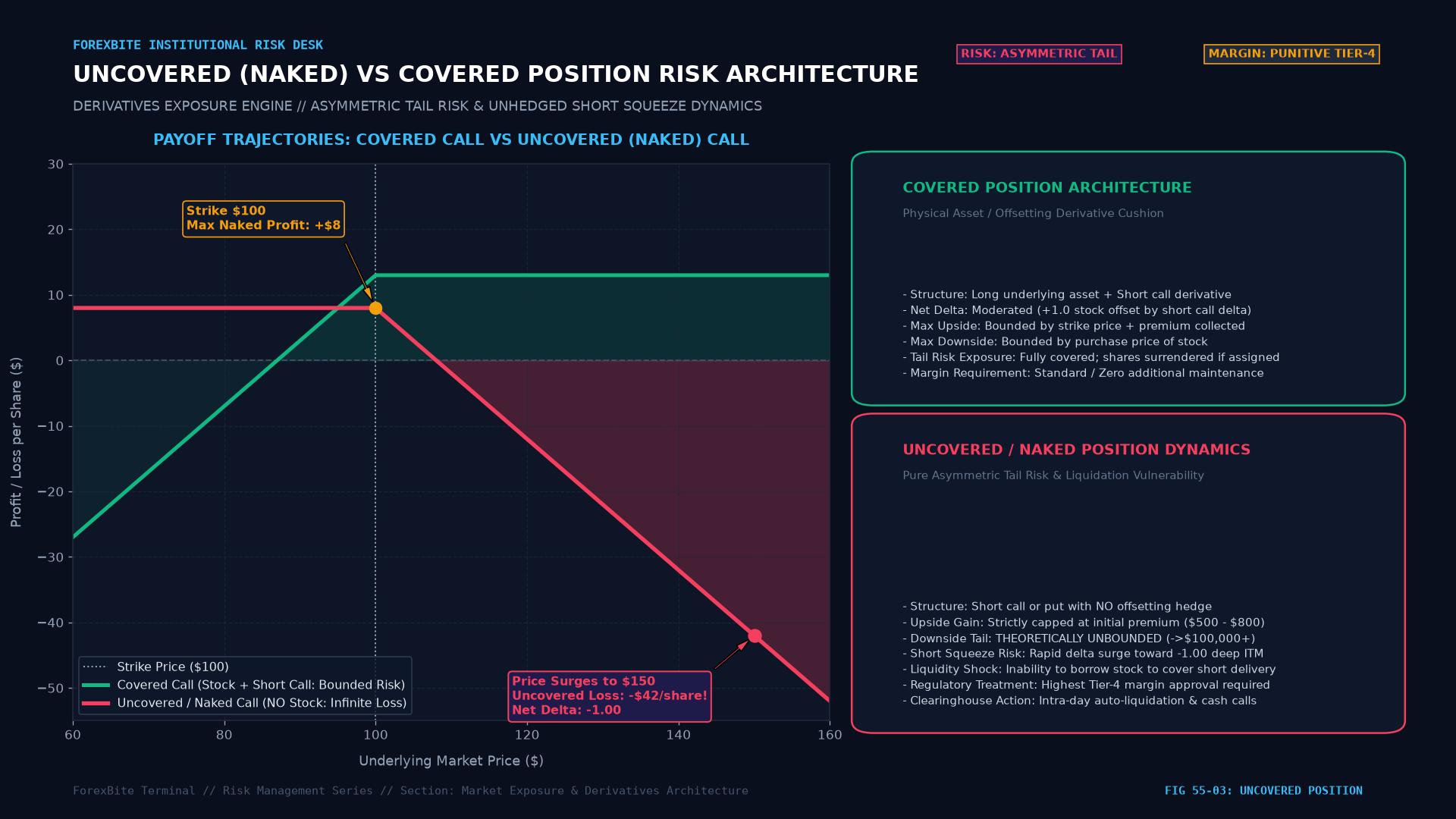 Figure: Payoff trajectories of covered call vs. uncovered (naked) call option showing bounded downside versus unbounded tail loss and short squeeze risk.
Mathematical Formulation & Risk Profiles
The mathematical exposure of an uncovered holding is defined by its net portfolio delta ($\Delta_{\text{net}}$) and unconstrained loss distribution.
1. Uncovered Spot / Futures Delta
A directional holding in currency or futures has a static delta of $+1.0$ (long) or $-1.0$ (short):
$$\Delta_{\text{net}} = \sum_{i=1}^{n} w_i \Delta_i \neq 0$$
The potential dollar profit/loss over holding interval $\Delta t$ is linear:
$$\Delta \Pi = \text{Notional} \times (S_{t+\Delta t} - S_t)$$
2. The Asymmetry of Uncovered Short Options
The payoff ($\Pi$) of writing an uncovered (naked) call option with strike $K$ and initial premium received $C_0$ is given by:
$$\Pi_{\text{naked_call}} = C_0 - \max(0, S_T - K)$$
As the terminal spot price $S_T \to \infty$, the position’s financial loss approaches negative infinity:
$$\lim_{S_T \to \infty} \Pi_{\text{naked_call}} = -\infty$$
Conversely, writing an uncovered put option with strike $K$ and premium $P_0$ exposes the seller to catastrophic downside bounded only by the asset hitting zero:
$$\text{Maximum Loss}_{\text{naked_put}} = K - P_0 \quad (\text{when } S_T = 0)$$
3. Value at Risk (VaR) of an Uncovered Holding
Risk engines calculate the parametric Value at Risk for an uncovered currency position as:
$$\text{VaR}{\alpha} = |\text{Notional}| \times Z{\alpha} \times \sigma \times \sqrt{\Delta t}$$
Where $Z_{\alpha}$ is the normal distribution critical value at confidence level $\alpha$ (e.g., $2.33$ for $99%$), and $\sigma$ is daily asset volatility. In covered portfolios, offsetting deltas reduce $\text{VaR}_{\alpha}$ close to zero.
Risk Profile Comparison Across Positions
| Position Type | Downside Protection | Capital Efficiency | Margin Requirement | Primary Risk Factor |
|---|---|---|---|---|
| Uncovered Spot FX Long | None (100% directional) | High (leveraged) | Standard Initial Margin (e.g., 2%–3.33%) | Adverse currency trend |
| Uncovered Short Call | None (unlimited upside tail) | Low (massive collateral required) | Extreme (Exchange Span Margin + OTM buffer) | Parabolic short squeeze / gap open |
| Covered Call | Asset collateralizes short call | Moderate | Minimal (covered by existing asset) | Opportunity cost; stock drops to zero |
| Delta-Neutral Hedge | Long Spot + Protective Put | High (risk bounded) | Moderate | Theta decay / spread financing drag |
Margin Treatment & Regulatory Constraints
Because uncovered positions expose the financial system to counterparty credit defaults, regulatory bodies (such as the US Commodity Futures Trading Commission and FINRA) enforce strict margin rules:
- Portfolio Margin & SPAN: Standardized Portfolio Analysis of Risk (SPAN) simulates thousands of adverse volatility and underlying price scenarios. Uncovered options trigger exponential margin surcharges as implied volatility spikes.
- Retail Broker Restrictions: Retail brokerages categorize option trading into approval tiers (Level 1 through Level 4). Uncovered (naked) option writing is restricted to Level 4 accounts, requiring substantial liquid net worth ($>$100,000$) and explicit risk disclosures.
- Automated Stop-Outs: Retail spot FX brokers monitor free margin ratios; once an uncovered leveraged position drains account equity below the maintenance threshold, automated liquidation protocols liquidate the trade at market.
Real-World Institutional Case Study: Nick Leeson & The Collapse of Barings Bank (1995)
The most notorious catastrophe involving uncovered positions in financial history occurred in 1995 at Barings Bank—a venerable 233-year-old British merchant bank that financed the Napoleonic Wars.
Nick Leeson, a derivatives trader in Barings’ Singapore office, initially engaged in low-risk index arbitrage between the Singapore International Monetary Exchange (SIMEX) and the Osaka Securities Exchange. However, to conceal mounting trading losses stashed in a secret error account (“88888”), Leeson transitioned into writing massive uncovered short straddles on the Nikkei 225 index.
[Uncovered Short Straddle Strategy]
Wrote Naked Calls + Naked Puts on Nikkei 225
Bet: Tokyo stock market would trade in a narrow, stable range near 19,000

[January 17, 1995: Kobe Earthquake Disaster]
Magnitude 6.9 earthquake strikes Kobe -> Nikkei plunges over 1,000 points in days
                    |
                    v
Uncovered Put Options Explode in Value (Deep In-The-Money)
                    |
                    v
Leeson Doubled Down: Bought thousands of uncovered Nikkei 225 futures contracts
                    |
                    v
Nikkei continued freefall from 19,000 to below 16,000
Total Uncovered Losses: $1.3 Billion (Exceeded Barings' entire capital reserves)
                    |
                    v
Result: Barings Bank collapsed into bankruptcy and was sold to ING for 1 British Pound
Because Leeson’s massive positions were entirely uncovered and unhedged against tail-risk volatility, the single macro shock of the Kobe earthquake triggered margin calls that overwhelmed Barings’ corporate balance sheet within weeks.
Frequently Asked Questions
Is holding an unhedged spot foreign exchange trade an uncovered position?
Yes. In financial risk taxonomy, holding any spot foreign exchange contract without a neutralizing hedge—such as a forward contract in the opposite direction, an offsetting correlated currency pair, or an out-of-the-money currency option—is formally an uncovered position.
Why do brokers require substantial margin for writing uncovered options?
When an investor buys an option, the maximum risk is strictly limited to the upfront premium paid. However, when an investor writes an uncovered option, the seller’s profit is capped at the small premium received, while the downside liability is theoretically infinite (for calls) or substantial (for puts). Brokers mandate high collateral reserves to ensure the trader does not default on multi-million dollar margin obligations.
How does a stop-loss order alter an uncovered position?
Attaching a resting stop-loss order to an uncovered position introduces an automated exit protocol that bounds nominal downside risk at a pre-specified threshold. However, institutional risk managers distinguish a stop-loss from a true hedge: in the event of an illiquid market gap or weekend dislocation, a stop-loss order suffers execution slippage, whereas a true derivative hedge guarantees fixed floor pricing.
Ready to trade forex?
Open a free demo account with a regulated broker. Practice with virtual funds before risking real money.