Strangle
A market-neutral, volatility-oriented options strategy constructed by simultaneously buying (or selling) an out-of-the-money put option and an out-of-the-money call option with different strike prices but the identical expiration date on the same underlying asset.
What Is a Strangle?
A strangle is a popular multi-leg options strategy designed to capitalize on large volatility expansions or contractions without requiring directional bias. Like its sister strategy—the straddle—a strangle positions the trader to profit when an asset makes an outsized move in either direction.
However, the structural architecture differs in strike price selection:
- A Long Strangle is established by purchasing an Out-of-The-Money (OTM) Put Option with a lower strike price ($K_1$) and an Out-of-The-Money (OTM) Call Option with a higher strike price ($K_2$), sharing the exact same expiration date ($T$).
- A Short Strangle is established by simultaneously selling the OTM put and OTM call, collecting upfront premium with the expectation that the asset will stay pinned between the two strikes.
Because both options are purchased out-of-the-money, a long strangle requires a substantially lower capital outlay (premium) than an at-the-money straddle. In exchange for this cost discount, the underlying asset must stage a vastly larger directional breakout to surpass the wider breakeven thresholds.
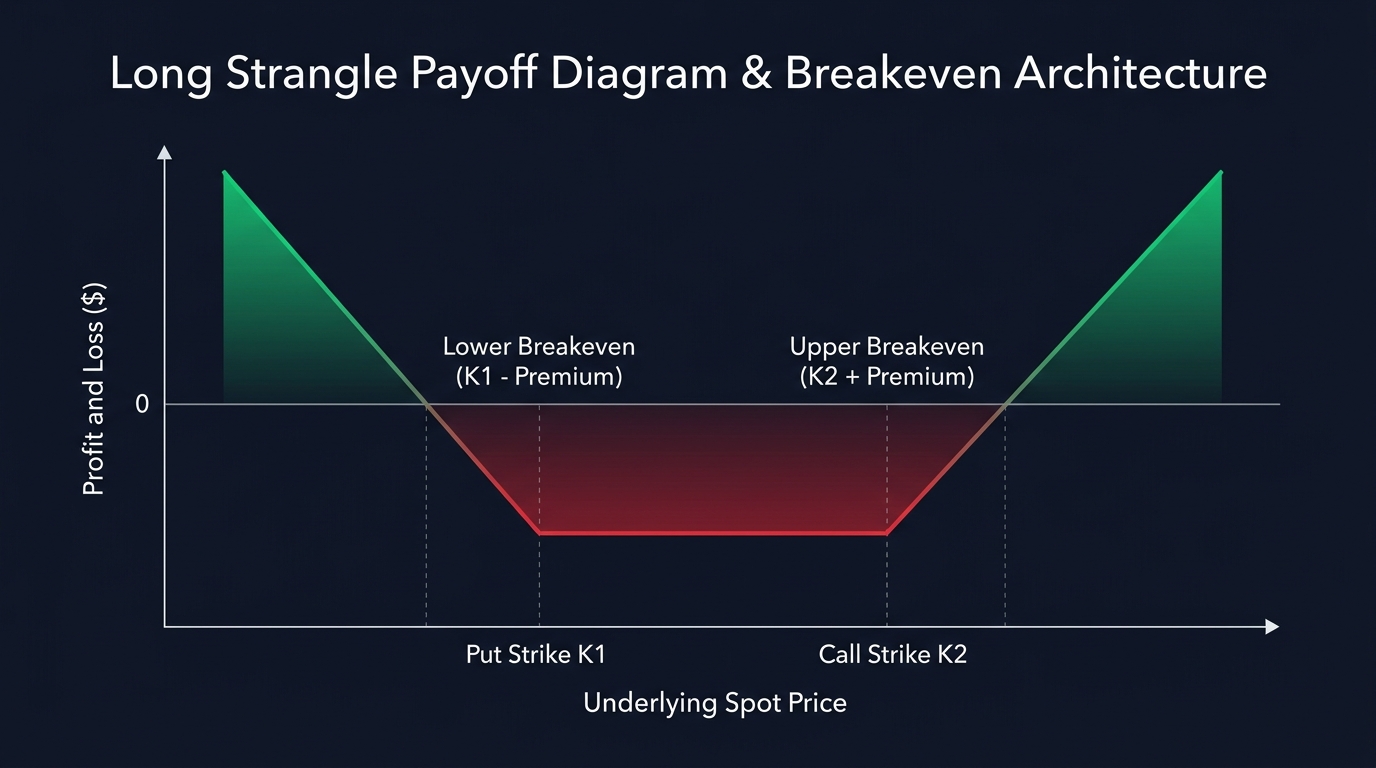
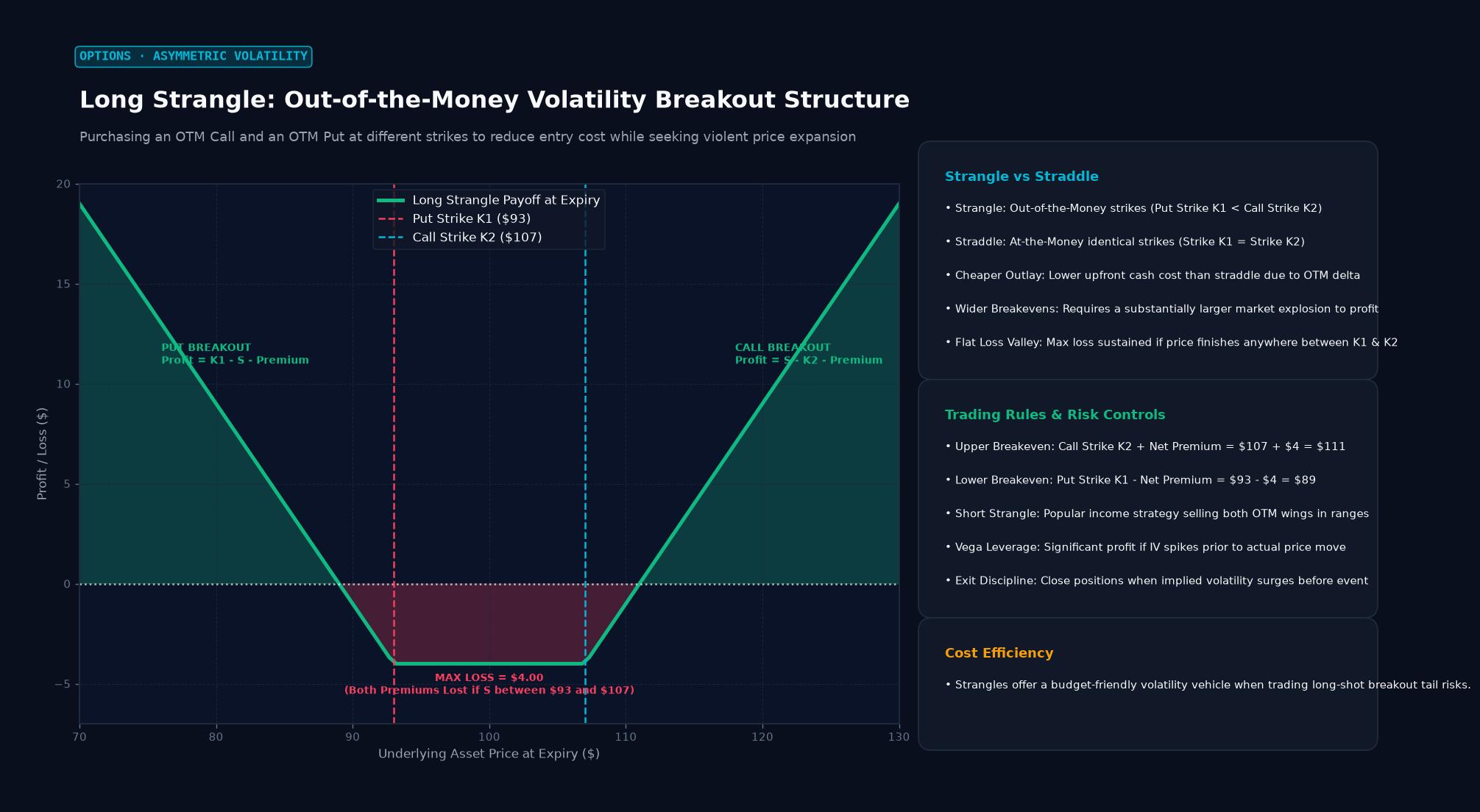 Figure: Purchasing an OTM Call and an OTM Put at different strikes to reduce entry cost while seeking violent price expansion
The Mathematics of a Long Strangle
A long strangle incurs a net debit equal to the sum of the two option premiums:
$$P_{\text{total}} = \text{Premium}{\text{Put}} (K_1) + \text{Premium}{\text{Call}} (K_2)$$
1. Dual Breakeven Thresholds
Because the strikes are separated, the breakeven points are wider apart than a straddle:
$$\text{Upper Breakeven} = K_2 + P_{\text{total}}$$
$$\text{Lower Breakeven} = K_1 - P_{\text{total}}$$
2. Payoff Calculations at Expiration
$$\text{Payoff} = \max\left(K_1 - S_T, ; 0\right) + \max\left(S_T - K_2, ; 0\right) - P_{\text{total}}$$
- Maximum Risk: Strictly capped at the total premium paid ($P_{\text{total}}$). This maximum loss occurs if the underlying asset expires anywhere between or exactly at the two strike prices ($K_1 \le S_T \le K_2$).
- Maximum Profit: Theoretically Unlimited on the upside (above $K_2$) and Substantial on the downside (below $K_1$ until the asset price reaches zero).
Concrete Numerical Example: Gold (XAU/USD) Strangle
Assume Spot Gold trades at $2,400:
- Buy $2,350 OTM Put ($K_1$): Premium = $25.00
- Buy $2,450 OTM Call ($K_2$): Premium = $25.00
- Total Net Outlay ($P_{\text{total}}$): $50.00 per ounce
- Upper Breakeven: $$2,450 + $50 = \mathbf{$2,500}$
- Lower Breakeven: $$2,350 - $50 = \mathbf{$2,300}$
Gold must trade above $2,500 or below $2,300 at expiration for the position to realize a net profit.
Strangle vs. Straddle vs. Iron Condor
| Parameter | Long Strangle | Long Straddle | Iron Condor |
|---|---|---|---|
| Strikes Used | Two different OTM strikes ($K_1 < K_2$) | Single ATM strike ($K_1 = K_2$) | Four strikes (Combines bear call & bull put spread) |
| Upfront Cost | Low to Moderate | High (Expensive ATM options) | Net credit received upfront |
| Breakeven Width | Wide (Requires large market move) | Narrower than strangle | Bounded within inner short strikes |
| Probability of Profit | Lower than straddle for long buyer | Moderate | High for credit seller |
| Maximum Loss | Capped at net premium paid | Capped at net premium paid | Defined: Difference in strikes minus credit |
Greek Sensitivities of a Strangle
               THE GREEKS OF A DELTA-NEUTRAL STRANGLE

 Metric               Long Strangle                 Short Strangle
 ────────────────────────────────────────────────────────────────────────
 Delta (Δ)            Near Zero (Δ ≈ 0)             Near Zero (Δ ≈ 0)
                      Balanced OTM Call & Put       Balanced OTM Call & Put

 Gamma (Γ)            Positive (Γ > 0)              Negative (Γ < 0)
                      Expands only as price nears   Risks catastrophic expansion
                      either strike barrier         if price tests a short strike

 Theta (Θ)            Negative (Time Decay Drag)    Positive (Income Engine)
                      Decays slower than straddle   Steadily earns daily decay

 Vega (V)             Positive (Benefits from IV)   Negative (Vulnerable to IV spikes)
Real-World Institutional Case Study: Short Strangles and the February 2018 “Volmageddon”
For institutional volatility-harvesting funds, selling Short Strangles is a primary income strategy during prolonged bull markets. Throughout 2017, market volatility was historically suppressed, and funds generated consistent returns by shorting wide OTM strangles on equity indices.
       THE "VOLMAGEDDON" COLLAPSE - FEBRUARY 5, 2018

 The Setup (2017 - Early 2018):
 - Hedge funds and retail ETPs (such as VelocityShares XIV) aggressively sold
   short out-of-the-money strangles, banking steady monthly premium decay.
 - VIX index drifted near all-time lows around 9.0 to 11.0.

 The Shock (February 5, 2018):
 - Strong U.S. wage growth sparked sudden bond yield spikes.
 - S&P 500 plunged 4.1% in a single afternoon.
 - Implied Volatility (VIX) exploded by an unprecedented 115% in one session,
   vaulting from 17.0 to over 50.0.

 The Catastrophe:
 1. As the market crashed, short put strikes were instantly breached.
 2. Short strangle sellers suffered catastrophic negative gamma and vega losses.
 3. Inverse volatility funds collapsed by over 90% in after-hours trading,
    erasing $3 billion in assets and bankrupting several options funds overnight.
Tactical Rules for Trading Strangles
- Trade Long Strangles Ahead of Structural Unknowns: Long strangles are ideally suited for events where analysts recognize huge divergence in possible outcomes—such as clinical trial drug approvals or high-stakes sovereign debt negotiations—where market movement will be massive but direction is unknown.
- Short Strangles Require Defined Buffers: If writing short strangles, always select strikes outside the 16-delta (1 standard deviation) or 5-delta (2 standard deviation) boundaries to ensure an 84% to 95% statistical probability of expiring worthless.
- Always Cap Risk (Convert to Iron Condor): Institutional risk guidelines strictly forbid unhedged short strangles. Buying cheap outer “wings” converts an unlimited-risk short strangle into a defined-risk Iron Condor, insulating the portfolio from black swan flash crashes.
Frequently Asked Questions
Why do traders buy strangles instead of straddles?
The primary reason is cost efficiency. Because out-of-the-money options carry significantly less extrinsic time value than at-the-money options, a long strangle can cost 40% to 60% less than a comparable straddle, allowing traders to risk less capital per trade.
What happens if an underlying asset settles between the two strikes?
If the asset price at expiration finishes anywhere between the lower put strike ($K_1$) and upper call strike ($K_2$), both options expire completely out-of-the-money and worthless. The long strangle buyer loses 100% of their invested premium, while the short strangle seller retains 100% of the collected premium as net profit.
Can a strangle have an uneven number of calls and puts?
Standard strangles use a 1:1 contract ratio. However, traders who hold a slight directional bias can create an asymmetric strangle (e.g., buying 2 calls and 1 put), creating a hybrid position that remains hedged to the downside while possessing enhanced leverage on an upside breakout.
Ready to trade forex?
Open a free demo account with a regulated broker. Practice with virtual funds before risking real money.