Underlying Asset
An underlying asset is the financial security, physical commodity, currency, or market index that provides the basis for the valuation, cash flows, and contractual settlement of a derivative contract.
What Is an Underlying Asset?
In financial derivatives and capital markets, an underlying asset (often referred to simply as the underlying) is the primary security, asset, index, or benchmark from which a secondary financial contract derives its intrinsic and extrinsic value. While primary securities (such as common stocks, physical gold bullion, or cash foreign currency) represent direct ownership or claims on economic capital, derivative contracts—such as options, futures, forwards, warrants, and swaps—exist purely as contractual agreements whose payoff depends on the performance of that underlying asset.
The underlying asset determines virtually all risk and pricing parameters of a derivative structure: its daily price volatility, liquidity profile, dividend or interest yield (carry), storage costs, and delivery specifications.
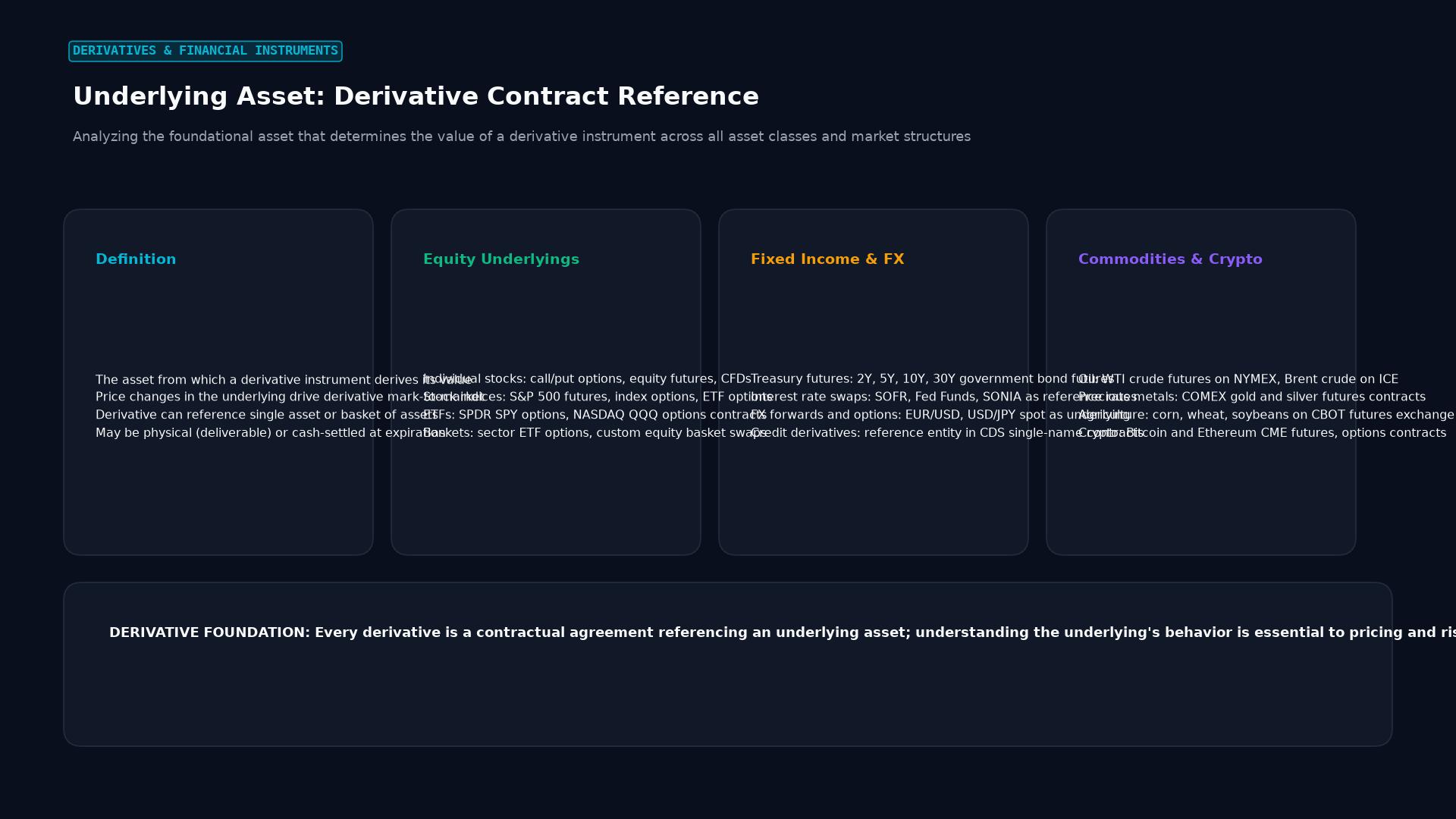 Figure: Analyzing the foundational asset that determines the value of a derivative instrument across all asset classes and market structures
Mathematical Formulation & Pricing Dependency
The valuation of any derivative instrument $V_t$ is mathematically expressed as a function of the underlying asset price $S_t$ along with prevailing contract parameters:
$$V_t = f(S_t, K, \tau, r, q, \sigma)$$
Where:
- $S_t$: Spot price of the underlying asset at time $t$.
- $K$: Contractual strike or exercise price.
- $\tau = T - t$: Time remaining until contract maturity.
- $r$: Risk-free interest rate.
- $q$: Continuous dividend yield, foreign interest rate, or convenience yield.
- $\sigma$: Implied volatility of the underlying asset.
1. Sensitivity Metric: Delta ($\Delta$)
The primary linear sensitivity of a derivative’s value relative to an infinitesimal price movement in the underlying asset is Delta:
$$\Delta = \frac{\partial V}{\partial S}$$
For deep-in-the-money options or forward contracts, $\Delta \approx 1.0$, meaning the derivative moves point-for-point with the underlying asset.
2. The Cost-of-Carry Model for Forwards and Futures
In forward markets, the theoretical relationship between the spot price of the underlying asset and its forward contract price $F_t$ is governed by the net cost of carry:
$$F_t = S_t e^{(r + u - y)\tau}$$
Where $u$ represents physical storage and insurance costs (crucial in commodities), and $y$ represents dividend yield or convenience yield (crucial in foreign exchange via Covered Interest Parity).
Taxonomy of Underlying Asset Classes
Derivative markets span several distinct categories of underlying assets, each exhibiting unique market microstructures and settlement dynamics:
| Asset Class | Representative Underlyings | Key Pricing Determinants | Standard Settlement Mechanism |
|---|---|---|---|
| Foreign Exchange | EUR/USD, USD/JPY, GBP/USD | Central bank interest rate differentials, CIP | Cash settlement or physical interbank delivery (PvP) |
| Commodities | WTI / Brent Crude, Gold, Natural Gas | Physical storage, transportation costs, convenience yield | Physical warehouse receipt delivery or cash settlement |
| Equities & Indices | S&P 500, Nasdaq 100, TSLA, MSFT | Corporate earnings, dividend yields, beta | Shares transfer (single stocks) or cash index settlement |
| Fixed Income / Rates | SOFR, US 10-Year T-Note, Euribor | Yield curve shifts, term premium, credit spreads | Physical delivery of cheapest-to-deliver bond or cash |
| Alternative Metrics | VIX (Volatility), Weather / Temperature | Statistical variance, catastrophe loss triggers | Exclusively cash-settled |
Settlement Disconnect: Physical vs. Cash Settlement
When a derivative contract reaches expiration, the contract terms dictate how the relationship with the underlying asset is finalized:
Physical Settlement:
[Option / Futures Expiry]  ----------------------------->  [Physical Transfer]
 Contract buyer pays full cash notional.                   Underlying asset transferred
                                                           (100 shares, 1,000 bbl oil, or cash FX).

Cash Settlement:
[Option / Futures Expiry]  ----------------------------->  [Net Cash Adjustment]
 No physical asset ever changes hands.                     Winning party receives:
                                                           Notional * (S_settle - Strike)
Cash-settled derivatives allow institutional speculators and algorithmic traders to gain price exposure to massive underlying markets without having to arrange physical shipping, storage, insurance, or custody.
Real-World Institutional Case Study: Cushing Storage & The April 2020 WTI Anomaly
The critical importance of an underlying asset’s physical characteristics was dramatically highlighted on April 20, 2020, when the May NYMEX West Texas Intermediate (WTI) crude oil futures contract collapsed to an unprecedented settlement price of $-$37.63$ per barrel.
Unlike cash-settled Brent crude contracts, the NYMEX WTI futures contract mandates physical delivery of the underlying asset: 1,000 barrels of light sweet crude oil per contract delivered directly to storage tank facilities in Cushing, Oklahoma.
[April 2020: Global Lockdown Demand Shock]
Worldwide oil demand plunges 30% due to COVID-19 pandemic
                     |
                     v
Cushing, Oklahoma Commercial Storage Reaches 100% Full Capacity
                     |
                     v
Financial ETFs & Retail Speculators Hold Long May Futures Expiring April 21
(These financial participants were legally and logistically unable to take physical oil delivery)
                     |
                     v
Physical storage facilities charged exorbitant fees ($10+ / bbl) to accept new crude
                     |
                     v
Emergency Liquidation: Speculators forced to pay physical buyers $37.63 per barrel
just to take the underlying asset off their hands before the delivery deadline
This historic event demonstrated that when derivatives require physical settlement, the price of the derivative does not merely reflect theoretical paper value; it is strictly bounded by the physical and logistical constraints of handling the underlying asset in the real world.
Frequently Asked Questions
Can an intangible economic metric serve as an underlying asset?
Yes. Modern financial engineering has expanded the definition of underlying assets beyond physical commodities and stocks to encompass non-tradable statistical benchmarks—such as implied volatility indexes (the Cboe VIX Index), inflation rates (TIPS CPI benchmarks), atmospheric temperature data (weather derivatives), and corporate default events (Credit Default Swaps).
How does the volatility of the underlying asset affect option prices?
Higher price volatility in the underlying asset directly increases the value of both call and put options. Because option buyers enjoy theoretically unlimited upside potential while their downside loss is strictly capped at the initial premium paid, greater underlying asset price fluctuations expand the probability of reaching highly profitable in-the-money terminal states.
What is the difference between the underlying asset and a derivative?
The underlying asset is the primary financial or physical instrument (e.g., a share of Apple stock or spot EUR/USD) that exists independently in the marketplace. A derivative is a secondary financial contract (e.g., an Apple call option or a EUR/USD forward) that has no independent physical existence and whose entire value is synthetically derived from the underlying asset.
Ready to trade forex?
Open a free demo account with a regulated broker. Practice with virtual funds before risking real money.