Parities
In international economics and quantitative finance, parities refers to the core family of theoretical equilibrium conditions—including Covered Interest Parity, Uncovered Interest Parity, and Purchasing Power Parity—that define no-arbitrage relationships between spot exchange rates, forward rates, interest differentials, and inflation rates.
What Are Foreign Exchange Parities?
In international finance and macroeconomic theory, parities refers to the comprehensive network of theoretical equilibrium relationships that govern open-economy currency markets. Developed by classical and modern monetary economists (including Gustav Cassel, John Maynard Keynes, and Irving Fisher), these parity conditions establish the mathematical benchmarks where international capital flows, goods arbitrage, and cross-border lending reach balance.
When international financial markets function frictionlessly without capital controls or excessive transaction costs, four interconnected parities link Spot Exchange Rates ($S$), Forward Exchange Rates ($F$), Nominal Interest Rates ($r$), and Inflation Rates ($\pi$) across sovereign jurisdictions.
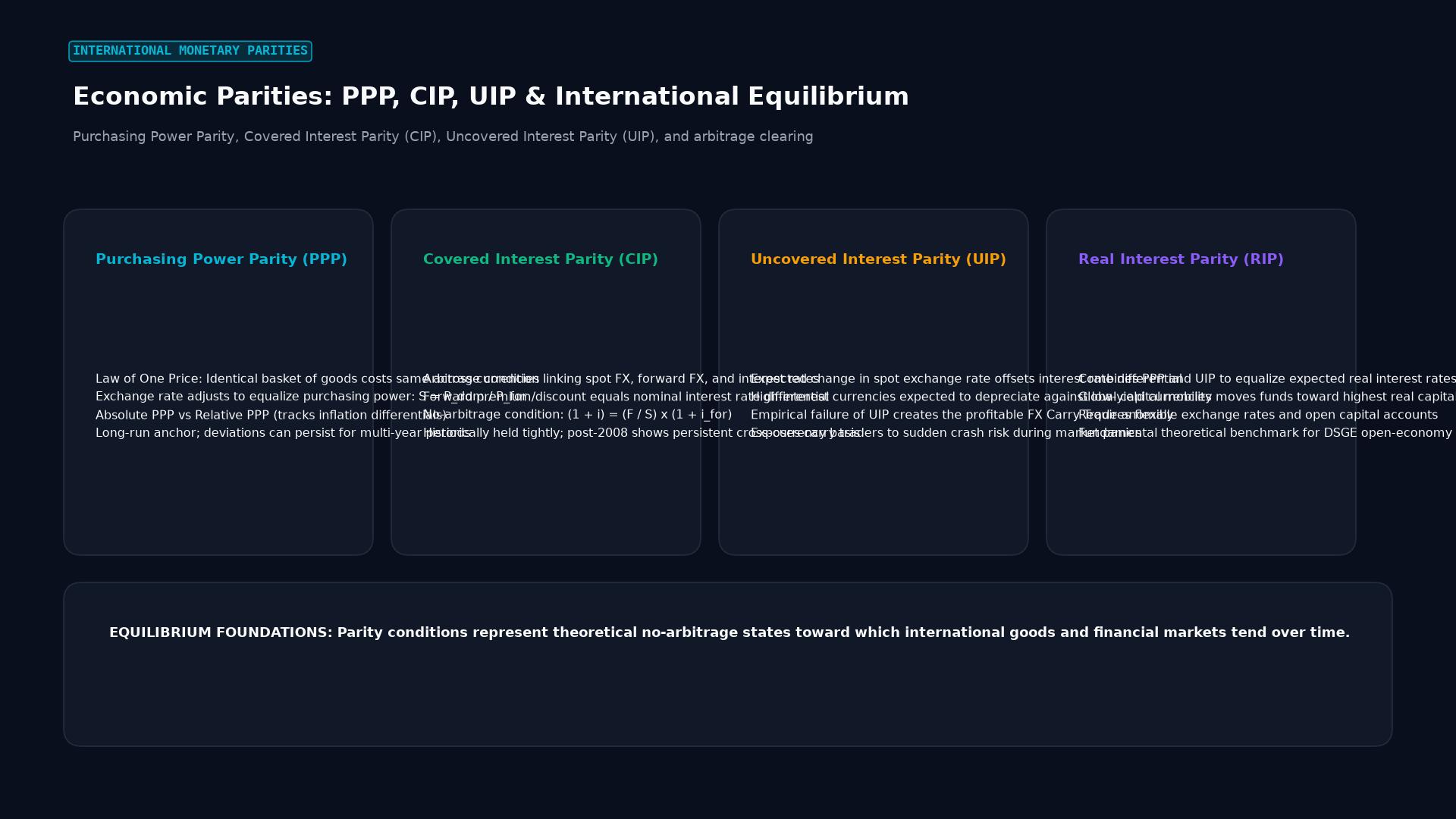 Figure: Purchasing Power Parity, Covered Interest Parity (CIP), Uncovered Interest Parity (UIP), and arbitrage clearing
The Four Core Macroeconomic Parities
Each parity condition describes an equilibrium across distinct economic transmission channels:
1. Covered Interest Parity (CIP)
Covered Interest Parity is an empirical no-arbitrage condition stating that the forward exchange rate premium or discount must exactly equal the interest rate differential between two currencies when foreign exchange risk is fully hedged using a forward contract:
$$\frac{F - S}{S} \approx r_{\text{domestic}} - r_{\text{foreign}}$$
$$\text{Exact CIP Form: } F = S \times \left[\frac{1 + r_{\text{domestic}}}{1 + r_{\text{foreign}}}\right]$$
If CIP were violated in frictionless markets, a currency dealer could borrow in the low-interest currency, convert to the high-interest currency at spot, lock in the reverse exchange rate via forward, and earn a riskless cross-currency arbitrage profit.
2. Uncovered Interest Parity (UIP)
Uncovered Interest Parity posits that the expected future spot exchange rate ($\mathbb{E}[S_{t+k}]$) should equal the current forward rate, meaning the expected percentage change in the exchange rate should offset the nominal interest rate differential:
$$\frac{\mathbb{E}[S_{t+k}] - S_t}{S_t} = r_{\text{domestic}} - r_{\text{foreign}}$$
Unlike CIP, UIP involves unhedged (uncovered) currency risk. In real-world markets, UIP frequently fails empirically over short- and medium-term horizons—a market anomaly known as the Forward Premium Puzzle, which creates the foundation for the profitable FX Carry Trade.
3. Purchasing Power Parity (PPP)
Formulated on the Law of One Price (LOOP), Purchasing Power Parity states that in the long run, exchange rates between currencies should adjust so that an identical basket of consumer goods costs the same in both nations:
- Absolute PPP: $S = \frac{P_{\text{domestic}}}{P_{\text{foreign}}}$, where $P$ represents the national price level.
- Relative PPP: The percentage change in the spot exchange rate over time equals the inflation rate differential between the two countries: $$\frac{\Delta S}{S} \approx \pi_{\text{domestic}} - \pi_{\text{foreign}}$$
4. The International Fisher Effect (IFE)
Named after economist Irving Fisher, the IFE combines PPP with the Fisher Hypothesis (nominal rate = real rate + expected inflation). Assuming real interest rates equalize globally due to free capital mobility, national nominal interest rate differentials reflect expected differences in national inflation rates:
$$r_{\text{domestic}} - r_{\text{foreign}} \approx \mathbb{E}[\pi_{\text{domestic}}] - \mathbb{E}[\pi_{\text{foreign}}]$$
Comparison of International Parity Conditions
The following matrix contrasts the four parity frameworks across horizons, empirical validity, and market mechanisms:
| Parity Condition | Core Variables Linked | Theoretical Mechanism | Real-World Empirical Validity |
|---|---|---|---|
| Covered Interest Parity (CIP) | Spot ($S$), Forward ($F$), Interest Rates ($r$) | Pure financial arbitrage by interbank dealers. | Held near-perfectly until 2008; now exhibits persistent Cross-Currency Basis spreads due to bank balance sheet regulations. |
| Uncovered Interest Parity (UIP) | Spot ($S$), Expected Spot ($\mathbb{E}[S]$), Interest Rates ($r$) | Risk-neutral speculative capital allocation. | Fails consistently over 1–5 year horizons (enabling carry trades); holds partially over 10+ year macro cycles. |
| Purchasing Power Parity (PPP) | Spot ($S$), Price Levels ($P$), Inflation ($\pi$) | Cross-border trade in physical goods and services. | Extremely poor predictor over short horizons (months/quarters); strong anchor for long-run currency fair value (5–10 years). |
| International Fisher Effect (IFE) | Interest Rates ($r$), Inflation Rates ($\pi$), Spot ($S$) | Global real interest rate equalization. | Moderate long-term validity; distorted by central bank unconventional balance sheet operations (QE/QT). |
Modern Breakdown: The Cross-Currency Basis and Post-2008 CIP Failure
Prior to the 2008 Global Financial Crisis, Covered Interest Parity was considered an immutable physical law of finance. Deviations were measured in fractions of a basis point.
However, since 2008, CIP has exhibited a persistent, structural breakdown known as the Cross-Currency Basis:
$$\text{Actual Forward Rate} \ne \text{Theoretical CIP Forward Rate}$$
                   THE POST-2008 CROSS-CURRENCY BASIS ANOMALY

  Theoretical CIP Equilibrium: FX Basis = 0 bps
               |
               v [Post-Crisis Basel III Regulations Imposed]
  - Supplementary Leverage Ratio (SLR)
  - Liquidity Coverage Ratio (LCR)
               |
               v
  Global Banks Face Massive Balance Sheet Costs to Arbitrage Discrepancies
               |
               v
  Result: Non-Zero Cross-Currency Basis (EUR/USD Basis: -30 to -60 bps)
          USD Borrowers via FX Swaps Pay a Structural Premium!
Under Basel III regulations (such as the Supplementary Leverage Ratio and Liquidity Coverage Ratio), commercial banks are required to hold expensive Tier-1 equity capital against gross balance sheet assets, regardless of how safe or fully hedged the arbitrage is. Because executing the multi-billion-dollar round-trip trades required to enforce CIP consumes scarce bank balance sheet capacity, dealers refuse to arbitrage away small rate discrepancies, leaving a permanent structural basis spread in global currency swap markets.
Real-World Case Study: The Failure of UIP and the Carry Trade Boom
From 2002 to 2007, the Australian Dollar maintained a 6.25% central bank cash rate, while the Bank of Japan maintained a 0.00% zero interest rate policy.
- The UIP Prediction: According to Uncovered Interest Parity, the Australian Dollar should have steadily depreciated against the Japanese Yen by approximately 6.25% per year to offset the yield advantage, leaving international investors with identical net returns.
- The Reality (UIP Failure): Instead of depreciating, the massive flood of global speculative capital into high-yielding AUD drove AUD/JPY from 60.00 to over 107.00—an appreciation of nearly 80%.
- The Double Windfall: Carry traders earned the massive 6.25% annual interest rate carry plus 80% in capital gains over five years, definitively disproving UIP over multi-year business cycles.
Frequently Asked Questions
Why does Purchasing Power Parity (PPP) fail in the short term?
PPP assumes that goods can be transported internationally without friction, tariffs, or shipping costs (the Law of One Price). In reality, many components of national price indices (such as healthcare, housing, and local services) are non-tradable. Furthermore, speculative daily capital flows in foreign exchange ($7.5+ trillion per day) dwarf physical merchandise trade flows, allowing currencies to decouple from PPP for years.
What is the Big Mac Index?
Developed by The Economist magazine in 1986, the Big Mac Index is a humorous, lighthearted, yet surprisingly robust real-world application of absolute Purchasing Power Parity. By comparing the local price of a standardized McDonald’s Big Mac burger across dozens of nations converted at current exchange rates, the index measures whether a currency is undervalued or overvalued relative to the US Dollar.
What is the difference between parity and parities?
- Parity typically refers to a single state of equality—such as an option trading at its intrinsic value or a currency trading at a 1.0000 exchange rate.
- Parities refers collectively to the four macroeconomic equilibrium models (CIP, UIP, PPP, IFE) that explain how exchange rates, interest rates, and inflation interact across the global monetary system.
Ready to trade forex?
Open a free demo account with a regulated broker. Practice with virtual funds before risking real money.