Unit Labor Costs
Unit Labor Costs (ULC) measure the average cost of labor compensation required to produce one unit of real economic output, calculated as total labor compensation divided by real output or hourly compensation divided by labor productivity.
What Are Unit Labor Costs (ULC)?
Unit Labor Costs (ULC) represent a foundational macroeconomic indicator published by national statistical agencies (such as the US Bureau of Labor Statistics and Eurostat) that quantifies the direct labor expense incurred to generate a single unit of real economic output. ULC directly links the labor market to corporate pricing behavior and underlying inflationary pressures.
While nominal wage statistics (like Average Hourly Earnings) capture raw worker pay, they do not account for worker efficiency. If wages rise by $5%$ while output per hour (labor productivity) simultaneously increases by $5%$, the cost of producing each unit of goods remains completely unchanged, generating zero wage-push inflation. Conversely, if wage compensation outpaces productivity gains, firms face mounting unit costs, compelling them to raise consumer prices to preserve profit margins. Consequently, central banks (including the Federal Reserve, ECB, and Bank of England) monitor ULC as a critical leading indicator of persistent core inflation.
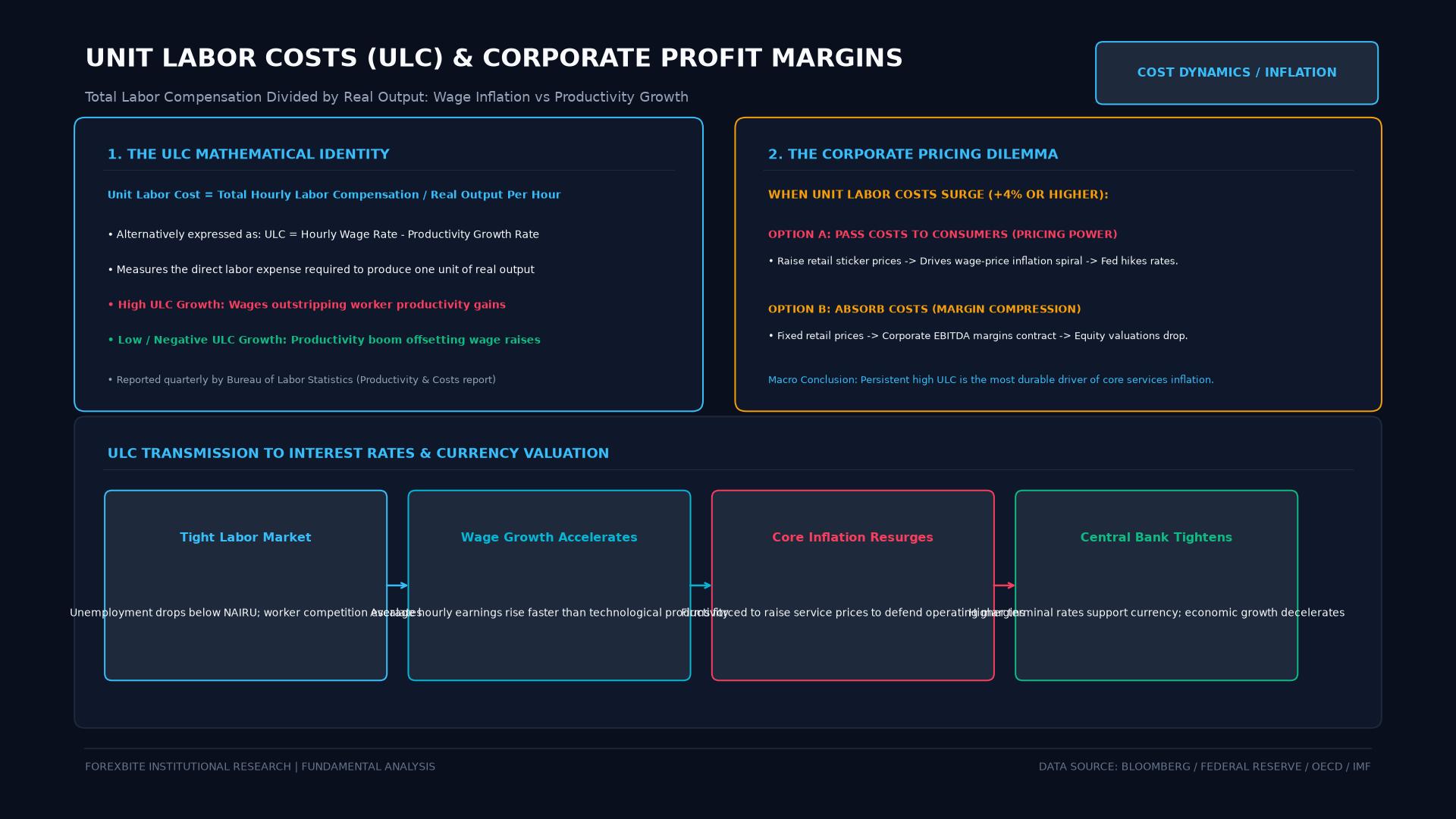 Figure: Mathematical and economic derivation of Unit Labor Costs ($ULC = \text{Hourly Compensation} / \text{Productivity}$), illustrating corporate pricing dilemmas and structural core services inflation transmission.
Mathematical Formulation & Growth Decomposition
Unit Labor Costs are calculated as total nominal labor compensation divided by real gross domestic product or real gross value added:
$$\text{ULC} = \frac{\text{Total Labor Compensation}}{\text{Real Output}} = \frac{W \times L}{Y}$$
Where $W$ represents the average nominal wage rate, $L$ is total labor hours employed, and $Y$ is real output produced.
1. The Productivity Ratio
Dividing both the numerator and the denominator by total labor hours ($L$) reveals the fundamental structural identity of ULC:
$$\text{ULC} = \frac{(W \times L) / L}{Y / L} = \frac{\text{Hourly Compensation}}{\text{Labor Productivity}}$$
Where $\text{Labor Productivity} = Y / L$ denotes real economic output produced per worker-hour.
2. Percentage Growth Approximation
In quarterly macroeconomic forecasting, percentage changes in Unit Labor Costs are decomposed linearly:
$$% \Delta \text{ULC} \approx % \Delta \text{Hourly Compensation} - % \Delta \text{Labor Productivity}$$
- If $% \Delta \text{Compensation} > % \Delta \text{Productivity} \implies \text{ULC rises}$ (inflationary bias).
- If $% \Delta \text{Compensation} < % \Delta \text{Productivity} \implies \text{ULC falls}$ (disinflationary / competitive gain).
Macroeconomic Labor Indicators Compared
Central bank monetary policy committees evaluate ULC in conjunction with several complementary labor market metrics:
| Metric | Source Agency | Frequency | What It Measures | Policy / Market Sensitivity |
|---|---|---|---|---|
| Unit Labor Costs (ULC) | Bureau of Labor Statistics (BLS) | Quarterly | Labor cost per unit of real output (wage adjusted for productivity). | High; primary driver of underlying cost-push inflation. |
| Employment Cost Index (ECI) | BLS | Quarterly | Total employer labor costs (wages + benefits), controlling for occupation shifts. | Very High; cleanest measure of pure wage pressure without mix bias. |
| Average Hourly Earnings (AHE) | BLS (Part of NFP report) | Monthly | Gross hourly wages paid to non-supervisory private sector workers. | Immediate; highly volatile, distorted by low-wage hiring/firing cycles. |
| Labor Productivity | BLS / OECD | Quarterly | Real output produced per labor hour worked. | Medium; long-term determinant of sustainable real living standards. |
Foreign Exchange & International Competitiveness
In global trade, relative changes in Unit Labor Costs determine whether a nation’s export sector gains or loses international price competitiveness. When evaluating currencies under the Real Effective Exchange Rate (REER), macro analysts frequently utilize ULC-deflated REER:
$$\text{REER}{\text{ULC}} = S \times \frac{\text{ULC}{\text{domestic}}}{\text{ULC}_{\text{foreign}}}$$
A country experiencing chronic ULC growth above its international competitors suffers real currency overvaluation, leading to persistent trade deficits, industrial hollow-out, and eventual currency depreciation pressures.
Real-World Institutional Case Study: The Eurozone Sovereign Debt Divergence (2000–2010)
The profound macroeconomic danger of unmonitored Unit Labor Cost divergence was exposed during the Eurozone Sovereign Debt Crisis of 2010–2012.
Upon adopting the single Euro currency in 1999, member nations surrendered the ability to devalue their sovereign exchange rates to restore international trade balance. Over the following decade, structural labor dynamics diverged radically across the currency bloc:
[2000 - 2010 Cumulative ULC Growth]
GERMANY: +5.8% (Stringent "Hartz IV" labor market reforms, aggressive wage moderation)
VS.
GREECE:   +35.2% (Rapid wage inflation without productivity improvements)
SPAIN:    +31.4% (Construction boom wage bidding, flat manufacturing efficiency)
PORTUGAL: +28.7% (Public sector wage expansion, productivity stagnation)
ULC DIVERGENCE CONSEQUENCES
--------------------------
Germany built massive current account surpluses (exporting machinery worldwide)
|
Southern European periphery accumulated unsustainable trade and current account deficits
|
Because periphery nations could NOT devalue the Euro, they suffered "Internal Devaluation":
Forced to slash public wages by 20%+, endure 25%+ unemployment, and accept emergency IMF/ECB bailoutsThis structural divergence demonstrated that within a fixed exchange rate regime or monetary union, failing to align wage increases with labor productivity inexorably leads to systemic solvency crises.
Frequently Asked Questions
Why does a sharp rise in Unit Labor Costs usually strengthen a currency in the short term?
In the short to medium term, an unexpected surge in Unit Labor Costs signals accelerating core inflation. Foreign exchange algorithmic trading models react to this data by pricing in aggressive interest rate hikes from the central bank, which increases the currency’s yield advantage and attracts foreign capital inflows.
Can Unit Labor Costs fall while wages are rising?
Yes. If real labor productivity rises faster than nominal compensation, Unit Labor Costs will decline even as workers enjoy wage increases. For example, if hourly compensation increases by $3%$ while technological automation boosts output per hour by $5%$, ULC declines by approximately $2%$, enhancing business competitiveness without dampening living standards.
How are employee benefits accounted for in Unit Labor Cost calculations?
Unlike simple wage measures, total labor compensation in ULC calculations incorporates gross wages, bonuses, employer contributions to social security and healthcare funds, paid vacation, severance pay, and corporate pension contributions, providing a comprehensive metric of the total cost of employment.
Ready to trade forex?
Open a free demo account with a regulated broker. Practice with virtual funds before risking real money.