Deflation
Deflation is a persistent, across-the-board decline in the general price level of goods and services throughout an economy, occurring when the annual inflation rate drops below zero percent. It increases the real purchasing power of money but can trigger a destructive economic contraction.
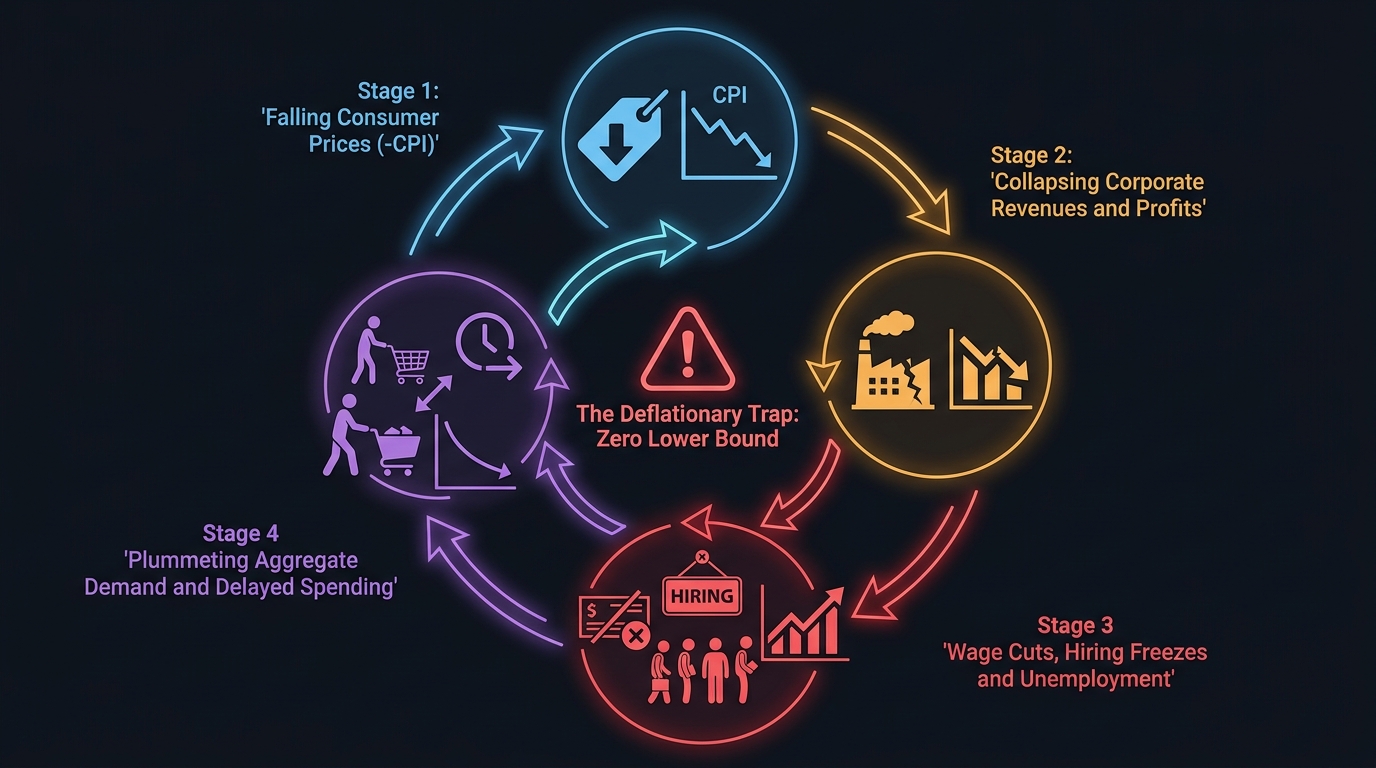
What Is Deflation?
In macroeconomic analysis, deflation is defined as a sustained, broad-based decrease in the general price level of finished goods and services across an entire national economy over an extended timeframe. Statistically, it occurs whenever the rate of inflation—measured by the Consumer Price Index (CPI) or Gross Domestic Product Deflator—falls below 0.0% (negative inflation).
Under deflationary conditions, each unit of currency gains real purchasing power: a single dollar, euro, or yen buys a larger basket of physical goods and services today than it did twelve months prior.
While falling prices sound intuitively attractive to consumers, economists and central bank governors view widespread, entrenched deflation as one of the most perilous diseases that can afflict a modern capitalist economy. Unlike mild inflation, which lubricates economic growth, deflation can trap an economy inside a vicious, self-reinforcing contraction known as the deflationary spiral.
Deflation vs. Disinflation: The Vital Difference
Financial media frequently confuse deflation with disinflation, but they represent fundamentally different economic states:
- Inflation: General prices are rising across the economy (e.g., CPI increases from +2.0% to +5.0% annually).
- Disinflation: General prices are still rising, but the rate of increase is slowing down (e.g., CPI inflation declines from +8.0% down to +3.0%). The price level continues to climb, but at a deceleration.
- Deflation: General prices are actively falling (e.g., CPI prints at -1.5% annually). The baseline price level is contracting in nominal terms.
The Destructive Mechanics of the Deflationary Spiral
Central banks target a positive inflation rate (typically 2.0%) specifically to maintain a safety buffer against deflation. Once deflation takes hold, it unleashes a multi-stage economic chain reaction:
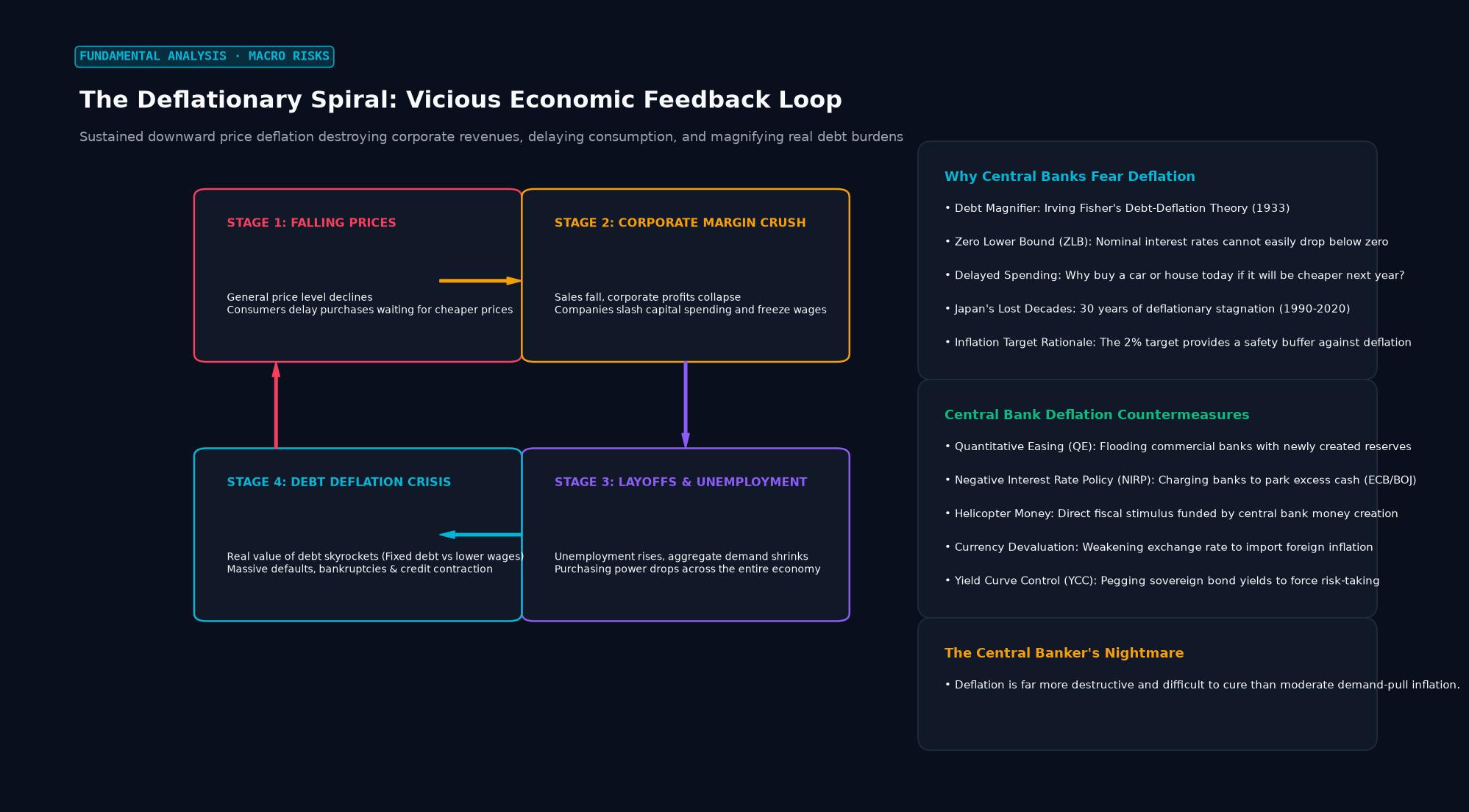 Figure: Sustained downward price deflation destroying corporate revenues, delaying consumption, and magnifying real debt burdens
When households observe prices falling month after month, their psychological expectations shift. Why buy a new automobile, computer, or home today if it will be 5% cheaper next year? As discretionary purchases are delayed, overall aggregate demand collapses, forcing businesses to enact deeper price cuts, slash capital investment, and lay off workers, entrenching mass unemployment.
Irving Fisher’s Debt-Deflation Theory
The most devastating consequence of deflation was articulated by Yale economist Irving Fisher in his seminal 1933 paper, The Debt-Deflation Theory of Great Depressions.
In modern economies, households, corporations, and governments accumulate vast debt obligations (mortgages, corporate bonds, sovereign debt) that are legally fixed in nominal currency terms.
- In an inflationary environment, debt becomes easier to pay off over time because borrowers repay loans with cheaper, inflated dollars.
- In a deflationary environment, the real burden of debt increases continuously. While a debtor’s wages or corporate revenues fall by 10% or 20% due to collapsing price levels, the monthly nominal mortgage payment or bond coupon remains 100% unchanged.
As borrowers spend an ever-increasing percentage of their dwindling cash flow simply servicing fixed debts, discretionary spending vanishes. Widespread loan defaults, corporate bankruptcies, and commercial banking insolvencies follow, dragging the economy into a deep depression.
The Liquidity Trap and the Zero Lower Bound
Deflation paralyzes standard central bank monetary policy through the Zero Lower Bound:
Under the Fisher equation, the Real Interest Rate ($r$) is equal to the Nominal Interest Rate ($i$) minus Expected Inflation ($\pi$): $$ r = i - \pi $$
- When inflation is positive (+3.0%) and the central bank sets nominal rates at 1.0%, the real interest rate is negative (-2.0%), stimulating borrowing and spending.
- But if deflation is running at -3.0% ($\pi = -0.03$), even if the central bank slashes nominal interest rates to 0.0%, the real interest rate remains positive: $$ r = 0.0% - (-3.0%) = +3.0% $$
The real cost of borrowing increases automatically during deflation, even when the central bank does everything in its power to ease credit. The economy falls into a liquidity trap where monetary policy loses its traditional transmission power.
The Historical Benchmark: Japan’s “Lost Decades”
The preeminent modern case study of deflation occurred in Japan following the collapse of its gigantic stock market and commercial real estate asset bubbles in 1990:
- Japanese property and stock valuations collapsed by over 70%, wiping out trillions of dollars in banking collateral.
- Japanese corporations and households responded by prioritizing debt repayment over capital investment or consumption—a structural condition economist Richard Koo termed a Balance Sheet Recession.
- For more than twenty years (from the late 1990s through the late 2010s), Japan experienced persistent near-zero inflation or outright deflation.
- To combat deflation, the Bank of Japan (BoJ) became the world’s pioneer of unconventional monetary policy: introducing Zero Interest Rate Policy (ZIRP) in 1999, launching Quantitative Easing (QE) in 2001, and ultimately adopting negative interest rates and Yield Curve Control (YCC).
Forex Market Implications of Deflation
Currency behavior during deflationary regimes is often counterintuitive for traders:
- The Real Purchasing Power Paradox: Because a deflationary currency gains purchasing power domestically, it frequently exhibits structural upward pressure against foreign currencies experiencing high inflation (following Purchasing Power Parity).
- The Safe-Haven Yen Phenomenon: Despite decades of domestic economic stagnation, the Japanese Yen (JPY) historically rallied sharply during global financial crises because Japanese institutions repatriated massive overseas investments back into yen cash.
- The Carry Trade Anchor: Because deflation forces the central bank to pin nominal interest rates at zero for years, the deflationary currency becomes the premier funding currency for the global carry trade. Investors borrow the zero-interest currency to buy high-yielding foreign assets, creating steady structural depreciation during stable economic expansions, followed by violent upward short-squeezes during panics.
Key Takeaways
- Deflation is a sustained drop in the general price level across an economy, represented by a negative inflation rate below zero percent.
- It differs from disinflation, which is simply a deceleration in the positive rate of inflation.
- The deflationary spiral occurs as delayed consumer spending crushes corporate revenues, forcing layoffs and deeper price cuts.
- Fisher’s debt-deflation theory demonstrates that deflation multiplies the real burden of fixed nominal debt, triggering corporate insolvencies.
- Deflation traps central banks at the Zero Lower Bound, rendering traditional interest rate cuts ineffective and necessitating quantitative easing.
FAQ
Why don’t consumers celebrate falling prices? While falling prices on a specific item (like consumer electronics becoming cheaper due to technology) are beneficial, economy-wide deflation threatens livelihoods. When general prices drop, corporate revenues decline, which leads to wage reductions, hiring freezes, and mass unemployment.
What is “good deflation” vs. “bad deflation”? “Good deflation” (supply-driven) occurs when technological breakthroughs, automation, or cheap energy reduce production costs, expanding real economic output while prices drop. “Bad deflation” (demand-driven) occurs when consumer spending collapses, creating a recessionary spiral of falling output and rising joblessness.
How do central banks escape a deflationary trap? To break deflation, central banks deploy unconventional monetary weapons: quantitative easing (large-scale asset purchases), negative interest rates, forward guidance, and coordinated fiscal stimulus where the government directly injects cash into the real economy to reignite aggregate demand.
Ready to trade forex?
Open a free demo account with a regulated broker. Practice with virtual funds before risking real money.