Unit of Driver Measure
In Activity-Based Costing (ABC) and managerial accounting, the unit of driver measure is the standardized quantitative metric used to measure the consumption of resources by activities or the consumption of activities by end cost objects.
Unit of Driver Measure
In Activity-Based Costing (ABC), Activity-Based Management (ABM), and operational cost accounting, the unit of driver measure is the standardized, quantitative common denominator used to track and assign indirect overhead costs. It serves as the measurable link between the expenditure consumed by a resource pool and the specific operational activities or end cost objects (such as individual products, customer service channels, or trade settlement desks) that create that demand.
By converting diverse operational tasks into standardized quantifiable units, such as machine run hours, direct engineering minutes, number of compliance reviews, or executed wire transfers, the unit of driver measure eliminates the distortions caused by traditional arbitrary overhead allocation methods. This metric enables enterprise leaders, corporate treasurers, and financial controllers to establish precise product margins, eliminate hidden cross-subsidization, and optimize operational capacity.
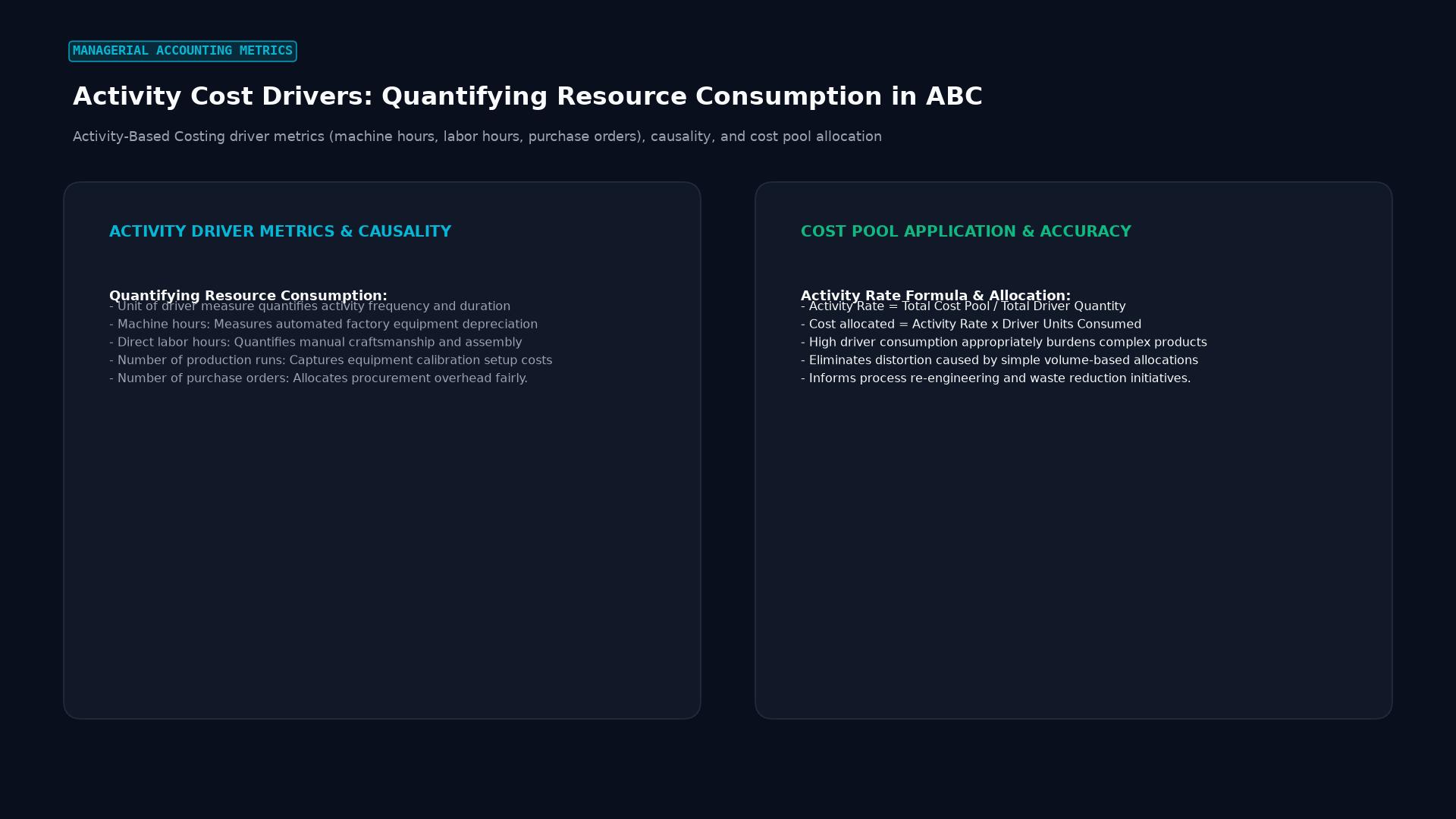 Figure: Activity-Based Costing driver metrics (machine hours, labor hours, purchase orders), causality, and cost pool allocation
The Three Tiers of Cost Drivers and Measurement Units
In modern managerial accounting frameworks developed by Robert Kaplan and Robin Cooper, cost drivers and their associated units of measure fall into three primary categories based on precision, tracking cost, and behavioral incentives:
1. Transaction Drivers (Unit: Discrete Event Count)
Transaction drivers count how frequently an operational activity occurs. They assume that every execution of the activity consumes an identical quantity of resources.
- Unit of Driver Measure: Number of customer purchase orders, number of supplier invoices processed, number of batch inspections, number of foreign currency remittances initiated.
- Measurement Precision: Moderate. Incurs low data collection costs, making it popular in standard enterprise resource planning (ERP) workflows.
- Limitation: Distorts cost allocation if individual transactions vary substantially in complexity or duration.
2. Duration Drivers (Unit: Elapsed Time Intervals)
Duration drivers measure the total elapsed time required to execute an activity. They are employed when different cost objects require vastly differing amounts of attention or operational labor.
- Unit of Driver Measure: Direct labor hours, machine calibration minutes, engineering consultation hours, software testing days, flight operating hours.
- Measurement Precision: High. Accurately captures variations in resource consumption between complex and standard operations.
- Trade-off: Requires time-tracking mechanisms, time sheets, or machine telemetry, increasing ongoing measurement expense.
3. Intensity Drivers (Unit: Weighted Resource Matrix)
Intensity drivers directly charge the exact physical and human resources committed to an operation. They are reserved for highly customized, high-stakes tasks where neither transaction count nor elapsed time captures the extreme variation in resource utilization.
- Unit of Driver Measure: Weighted points matrix combining surgical suite minutes, specialist surgeon tiers, and blood component units in healthcare, or high-tier quantitative developer hours plus dedicated supercomputing cycles in financial derivatives structuring.
- Measurement Precision: Maximum possible accuracy.
- Use Case: Justified only when the financial cost of misallocation would severely impair strategic decision-making.
Mathematical Formulation of Activity Rates and Cost Assignment
The selection of the unit of driver measure enables the mathematical calculation of the predetermined overhead activity rate:
1. Activity Rate Formula
$$\text{Activity Cost Driver Rate } (R_{\text{activity}}) = \frac{\text{Budgeted Cost of Activity Pool}}{\text{Practical Capacity of Driver Units}}$$
Where:
- Budgeted Cost of Activity Pool: Total direct and indirect expenditures (personnel, software, equipment depreciation, utility power) allocated to the operational activity.
- Practical Capacity of Driver Units: The realistic volume of driver units the activity center can deliver under normal operating conditions, after accounting for unavoidable downtime, routine maintenance, and employee breaks (typically 80% to 85% of theoretical capacity).
2. Cost Assignment to Object
$$\text{Cost Assigned to Object } i = \sum_{k=1}^{n} \left(\text{Driver Units Consumed}{i,k} \times R{\text{activity},k}\right)$$
Where $k$ represents each specific activity pool contributing to the creation, delivery, or servicing of cost object $i$.
+------------------------------------------------------------------------+
|        Selection Matrix: Identifying the Proper Driver Unit            |
+------------------------------------------------------------------------+
| Activity Center        | Poor Driver Unit (Distorts) | Superior Driver Unit (Causal)|
| Machine Stamping       | Direct Labor Hours          | Machine Running Hours        |
| Customer Support       | Number of Customers         | Support Call Duration Minutes|
| Credit Evaluation      | Loan Dollar Volume          | Risk-Weighted Review Hours   |
| Procurement Department | Dollar Value of Purchases   | Number of Purchase Orders    |
| IT Data Center         | Headcount by Department     | Gigabytes of Cloud Storage   |
+------------------------------------------------------------------------+
The Danger of Cross-Subsidization from Improper Driver Measures
When an organization selects an improper unit of driver measure, it inadvertently creates systemic cross-subsidization, where standard, high-volume products or clients appear artificially expensive while complex, low-volume, customized products appear artificially profitable.
Consider an industrial components manufacturer using traditional “direct labor hours” as the universal driver unit for assigning setup costs:
- Product A (Standard Bolt): Produced in batches of 100,000 units. Requires 2 hours of machine setup time and 200 hours of direct machining labor.
- Product B (Custom Titanium Flange): Produced in batches of 100 units. Requires 2 hours of machine setup time and only 5 hours of direct machining labor.
If setup costs are allocated based on direct labor hours, Product A absorbs 97.5% of the machine setup expense simply because it runs longer on the factory floor, even though both batches consumed the exact same 2 hours of setup technician labor. As a consequence:
- Product A is overpriced in the marketplace, causing the firm to lose market share to specialized commodity competitors.
- Product B is underpriced, causing customers to flood the firm with customized orders that secretly generate massive operational losses.
Correcting the unit of driver measure to “number of machine setups” or “setup labor hours” immediately exposes the true cost of Product B, enabling management to implement minimum order quantities or bespoke setup surcharges.
Applied Operational Case Study: Asset Management Clearing Operations
To evaluate the impact of driver measure selection in financial services, consider Vanguard-Style Clearing Partners (VCP), an institutional clearing broker serving two distinct asset management clients:
- Client 1 (Passive Index Fund): Executes 50,000 standardized, automated electronic equity trades per month.
- Client 2 (Global Macro Hedge Fund): Executes 1,000 multi-leg cross-border currency and interest rate derivative swap trades per month, each requiring manual margin calculation, ISDA documentation checks, and bilateral counterparty collateral calls.
Back-Office Operational Cost Pool
- Trade Support and Settlement Pool Cost: $600,000 per month.
Scenario A: Flawed Driver Measure (Transaction Count)
Management selects “Number of Executed Trades” as the unit of driver measure:
- Total driver units = 50,000 + 1,000 = 51,000 trades.
- Activity Driver Rate: $$R = \frac{$600,000}{51,000} = $11.7647 \text{ per trade}$$
- Assigned Cost to Passive Fund: $$50,000 \times $11.7647 = $588,235$$
- Assigned Cost to Macro Hedge Fund: $$1,000 \times $11.7647 = $11,765$$
Under this measurement, the passive fund appears to consume nearly 98% of the back-office budget, prompting management to contemplate imposing higher per-trade execution fees that would cause the passive fund to take its business to a competing prime broker.
Scenario B: Accurate Driver Measure (Reconciliation Time Minutes)
Management conducts time-tracking studies and changes the unit of driver measure to “Operational Labor Minutes”:
- Passive Fund: Consumes 0.05 minutes of automated algorithmic monitoring per trade: $$50,000 \times 0.05 = 2,500 \text{ minutes}$$
- Macro Hedge Fund: Consumes 25.0 minutes of manual broker coordination, ISDA checks, and margin reconciliation per complex trade: $$1,000 \times 25.0 = 25,000 \text{ minutes}$$
- Total Driver Volume = 2,500 + 25,000 = 27,500 operational labor minutes.
- Revised Activity Rate: $$R_{\text{minute}} = \frac{$600,000}{27,500} \approx $21.8182 \text{ per labor minute}$$
- Accurate Cost Assignment:
- Passive Index Fund: $2,500 \text{ mins} \times $21.8182 = \mathbf{$54,545}$
- Macro Hedge Fund: $25,000 \text{ mins} \times $21.8182 = \mathbf{$545,455}$
+------------------------------------------------------------------------+
|          Comparison of Overhead Assignment Under Different Units       |
+------------------------------------------------------------------------+
| Institutional Client | Transaction Count Unit | Labor Minutes Unit     |
| Passive Index Fund   | $588,235 (Severe Over) | $54,545 (True Cost)    |
| Macro Hedge Fund     | $11,765 (Severe Under) | $545,455 (True Cost)   |
+------------------------------------------------------------------------+
By switching to operational labor minutes as the unit of driver measure, VCP eliminated a $533,690 distortion, protected its low-cost institutional relationship with the passive fund, and established profitable custom derivative processing fees for the hedge fund.
Frequently Asked Questions
What criteria should management use to choose an appropriate unit of driver measure?
Management should evaluate three core criteria:
- Causal Correlation: High statistical correlation between changes in the driver metric and total activity expenditure.
- Measurement Cost: The ease of tracking the data within existing enterprise software systems without imposing excessive manual paperwork on staff.
- Behavioral Impact: Ensuring the selected unit incentivizes staff and clients to reduce operational waste rather than game the reporting system.
How does practical capacity differ from theoretical capacity when calculating driver rates?
Theoretical capacity represents maximum output assuming zero interruptions, perfect machine health, and continuous 24/7 operations. Practical capacity adjusts theoretical limits downward (typically by 15% to 20%) to account for statutory holidays, routine maintenance, setup delays, and operational friction. Using practical capacity prevents managers from artificially understating driver rates and penalizing current production with the cost of idle capacity.
What is the role of the unit of driver measure in Activity-Based Budgeting (ABB)?
In Activity-Based Budgeting, the process works in reverse: instead of allocating historical costs, managers forecast anticipated output volumes for each product, multiply by the unit of driver measure per unit, and calculate the total driver demand required. This determines the exact staffing levels, machinery capacity, and financial resources needed in the upcoming fiscal budget.
Ready to trade forex?
Open a free demo account with a regulated broker. Practice with virtual funds before risking real money.