Unit
A unit is the fundamental, standardized quantum of base currency or asset quantity exchanged in a financial transaction, serving as the foundational building block for lot sizes, position sizing, and pip value calculations.
What Is a Unit?
In foreign exchange and financial markets, a unit represents the elemental atomic measurement of volume in a transaction. In currency trading, one unit is equal to exactly one single unit of the base currency (the first currency denoted in a currency pair). For example, in a EUR/USD transaction, one unit equals $€1.00$ Euro; in USD/JPY, one unit equals $$1.00$ US Dollar; in GBP/CHF, one unit equals $£1.00$ British Pound.
Because exchanging a single unit of currency on interbank networks is commercially impractical, institutional and retail markets aggregate units into standardized contract bundles known as lots. Understanding unit quantities is essential for precise capital allocation, margin requirement calculations, and risk-adjusted position sizing.
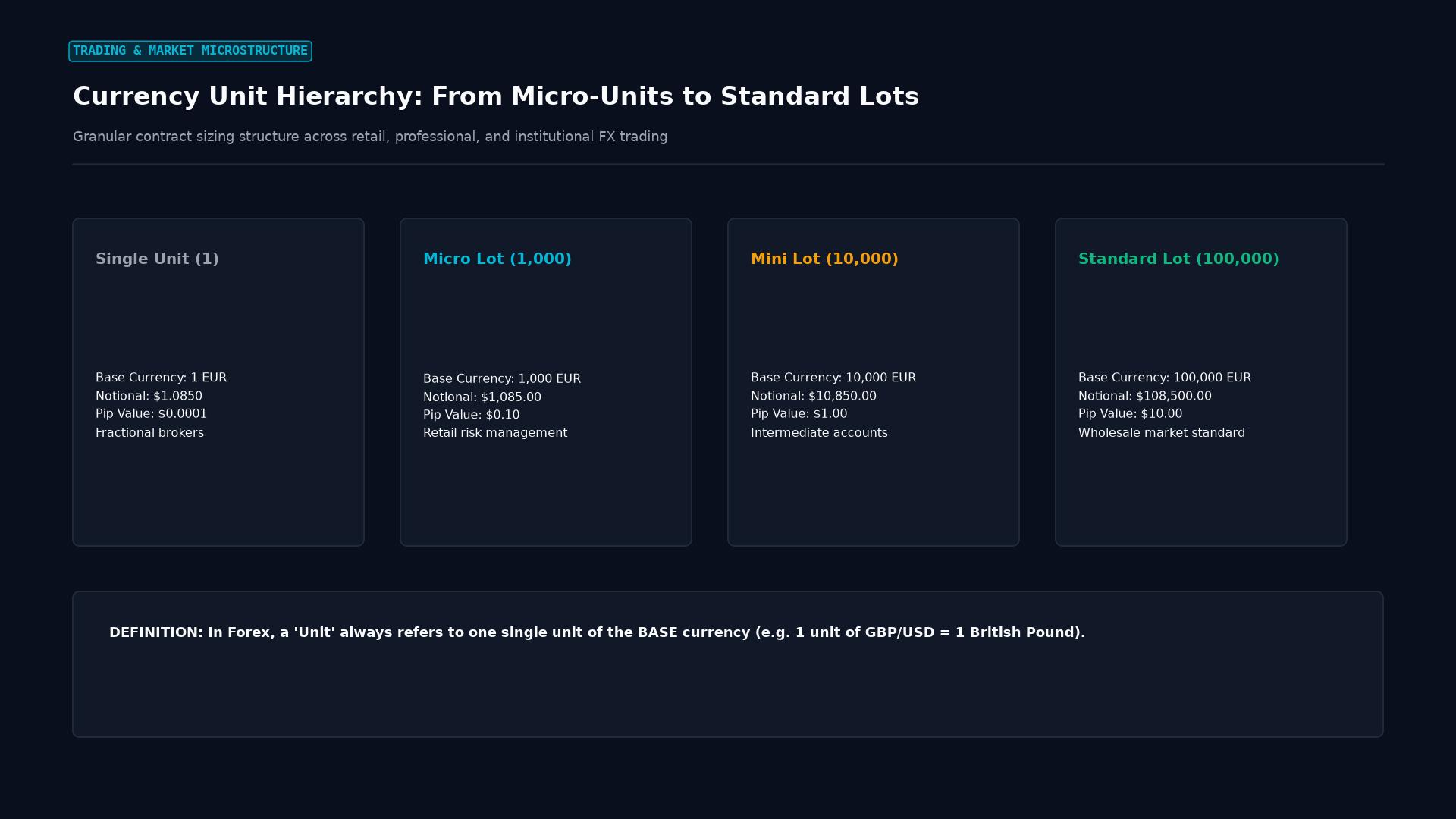 Figure: Contract sizing tiers: single fractional units, micro lots (1,000 units), mini lots (10,000 units), and standard interbank lots (100,000 units).
Mathematical Formulation: Units & Position Sizing
Accurate risk management mandates calculating unit exposure based on predetermined capital risk budgets rather than arbitrary lot sizes.
1. Pip Value Derivation from Units
The monetary value of a single pip movement ($0.0001$ for 4-decimal pairs) is directly proportional to the total unit count:
$$\text{Pip Value} = \text{Units} \times \text{Pip Size} \times \left( \frac{\text{Quote Currency}}{\text{Account Currency Rate}} \right)$$
For an account denominated in US Dollars trading EUR/USD ($\text{Pip Size} = 0.0001$):
- 100,000 Units (1 Standard Lot): $100,000 \times 0.0001 = $10.00$ per pip.
- 25,000 Units (Custom Position): $25,000 \times 0.0001 = $2.50$ per pip.
2. Algorithmic Unit Position Sizing
To risk no more than an exact dollar threshold ($R_{$}$) given a stop-loss distance in pips ($SL_{\text{pips}}$):
$$\text{Required Units} = \frac{\text{Account Equity} \times \text{Risk %}}{SL_{\text{pips}} \times \text{Pip Value per Single Unit}}$$
If a trader with a $$50,000$ account risks $1%$ ($$500$) on EUR/USD with a 25-pip stop loss:
$$\text{Required Units} = \frac{$500}{25 \times 0.0001} = \frac{$500}{0.0025} = 200,000 \text{ Units (2.0 Standard Lots)}$$
Unit Specifications Across Contract Tiers
Brokers provide varying levels of unit granularity depending on platform infrastructure and account classification:
| Lot Type | Unit Volume | Notional Value (EUR/USD @ 1.08) | Typical Margin Required (1:30 Leverage) | Target Demographic |
|---|---|---|---|---|
| Institutional / Yard | $1,000,000$–$100,000,000$ | $$1.08\text{M}$–$$108\text{M}$ | Prime Broker Credit Facilities | Central banks, hedge funds, sovereign funds |
| Standard Lot | $100,000$ Units | $$108,000$ | $$3,600$ | Well-capitalized experienced traders |
| Mini Lot (0.10) | $10,000$ Units | $$10,800$ | $$360$ | Intermediate retail traders |
| Micro Lot (0.01) | $1,000$ Units | $$1,088$ | $$36$ | Beginner traders, automated EA testing |
| Unit-Level (Fractional) | $1$ Unit | $$1.08$ | $$0.036$ | Cent accounts, algorithmic micro-balancing |
Units vs. Contracts in Multi-Asset Trading
In foreign exchange, positions are quoted directly in base currency units, but other financial asset classes utilize alternative standardized unit conventions:
Foreign Exchange:   Quoted in Base Currency Units (e.g., 100,000 EUR)
Equity Options:     1 Contract = 100 Share Units
Futures (CME ES):   1 E-mini Contract = $50 Multiplier x Index Points
Commodities (WTI):  1 Futures Contract = 1,000 Physical Barrel Units
Precious Metals:    1 Spot Gold Lot (XAU/USD) = 100 Troy Ounce Units
Real-World Institutional Case Study: The Modern Retail “Unit-Level” Disruption
Historically, foreign exchange trading was accessible only to institutions transacting in massive wholesale “clips” of 1 million or 5 million units via interbank voice brokers. Retail participants had to trade through early brokers that strictly mandated 100,000-unit standard lots, requiring tens of thousands of dollars in capital to withstand a 50-pip drawdown.
In the mid-2000s, pioneering electronic retail market makers like OANDA disrupted the brokerage industry by introducing unit-level fractional trading. Rather than forcing clients into rigid 100,000 or 10,000 lot increments, their proprietary matching engines allowed retail traders to enter positions with arbitrary unit precision (e.g., executing exactly 1,437 units of EUR/USD).
[Legacy Broker: Fixed Lot Rigidness]
Trader Equity: $2,500 | Stop Loss: 60 Pips | Risk Budget: 1% ($25)
Required Position Size: 4,166 Units
Legacy Broker Forces: 1 Mini Lot (10,000 Units) -> Actual Risk = $60 (2.4% - OVER-LEVERAGED)

[Modern Unit-Level Execution Engine]
Trader Inputs: Exact $25 Risk Budget
Engine Routes: Exactly 4,166 Units
Result: Exact 1.0% risk preservation; eliminates rounding over-exposure
This technological transition to unit-level precision eliminated rounding errors in risk management, enabling retail traders and algorithmic developers to implement sophisticated mathematical sizing formulas (such as fractional Kelly betting and ATR risk-parity) previously restricted to institutional quantitative desks.
Frequently Asked Questions
Can I buy a single unit of currency in forex?
Yes. Several modern online brokerages offer “cent accounts” or unit-based execution models where you can trade as little as 1 single unit of currency ($€1.00$ or $$1.00$), requiring only pennies in margin collateral. However, standard institutional MetaTrader 4/5 accounts typically establish their minimum order threshold at $0.01$ lots ($1,000$ units).
What is the base currency unit in a crypto pair like BTC/USD?
In cryptocurrency pairs such as BTC/USD, the base asset is Bitcoin, and the unit is $1$ Bitcoin ($1.0$ BTC). However, unlike traditional currencies, Bitcoin is divisible down to eight decimal places ($0.00000001$ BTC), where the smallest sub-unit is known as a Satoshi ($100$ million Satoshis per BTC unit).
How does currency pair notation determine the unit?
The first currency listed in any foreign exchange pair is always the base currency and represents the unit being bought or sold. The second currency is the quote currency (or counter currency), which dictates the price paid per single base unit. In USD/CAD, the unit is US Dollars; in GBP/USD, the unit is British Pounds.
Ready to trade forex?
Open a free demo account with a regulated broker. Practice with virtual funds before risking real money.