US Prime Rate
The US Prime Rate is the foundational benchmark lending rate that commercial banks charge their most creditworthy institutional and corporate borrowers, historically set by market consensus at 300 basis points (3.00%) above the Federal Reserve's Federal Funds Target Rate.
What Is the US Prime Rate?
The US Prime Rate (widely referenced as the Wall Street Journal Prime Rate) is the benchmark interest rate that major United States commercial banks charge their largest, most financially sound corporate borrowers for unsecured short-term loans. While very few retail consumers borrow at the prime rate itself, the US Prime Rate serves as the universal index upon which hundreds of billions of dollars in variable-rate consumer credit contracts—including credit cards, home equity lines of credit (HELOCs), auto loans, and Small Business Administration (SBA) loans—are priced.
Rather than being decreed by an act of Congress or set by the Federal Reserve, the Prime Rate is technically established independently by individual commercial banks (such as JPMorgan Chase, Bank of America, and Wells Fargo). However, by long-standing interbank convention, major banks adjust their prime rate in lockstep whenever the Federal Reserve’s Federal Open Market Committee (FOMC) changes the target range for the Federal Funds rate.
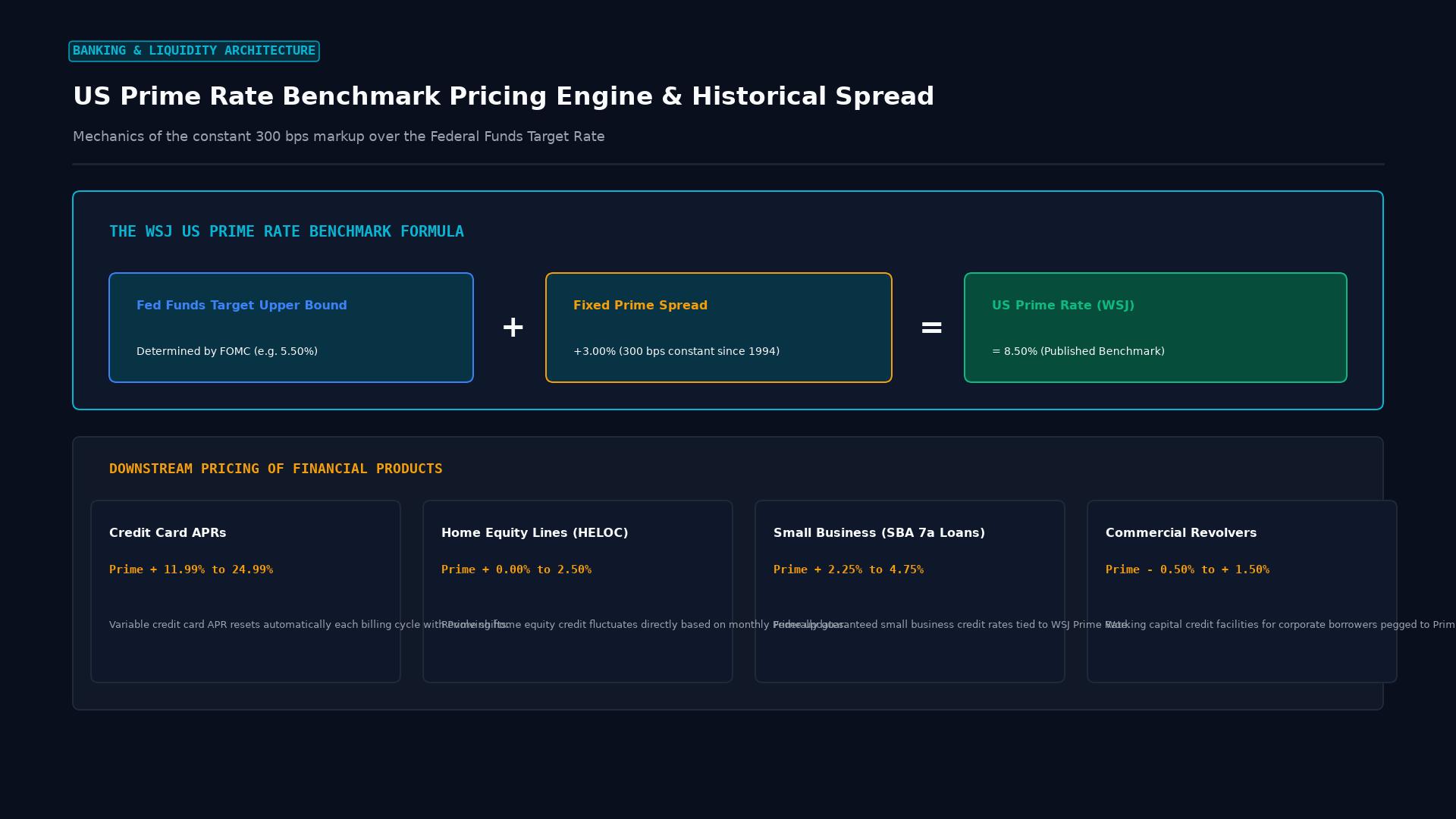 Figure: Pricing transmission engine: Federal Funds Target Upper Bound plus constant 300 bps markup determining retail credit card, HELOC, and commercial loan rates.
Mathematical Formulation: The 300-Basis-Point Spread
Since the mid-1990s, the US Prime Rate has maintained an almost unbreakable mathematical relationship with the upper limit of the Federal Reserve’s Federal Funds Target Rate:
$$\text{US Prime Rate} = \text{Fed Funds Target Rate (Upper Bound)} + 3.00% \quad (300 \text{ bps})$$
For example, when the Federal Reserve set its target range at $5.25%–5.50%$, the prime rate adjusted immediately to:
$$\text{US Prime Rate} = 5.50% + 3.00% = 8.50%$$
Consumer APR Calculation
Variable-rate consumer loan contracts legally define their Annual Percentage Rate (APR) as the Prime Rate plus an underwriting credit margin ($\text{Margin}_{\text{credit}}$):
$$\text{Borrower APR}_t = \text{Prime Rate}t + \text{Margin}{\text{credit}}$$
If the FOMC announces an emergency 50 basis point rate hike, the Prime Rate shifts from $8.50%$ to $9.00%$ within hours, and every consumer holding a floating-rate credit card experiences an automatic increase in their borrowing APR on their next monthly billing statement.
US Lending Benchmarks Compared
Institutional credit analysts distinguish the Prime Rate from other short-term debt benchmarks:
| Rate Benchmark | Setting Mechanism | Typical Borrowers / Scope | Spread over Fed Funds |
|---|---|---|---|
| US Prime Rate | Consensus of top commercial banks (WSJ survey) | Prime corporations, consumer credit cards, HELOCs, SBA loans | $+300$ bps (Fixed) |
| Federal Funds Effective (FFER) | Overnight interbank lending of reserve balances | Depository institutions borrowing excess central bank reserves | Trades within Fed target range |
| Secured Overnight Financing (SOFR) | Overnight Treasury repo market transaction volume | Global derivatives, syndicated corporate loans, floating rate notes | Slightly below or equal to FFER |
| Discount Rate (Primary Credit) | Federal Reserve Board of Governors decree | Solvent commercial banks borrowing directly at the Fed discount window | Typically $+50$ bps over FFER |
Macroeconomic Impact on the Foreign Exchange Market
Although the Prime Rate directly impacts commercial loans, it is closely watched by global currency traders as a transmission gauge:
[Federal Reserve Hikes Rates]
              |
              v
Prime Rate Rises (+300 bps spread maintained)
              |
              v
Cost of Consumer and Corporate Borrowing Explodes
              |
              v
Domestic Credit Creation Contracts -> Domestic Demand & Import Absorption Cools
              |
              v
Foreign Capital Inflows Seek Higher Yields -> US DOLLAR STRENGTHENS
Real-World Institutional Case Study: Paul Volcker & The 21.50% Prime Rate Shock (1980–1981)
The most extreme episode in the history of the US Prime Rate occurred between 1979 and 1981 under the leadership of Federal Reserve Chairman Paul Volcker.
Facing runaway stagflation where US Consumer Price Index (CPI) inflation breached $14.8%$ in March 1980, Volcker abandoned traditional interest rate targeting, choosing instead to target bank reserves to crush credit expansion. As the Fed starved the banking system of liquid reserves, the cost of funds skyrocketed:
[December 1980: The All-Time Record Peak]
Federal Funds Rate reached 20.00%
                   |
                   v
Commercial Banks raised the US Prime Rate to an unprecedented 21.50%
                   |
                   v
COLLAPSE OF CREDIT SENSITIVE SECTORS:
* 30-Year Mortgage rates surged past 18.5%
* Housing starts plunged 50%; auto manufacturing ground to a near-total halt
* Farmers picketed the Federal Reserve headquarters in Washington with tractors
                   |
                   v
RESULT: Triggered the severe 1981-1982 recession (unemployment peaked at 10.8%)
BUT: Broke the psychological back of inflation, which collapsed from 14.8% to 3.8% by 1983
The $21.50%$ prime rate demonstrated the immense power of commercial bank lending rates to suppress aggregate economic demand. It established the modern precedent that central banks must willingly accept sharp increases in the prime rate to preserve the long-term purchasing power of the national currency.
Frequently Asked Questions
Who officially publishes the US Prime Rate?
The Wall Street Journal (WSJ) publishes the consensus US Prime Rate, which is recognized across the financial services industry as the official reference rate. The WSJ surveys the 30 largest commercial banks in the United States and updates the published rate as soon as at least 23 of the 30 surveyed banks (or $75%$) change their prime lending rate.
Why doesn’t the prime rate change every day like SOFR?
Unlike daily market rates (such as SOFR or Treasury yields) that fluctuate tick-by-tick based on open-market liquidity, the Prime Rate is an administered rate. Commercial banks maintain a fixed spread and adjust the prime rate only when the Federal Reserve formally alters its monetary policy stance during FOMC meetings.
What is a “Sub-Prime” borrower?
A sub-prime borrower is an individual or business whose credit score (typically FICO below 620), income stability, or debt-to-income ratio disqualifies them from receiving loans at or near the prime rate. Because sub-prime borrowers represent higher default probabilities, banks charge them punitive interest rate spreads far above prime.
Ready to trade forex?
Open a free demo account with a regulated broker. Practice with virtual funds before risking real money.