Zero Bound (Zero Lower Bound - ZLB)
The Zero Lower Bound (ZLB) is a macroeconomic condition where nominal central bank policy interest rates reach zero percent, preventing further conventional rate cuts and forcing monetary authorities to adopt unconventional policy tools.
What Is the Zero Lower Bound (ZLB)?
The Zero Lower Bound (ZLB) is a fundamental constraint in monetary economics that occurs when a central bank’s nominal policy interest rate reaches zero percent ($0.0%$). Under classical monetary mechanics, nominal interest rates cannot easily drop below zero because economic agents have the alternative of withdrawing deposits and holding physical cash currency, which carries a nominal return of exactly zero percent.
When a severe recession, financial crisis, or deflationary shock strikes an economy already operating near the zero bound, conventional monetary policy becomes paralyzed. The central bank can no longer stimulate commercial lending or consumer spending by simply cutting the benchmark overnight interest rate, plunging the economy into what John Maynard Keynes termed a liquidity trap.
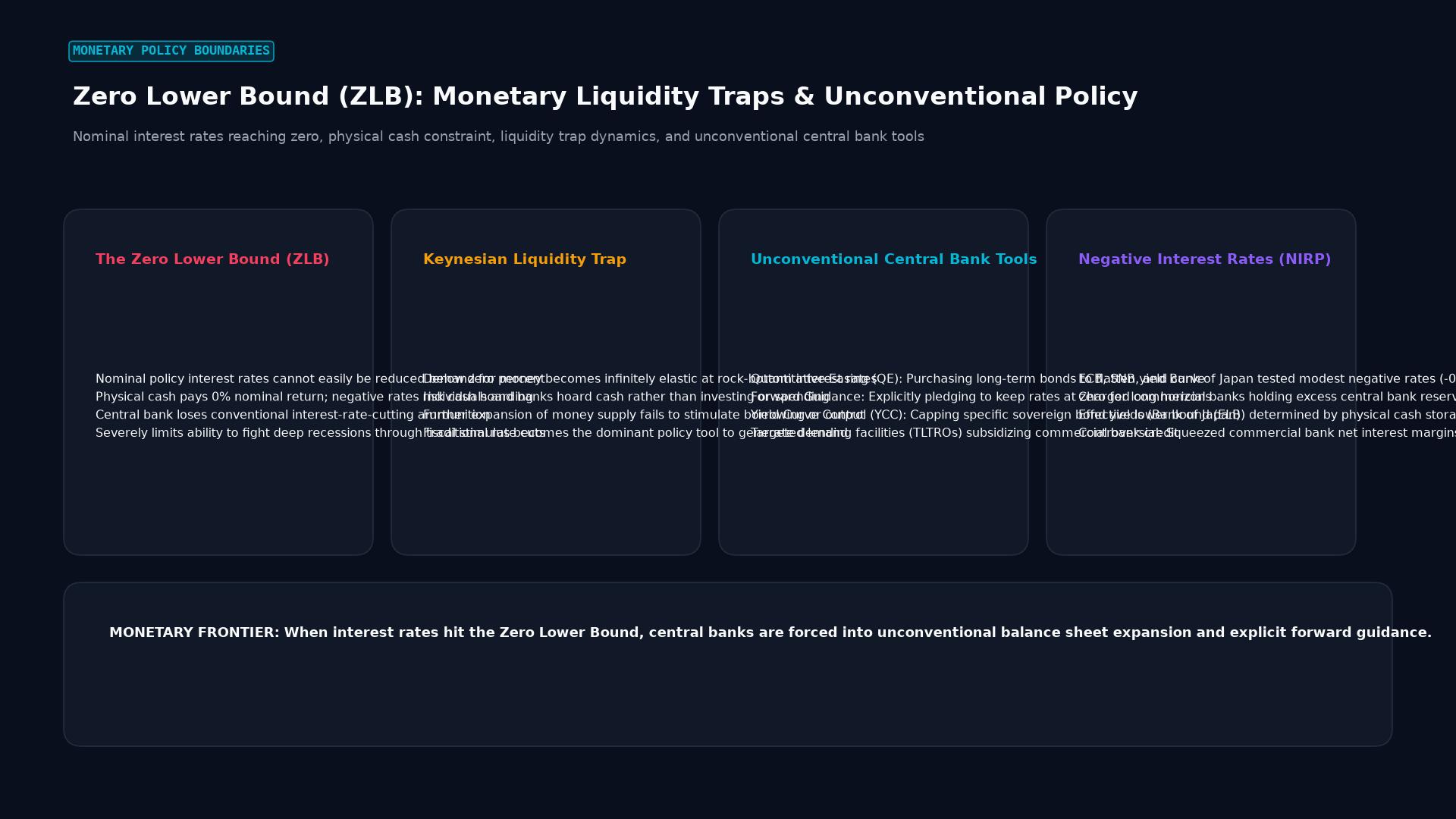 Figure: Nominal interest rates reaching zero, physical cash constraint, liquidity trap dynamics, and unconventional central bank tools
Technical Mechanics & The Shadow Rate Framework
During severe economic downturns, benchmark monetary policy rules—such as John Taylor’s celebrated Taylor Rule—frequently recommend negative interest rates to restore full employment:
$$i_{\text{Taylor}} = r^* + \pi_t + 0.5(\pi_t - \pi^) + 0.5(y_t - y^)$$
Where:
- $r^*$: Equilibrium real interest rate.
- $\pi_t - \pi^*$: Inflation gap (current inflation relative to the central bank’s 2% target).
- $y_t - y^*$: Output gap (actual GDP relative to potential GDP).
During the 2008 Global Financial Crisis, the Taylor Rule prescribed an optimal US Fed Funds rate of approximately $-4.0%$ to $-5.0%$. However, constrained by the nominal bound:
$$i_{\text{actual}} = \max\left(0, i_{\text{Taylor}}\right)$$
The Wu-Xia Shadow Rate
To measure the true monetary policy stance when policy rates are constrained at zero, quantitative economists Cynthia Wu and Fan Dora Xia developed the Shadow Federal Funds Rate. By evaluating the entire term structure of interest rates across Treasury maturities, the shadow rate measures the synthetic negative interest rate generated by unconventional monetary policy:
$$\text{Shadow Rate } s_t = g(\text{Term Structure Yields}) \approx -3.0% \text{ (US, 2014)}$$
The Central Bank Unconventional Policy Toolkit
When trapped at the Zero Lower Bound, central banks deploy four primary unconventional weapons to bypass the nominal rate constraint:
| Unconventional Policy | Operational Mechanism | Intended Market Effect | Primary Examples |
|---|---|---|---|
| Quantitative Easing (QE) | Direct central bank purchases of long-term government and corporate bonds | Lowers long-term borrowing yields; expands bank reserves | US Fed (QE1-QE4), ECB, BOE |
| Forward Guidance | Explicit contractual communication regarding the future path of interest rates | Flattens the short-to-intermediate end of the yield curve | Fed “lower for longer” pledges |
| Negative Interest Rates (NIRP) | Charging commercial banks a fee on excess reserves held at the central bank | Penalizes cash hoarding; incentivizes interbank lending | ECB ($-0.50%$), Swiss SNB ($-0.75%$) |
| Yield Curve Control (YCC) | Central bank commits to purchasing unlimited bonds to pin a specific yield | Eliminates interest rate volatility; caps sovereign debt costs | Bank of Japan 10-year JGB cap |
Real-World Case Study: The Bank of Japan’s 25-Year Zero Bound Odyssey (1999–2024)
No monetary institution has more extensive experience at the Zero Lower Bound than the Bank of Japan (BOJ).
The Bank of Japan's Historical Timeline at the ZLB:
- February 1999: Confronted with the bursting of its 1990s asset bubble and chronic deflation, the BOJ introduced the world's first Zero Interest Rate Policy (ZIRP).
- March 2001: Trapped at the zero bound, the BOJ pioneered Quantitative Easing (QE), targeting commercial bank current account balances rather than the overnight rate.
- January 2016: The BOJ breached the zero bound by adopting a Negative Interest Rate Policy (NIRP) of -0.10% on excess reserves.
- September 2016: Introduced Yield Curve Control (YCC), committing to purchase unlimited quantities of 10-year Japanese Government Bonds (JGBs) to hold the yield at exactly 0.0%.
- March 19, 2024: After 25 consecutive years of unconventional experimentation, the BOJ formally exited NIRP and YCC, raising the policy rate back to a positive 0.0% to 0.10% range.
The BOJ’s multi-decade zero-bound struggle proved that while unconventional policies prevent financial collapse, escaping a liquidity trap requires coordinated fiscal expansion and wage growth.
Frequently Asked Questions (FAQ)
What is the difference between the Zero Lower Bound (ZLB) and the Effective Lower Bound (ELB)?
The Zero Lower Bound is the theoretical economic limit where nominal interest rates equal exactly $0.0%$. The Effective Lower Bound (ELB) is the actual, practical boundary below which cutting interest rates produces counterproductive economic damage. Because commercial banks cannot easily pass negative interest rates onto retail depositors without triggering a bank run, cutting policy rates too far below zero compresses net interest margins, impairing bank profitability and restricting lending—a perverse outcome known as the “reversal interest rate.”
How does reaching the Zero Bound impact a nation’s currency in foreign exchange markets?
When a nation’s central bank cuts rates to the zero bound while other nations maintain positive yields, the currency typically undergoes sustained structural depreciation. The absence of nominal yield makes the currency an ideal funding currency for global carry trades. Investors borrow the zero-bound currency at virtually zero financing cost and convert the proceeds into higher-yielding foreign currencies, exerting continuous selling pressure on the spot exchange rate.
What is a “liquidity trap” and how is it related to the Zero Bound?
A liquidity trap is an economic condition where consumers and commercial enterprises hoard money in risk-free cash accounts rather than investing or spending it, regardless of how much liquidity the central bank creates. At the Zero Lower Bound, the opportunity cost of holding liquid cash is zero. Because interest rates cannot fall any lower and expected returns on capital remain deeply pessimistic, additional injections of central bank base money simply sit idle in bank reserves, causing the velocity of money to collapse.
Ready to trade forex?
Open a free demo account with a regulated broker. Practice with virtual funds before risking real money.