US Treasury
The United States Department of the Treasury is the federal executive cabinet department responsible for managing sovereign public finances, issuing US government debt securities (Treasuries), collecting federal revenues, and overseeing national fiscal solvency.
What Is the US Treasury?
The United States Department of the Treasury is the executive department of the US federal government responsible for promoting economic prosperity and ensuring the financial security of the United States. Established by the First Congress in 1789 with Alexander Hamilton as its first Secretary, the Treasury operates at the nexus of international finance, domestic taxation, sovereign borrowing, and geopolitical economic sanctions.
In global capital markets, the US Treasury plays an unmatched systemic role through its Office of Debt Management, which finances federal budget deficits by issuing sovereign debt securities—collectively known as US Treasuries (Bills, Notes, Bonds, and TIPS). Backed by the “full faith and credit” of the United States government, US Treasuries form the bedrock of the global financial system, serving as the benchmark risk-free rate for global asset pricing and the premier reserve asset held by foreign central banks.
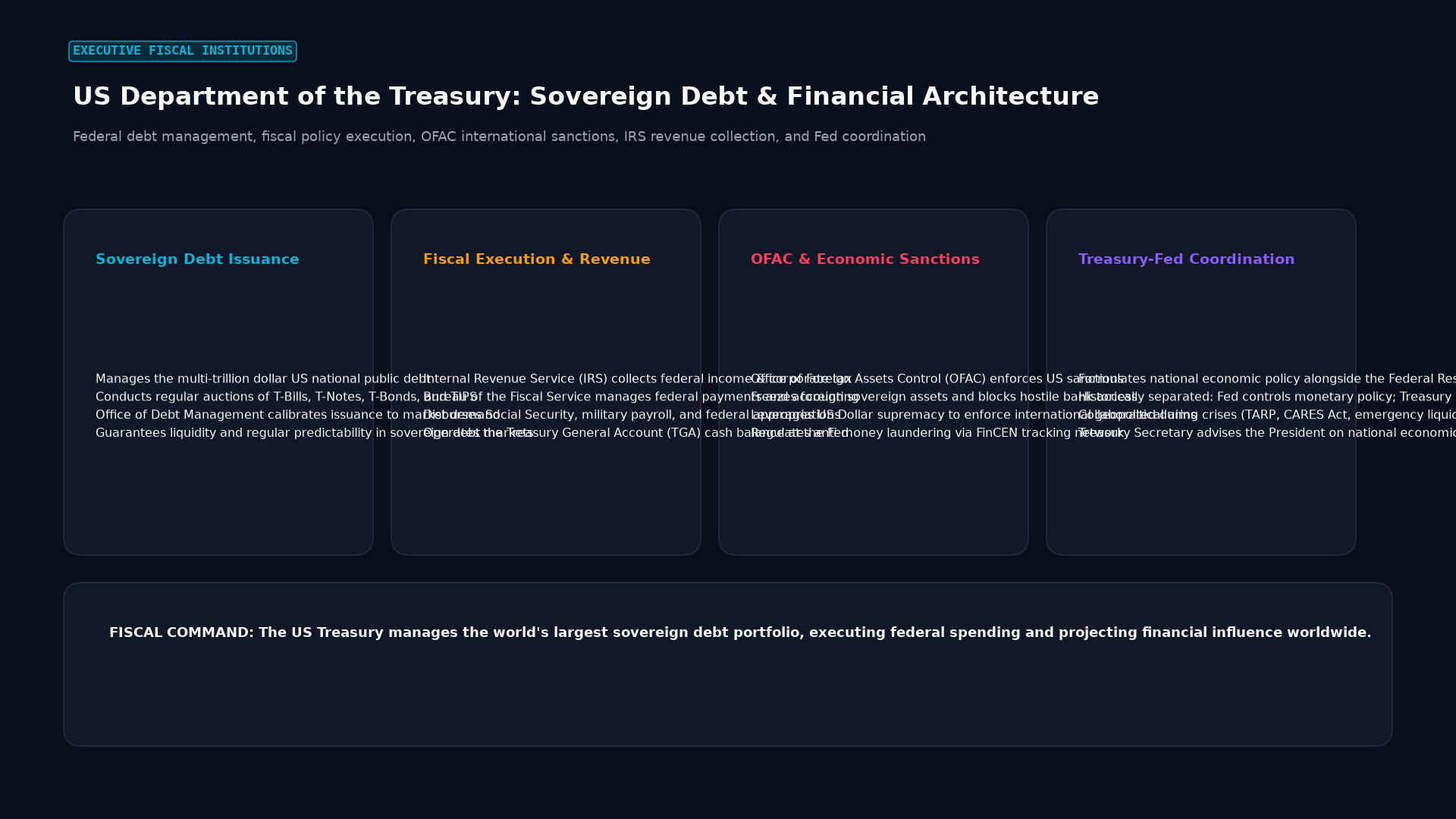 Figure: Federal debt management, fiscal policy execution, OFAC international sanctions, IRS revenue collection, and Fed coordination
Treasury Securities: Maturity & Valuation
The Treasury issues four principal categories of sovereign debt to fund federal operations:
1. Treasury Bills (T-Bills)
Short-term zero-coupon obligations issued at a discount to par with maturities of 4, 8, 13, 17, 26, and 52 weeks. The annualized discount yield is calculated using a 360-day year:
$$Y_{\text{discount}} = \left( \frac{\text{Par} - P}{\text{Par}} \right) \times \frac{360}{t}$$
The true annualized Bond Equivalent Yield (BEY) on a 365-day basis is:
$$Y_{\text{BEY}} = \left( \frac{\text{Par} - P}{P} \right) \times \frac{365}{t}$$
2. Treasury Notes (T-Notes)
Fixed-principal coupon debt issued with maturities of 2, 3, 5, 7, and 10 years, paying semi-annual coupons. The 10-Year Treasury Note serves as the universal pricing anchor for corporate bonds, mortgages, and equity discount rates worldwide.
3. Treasury Bonds (T-Bonds)
Long-term sovereign debt issued with 20-year and 30-year maturities, exposed to substantial duration risk and term premiums.
4. TIPS (Treasury Inflation-Protected Securities)
Debt instruments whose principal value adjusts dynamically with changes in the Consumer Price Index (CPI), protecting investor purchasing power.
US Treasury vs. The Federal Reserve System
Novice market participants frequently confuse the US Treasury with the US Federal Reserve:
| Dimension | US Department of the Treasury | Federal Reserve System |
|---|---|---|
| Nature of Institution | Executive Cabinet Department (Government) | Independent Central Bank (Quasi-Public) |
| Primary Domain | Fiscal Policy: Taxation, borrowing, spending, sanctions. | Monetary Policy: Money supply, interest rates, bank regulation. |
| Leadership | Secretary of the Treasury (Appointed by President) | Chair of the Federal Reserve (Appointed with Senate approval) |
| Key Instrument | Issues sovereign debt securities (Treasuries). | Regulates bank reserves; adjusts overnight Fed Funds target rate. |
| Money Creation | Prints physical paper currency (Bureau of Engraving and Printing). | Creates electronic bank reserves through open-market operations. |
Macro Dynamics: The Treasury General Account (TGA)
Global macro hedge funds and foreign exchange desks monitor daily fluctuations in the Treasury General Account (TGA)—the federal government’s cash balance maintained at the Federal Reserve Bank of New York:
$$\Delta \text{Bank Reserves} \approx -\Delta \text{TGA} - \Delta \text{ON RRP} + \Delta \text{Fed Assets}$$
When the Treasury issues massive debt to replenish the TGA, it drains cash from commercial bank reserves, tightening interbank dollar liquidity and creating upward pressure on the US Dollar Index. Conversely, when the Treasury runs down its TGA cash to fund federal spending without new debt issuance, it injects hundreds of billions of dollars of high-powered liquidity directly into the commercial banking system.
Real-World Institutional Case Study: The Post-Debt Ceiling TGA Tsunami (June 2023)
In early 2023, the US government struck its statutory $$31.4\text{ trillion}$ debt ceiling, prohibiting the Treasury from issuing new debt. To avoid defaulting on sovereign obligations, Treasury Secretary Janet Yellen initiated “extraordinary measures,” running down the Treasury General Account from $$600\text{ billion}$ down to an alarming $$22\text{ billion}$ by June 1, 2023.
On June 3, 2023, Congress passed the Fiscal Responsibility Act, suspending the debt limit through 2025. The Treasury immediately launched an unprecedented borrowing blitz to replenish its depleted cash reserves:
[June - October 2023: The $1 Trillion Debt Flood]
Treasury issued over $1,000,000,000,000 in short-term T-Bills within 4 months
                     |
                     v
Wall Street feared a catastrophic private liquidity squeeze (draining bank deposits)
                     |
                     v
THE RELIEF VALVE: Money Market Funds redirected cash out of the Fed's Overnight
Reverse Repo (ON RRP) facility into newly issued high-yielding T-Bills (5.40%+)
                     |
                     v
Macro Outcome: TGA successfully surged from $22B back to $800B;
However, massive longer-dated Treasury issuance drove 10-Year yields above 5.00%
for the first time in 16 years (October 2023), causing global equity market corrections
This episode demonstrated that Treasury debt management decisions—such as whether to issue short-term T-Bills versus long-term T-Bonds—exert an impact on global yields and financial conditions comparable to central bank interest rate decisions.
Frequently Asked Questions
Does the US Treasury print money to pay off government debt?
No. The Treasury’s Bureau of Engraving and Printing manufactures physical paper currency notes, but only to meet physical cash demand from commercial banks. The Treasury cannot legally create money out of thin air to pay federal debt obligations; it must finance all expenditures through either tax revenues collected by the Internal Revenue Service (IRS) or by issuing marketable Treasury debt securities at public auction.
What are “Primary Dealers” in US Treasury auctions?
Primary Dealers are a select group of approximately 24 elite commercial and investment banks (including JPMorgan Chase, Goldman Sachs, Citigroup, and Morgan Stanley) authorized to trade directly with the US Treasury and the Federal Reserve. Primary dealers are legally obligated to bid on every Treasury debt auction, ensuring that the US sovereign government never fails to fund its deficit spending.
What happens if the US Treasury runs out of cash during a debt ceiling crisis?
If the statutory debt ceiling is reached and the Treasury exhausts its operational cash and extraordinary accounting measures, it faces technical default. It would be forced to halt payments on Social Security, military salaries, and vendor contracts, or delay coupon payments on maturing sovereign bonds, an event that rating agencies warned would trigger a downgrade of US sovereign credit and shock global financial markets.
Ready to trade forex?
Open a free demo account with a regulated broker. Practice with virtual funds before risking real money.