Value Today
Value Today, commonly termed a Cash FX transaction (designated as T+0 or TOD), is a foreign exchange agreement in which trade execution, clearing, and final settlement occur on the exact same calendar business day.
What Is Value Today (TOD)?
In the foreign exchange market, Value Today (widely designated in dealer shorthand as TOD or Cash Settlement) describes a transaction whose value date (settlement date) is identical to its transaction date ($T+0$). While standard interbank foreign exchange spot contracts settle on a $T+2$ convention (two business days following execution), a Value Today contract requires that both currency legs be cleared and irrevocably transferred into counterparties’ respective central bank accounts before the close of local business on that exact same day.
Value Today transactions are primarily utilized by corporate treasurers, multinational banks, and sovereign wealth managers who face immediate intraday liquidity shortfalls—such as urgent cross-border payroll obligations, unexpected margin calls, or emergency treasury cash balancing. Because clearing two currencies simultaneously across disparate time zones on zero notice presents substantial operational hurdles, Value Today trades trade at a price adjustment relative to the benchmark spot rate.
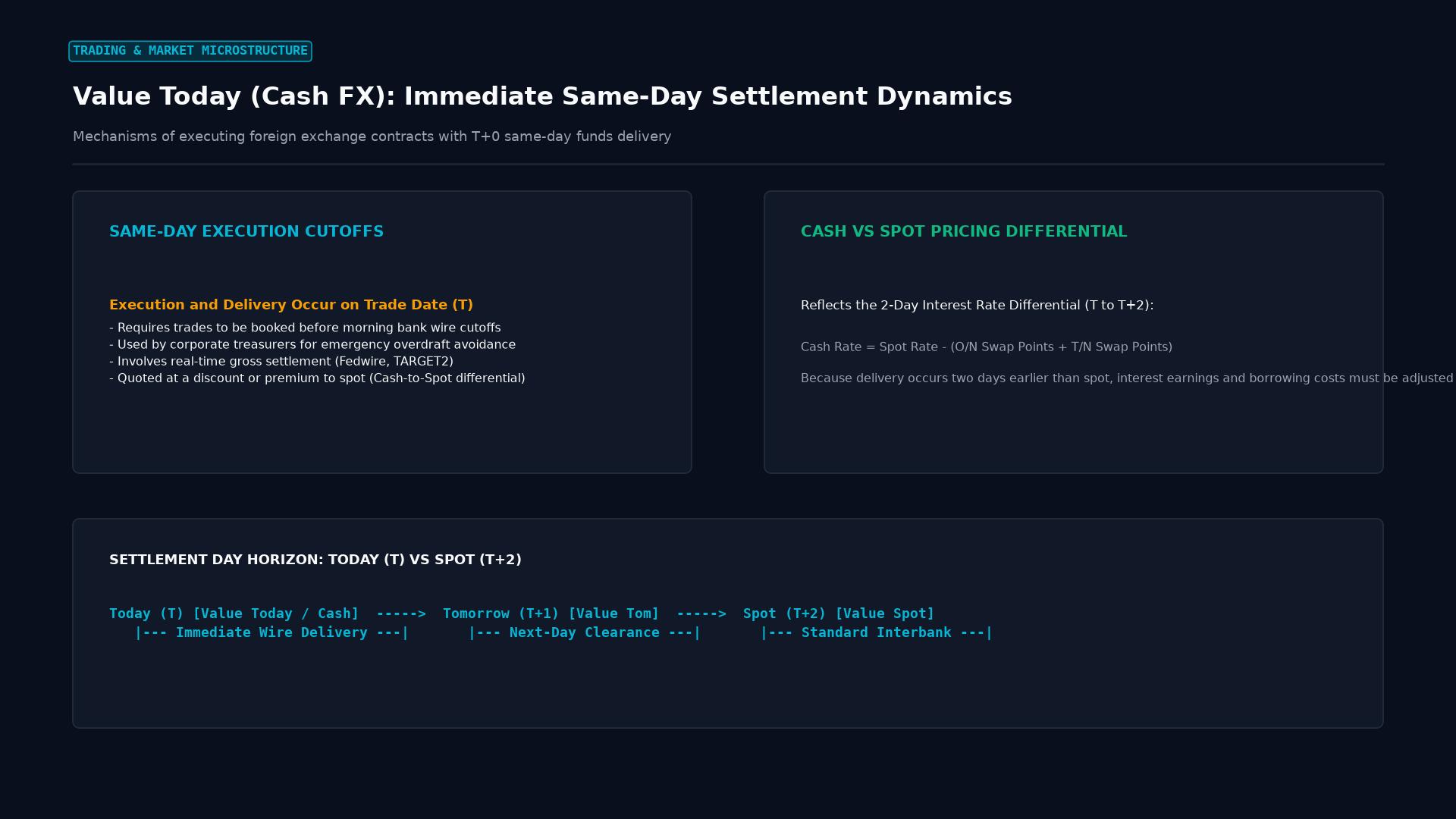 Figure: Same-day cash settlement: booking foreign exchange transactions for immediate T+0 delivery with cash-to-spot interest rate adjustments.
Pricing Mechanics: Rolling Backward from Spot
In institutional pricing engines, the benchmark price of a currency pair is always quoted for Spot ($T+2$). Therefore, pricing a Value Today ($T+0$) trade requires dealers to deduct two days of interest rate differentials (forward swap points) to reflect the fact that the seller delivers the funds two days earlier than conventional spot:
$$S_{\text{TOD}} = S_{\text{spot}} - \text{Swap Points}{\text{Overnight (O/N)}} - \text{Swap Points}{\text{Tom-Next (T/N)}}$$
Under Covered Interest Parity (CIP), the theoretical overnight swap point adjustment is given by:
$$\text{Swap Points}{\text{O/N}} \approx S{\text{spot}} \times \left( \frac{r_d - r_f}{360} \right) \times 1$$
Where:
- $r_d$: Domestic (quote currency) overnight risk-free rate.
- $r_f$: Foreign (base currency) overnight risk-free rate.
If the base currency carries a higher interest rate than the quote currency ($r_f > r_d$), settling today forfeits two days of higher foreign interest accruals, causing the dealer to adjust the exchange rate in favor of the party delivering the high-yielding currency early.
Settlement Conventions Across FX Horizons
| Settlement Designation | Shorthand | Settlement Horizon | Common Market Use Case | Interbank Clearing Window |
|---|---|---|---|---|
| Value Today | TOD / Cash | $T+0$ (Same Day) | Emergency liquidity, same-day cross-border acquisitions | Closes early (typically 11:00 to 14:00 local time) |
| Value Tomorrow | TOM | $T+1$ (Next Business Day) | Standard spot for USD/CAD, USD/TRY, USD/PHP | Standard overnight RTGS clearing |
| Value Spot | SPOT | $T+2$ (Two Business Days) | Global default for EUR/USD, GBP/USD, USD/JPY | Continuous Linked Settlement (CLS Bank) |
| Forward Contract | FWD | $T > 2$ (Days to Years) | Corporate commercial trade hedging, carry positioning | Periodic fixing / customized credit facility |
Operational Hurdles: The Time Zone & Clearing Cutoff Barrier
Executing a Value Today transaction requires overcoming strict central bank Real-Time Gross Settlement (RTGS) cutoffs. For example, in an EUR/USD Value Today trade:
[The EUR/USD Same-Day Friction]
Frankfurt / European TARGET2 System Closes at 18:00 CET (12:00 PM New York Time)
                    |
                    v
A New York corporate treasurer who submits a Value Today trade at 1:00 PM EST
cannot settle the Euro leg today because European central bank clearing is ALREADY CLOSED.
                    |
                    v
Operational Rule: Value Today trades in European currencies must be executed
prior to strict morning cutoff windows (typically before 10:30 AM EST).
Because of these temporal constraints, Asia-Pacific currencies (JPY, AUD, NZD, SGD) cannot be settled Value Today from London or New York trading desks under normal banking channels, as Asian central bank settlement systems are already closed for the night when Western trading begins.
Real-World Institutional Case Study: The Corporate Dash for Cash (March 2020)
During the acute liquidity shock of the COVID-19 pandemic in March 2020, multinational corporations worldwide drew down tens of billions of dollars on their emergency revolving credit facilities simultaneously to guarantee operational survival.
Global manufacturing conglomerates with extensive overseas operations suddenly faced urgent local currency liquidity deficits:
[March 16-19, 2020: The Same-Day Cash Squeeze]
US industrial manufacturer needed €150 Million in Frankfurt by 4:00 PM local time
to fund emergency supplier guarantees and maintain commercial supply lines
                    |
                    v
Standard Spot FX (T+2) would settle 48 hours too late
Corporate desk instructed Wall Street dealer to execute "VALUE TODAY" EUR/USD
                    |
                    v
LIQUIDITY PREMIUM: Because interbank US Dollar funding markets were severely stressed
(Cross-Currency Basis Swaps blown out to 150+ bps discount),
dealers charged punitive liquidity surcharges to source same-day deliverable Euros
                    |
                    v
The firm paid an effective 25-pip penalty relative to spot just to guarantee T+0 settlement
This event highlighted that in times of systemic market stress, the ability to settle Value Today rather than Value Spot is a premium operational capability that commands substantial liquidity markups.
Frequently Asked Questions
Can retail traders execute Value Today trades?
Generally, no. Retail forex brokers provide leveraged Contracts for Difference (CFDs) or rolling spot accounts where trades do not enter physical interbank delivery. Retail positions are automatically held in perpetuity and rolled over daily at 17:00 EST via synthetic Tom-Next swap points, meaning physical settlement dates ($T+0, T+1, T+2$) do not directly apply to the retail client.
What is the difference between Value Today and Value Spot?
Value Spot is the default market convention where payment delivery occurs two valid business days after the trade date ($T+2$). Value Today is an accelerated same-day contract ($T+0$) where cash delivery occurs before banking cutoffs on the exact date the trade is negotiated.
Why do Value Today trades require pre-established bilateral credit lines?
Because same-day settlement leaves no time for multilateral post-trade netting or dispute resolution, banks will only quote Value Today prices to counterparties with whom they have fully executed ISDA Master Agreements, pre-funded custodial accounts, or active intraday prime brokerage credit lines.
Ready to trade forex?
Open a free demo account with a regulated broker. Practice with virtual funds before risking real money.