Vanilla
In derivatives and financial engineering, a vanilla instrument—predominantly a plain vanilla option or swap—is a standard contract governed by conventional exercise terms, fixed strike prices, and linear underlying dependencies without exotic trigger barriers or path-dependent payoffs.
What Is a Vanilla Instrument?
In financial markets, the descriptor vanilla (or plain vanilla) designates the most basic, standardized, and liquid version of a financial instrument or derivative contract. Analogous to vanilla ice cream being the standard baseline flavor, a plain vanilla security contains no customized bells and whistles, leverage multipliers, optionality barriers, averaging mechanisms, or embedded path-dependent conditions.
The term is most prominently employed across two multi-trillion-dollar derivatives arenas:
- Plain Vanilla Options: Standard European or American call and put options with fixed strike prices and defined expiration dates, traded actively on public exchanges (such as Cboe) and over-the-counter (OTC) interbank currency markets.
- Plain Vanilla Interest Rate Swaps: Generic fixed-for-floating interest rate exchanges where one counterparty pays a fixed coupon while receiving a floating benchmark rate (such as SOFR or Euribor) based on a static notional principal.
Because of their transparent structure, plain vanilla instruments enjoy the deepest market liquidity, the tightest bid-ask spreads, and universal mathematical pricing models (such as Black-Scholes and Garman-Kohlhagen).
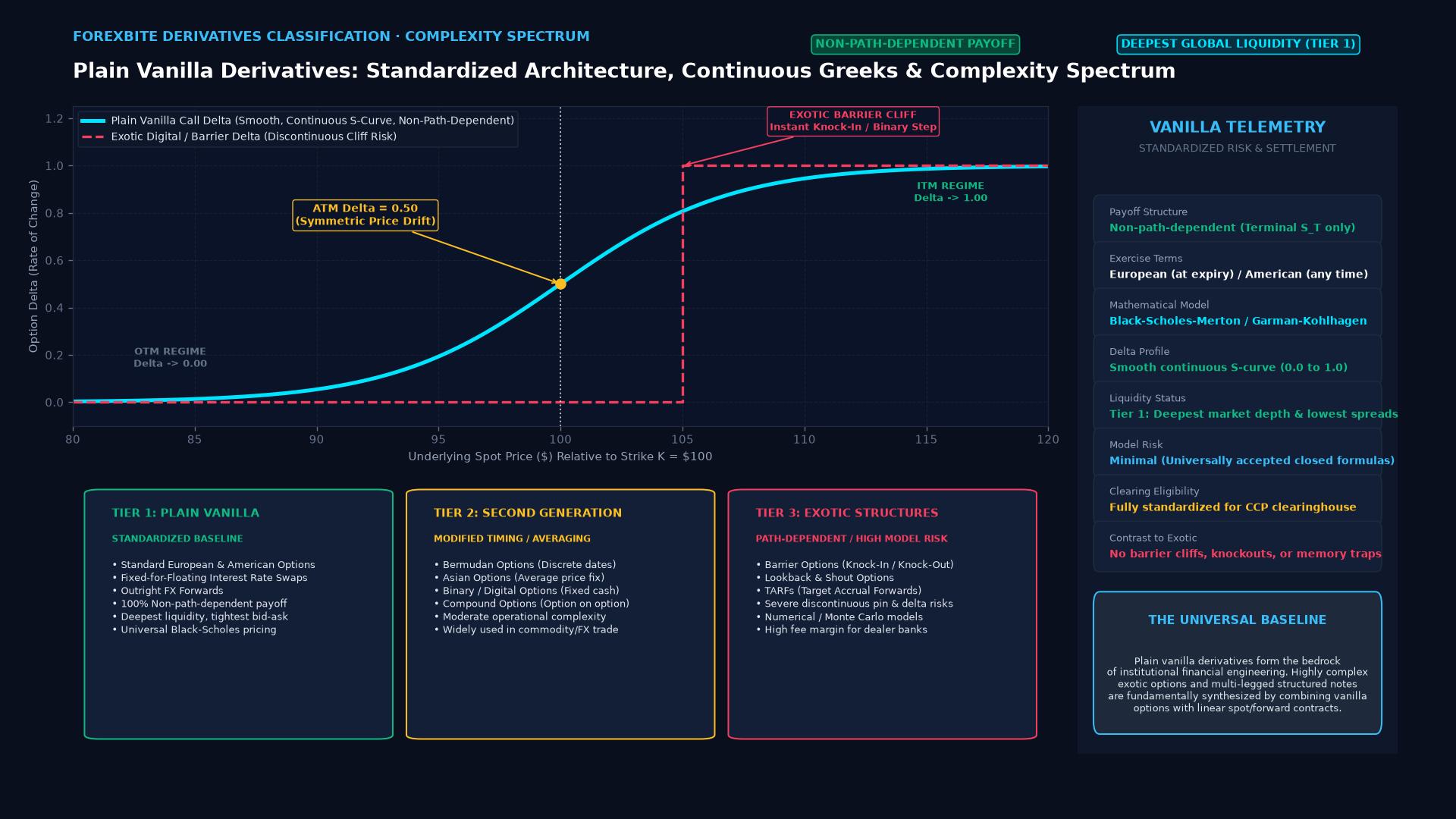
Mathematical Formulation: Plain Vanilla FX Options
The terminal payoff ($\Pi$) of a plain vanilla option is purely non-path-dependent, determined exclusively by the spot price of the underlying asset at expiration ($S_T$) relative to the strike price ($K$):
$$\Pi_{\text{vanilla_call}} = \max(0, S_T - K), \quad \Pi_{\text{vanilla_put}} = \max(0, K - S_T)$$
The Garman-Kohlhagen Pricing Model (FX Vanilla Options)
Because currencies pay continuous interest rates in both the domestic currency ($r_d$) and foreign currency ($r_f$), European plain vanilla foreign exchange options are valued using Mark Garman and Steven Kohlhagen’s 1983 extension of the Black-Scholes formula:
$$C = S_0 e^{-r_f T} N(d_1) - K e^{-r_d T} N(d_2)$$
$$P = K e^{-r_d T} N(-d_2) - S_0 e^{-r_f T} N(-d_1)$$
Where: $$d_1 = \frac{\ln(S_0 / K) + \left( r_d - r_f + \frac{\sigma^2}{2} \right) T}{\sigma \sqrt{T}}, \quad d_2 = d_1 - \sigma \sqrt{T}$$
And $N(\cdot)$ represents the cumulative standard normal distribution function. This closed-form analytical solution allows interbank dealers to price and hedge millions of vanilla contracts instantaneously.
Plain Vanilla vs. Exotic Derivatives Compared
| Characteristic | Plain Vanilla Option | Barrier Option | Asian Option | Target Accrual Forward (TARF) |
|---|---|---|---|---|
| Payoff Determination | Spot price at terminal expiration ($S_T$) | Breaching a price barrier ($H$) activates/kills option | Arithmetic or geometric average price over duration | Accumulated target profit cap; leveraged downside |
| Pricing Model | Closed-form Black-Scholes / Garman-Kohlhagen | PDE / Analytical reflection principle | Monte Carlo simulation / Moment matching | Complex numerical lattice simulation |
| Liquidity & Spreads | Ultra-tight spreads; central exchange clearing | Moderate; customized OTC dealer books | Moderate; popular in commodity hedging | Low; bespoke structured OTC banking product |
| Counterparty Risk | Minimal; cleared via CCP (OCC, CME) | Bilateral ISDA Master Agreement | Bilateral ISDA Master Agreement | Extreme; asymmetric corporate bankruptcy risk |
Why Institutional Investors Default to Plain Vanilla
Despite the marketing of exotic derivatives by investment banking structuring desks, corporate treasurers and institutional asset managers rely on plain vanilla contracts for $90%+$ of their hedging operations due to three structural pillars:
- Accounting Simplicity (IFRS 9 / ASC 815): Plain vanilla options and swaps easily qualify for hedge accounting, allowing gains and losses to offset directly against underlying business cash flows on financial statements without introducing quarterly P&L volatility.
- Transparent Price Discovery: Because vanilla options trade on transparent order books, corporate hedgers can verify fair value against interbank volatility surfaces, preventing dealers from embedding hidden structural markups.
- Absence of Gap / Knock-Out Risk: Unlike barrier options—which can cease to exist (knock out) precisely when the hedge is most needed during a sudden currency devaluation—a plain vanilla option guarantees permanent downside protection regardless of intervening market chaos.
Real-World Institutional Case Study: The Corporate TARF Disaster vs. Plain Vanilla Hedging
Between 2008 and 2014, major international banks aggressively marketed exotic structured products known as Target Accrual Redemption Forwards (TARFs) to corporate treasurers in emerging markets (including China, Brazil, Mexico, and South Korea) as “zero-cost” alternatives to plain vanilla currency options.
Under a TARF, the corporate client was offered an attractive, above-market exchange rate to convert foreign revenues, provided the currency moved in a stable range. However, the contract contained an asymmetric trap: if the currency depreciated beyond a barrier, the bank’s exposure was capped and terminated, while the corporate client was forced to buy foreign currency at a $2\times$ leveraged penalty rate for years.
[The Structural Trap]
Treasury Alternative A: Buy Plain Vanilla USD/CNH Put Option
* Upfront cost: 1.5% premium
* Outcome: Guaranteed floor protection; ZERO downside liability beyond the premium

Treasury Alternative B: Enter "Zero-Cost" Exotic TARF
* Upfront cost: $0 (Marketed as "Free Money")
* Outcome: Hidden $2x leverage multiplier triggered on currency crash
                    |
                    v
[2014-2015 Chinese Yuan / Brazilian Real Currency Devaluations]
Currencies broke through barrier levels
                    |
                    v
TARF contracts knocked out for banks; corporate losses multiplied exponentially:
* Thousands of Asian and Latin American export manufacturers faced immediate bankruptcy
* Over $20 Billion in collective corporate losses recorded across emerging markets
Corporations that strictly mandated plain vanilla hedging policies survived the volatility intact, while firms lured into complex exotic structures suffered devastating balance-sheet wipeouts.
Frequently Asked Questions
What is a plain vanilla interest rate swap?
A plain vanilla interest rate swap is the standard derivative contract where two parties exchange interest rate cash flows based on a specified principal amount. Typically, Company A agrees to pay a fixed interest rate (e.g., $4.25%$) to Company B, and in return, Company B pays Company A a floating interest rate (such as 3-month SOFR). Neither party exchanges the underlying principal; only the net interest difference is settled.
Can a plain vanilla option be exercised before expiration?
It depends on the exercise style. An American vanilla option can be exercised by the holder on any business day up to and including the expiration date. A European vanilla option can only be exercised on the exact day of contract expiration. Foreign exchange interbank options are overwhelmingly European style.
Why are vanilla options cheaper to trade than exotic options?
Vanilla options trade in massive volumes across standardized electronic exchanges and interbank multi-dealer portals. Because market makers can effortlessly hedge their delta, gamma, and vega risks using liquid underlying futures and spot markets, they operate with minimal risk premiums and quote bid-ask spreads that are a fraction of those charged for illiquid, bespoke exotic options.
Ready to trade forex?
Open a free demo account with a regulated broker. Practice with virtual funds before risking real money.