Shout Option
A path-dependent exotic European option that allows the holder to lock in a guaranteed minimum profit level at any chosen point during the contract's life by notifying the writer, while retaining the right to benefit from further favorable price moves until expiration.
What Is a Shout Option?
A shout option is an exotic, path-dependent financial derivative that combines the defined-risk profile of a standard European option with the profit-locking flexibility of a conditional floor. At any single juncture during the lifespan of the contract, the option holder has the contractual right to “shout” to the option writer (seller).
By shouting, the holder establishes an irrevocable minimum intrinsic payoff based on the asset’s market price at that precise moment ($S_\tau$), regardless of whether the underlying asset subsequently crashes. Crucially, shouting does not terminate the option. The contract remains alive until final maturity ($T$), allowing the holder to participate in any subsequent upside if the market continues to appreciate.
Because it protects accumulated paper gains without requiring early exercise or termination, the shout option is widely deployed by institutional asset managers, private wealth banks, and structured product desks to engineer capital-guaranteed investment vehicles.
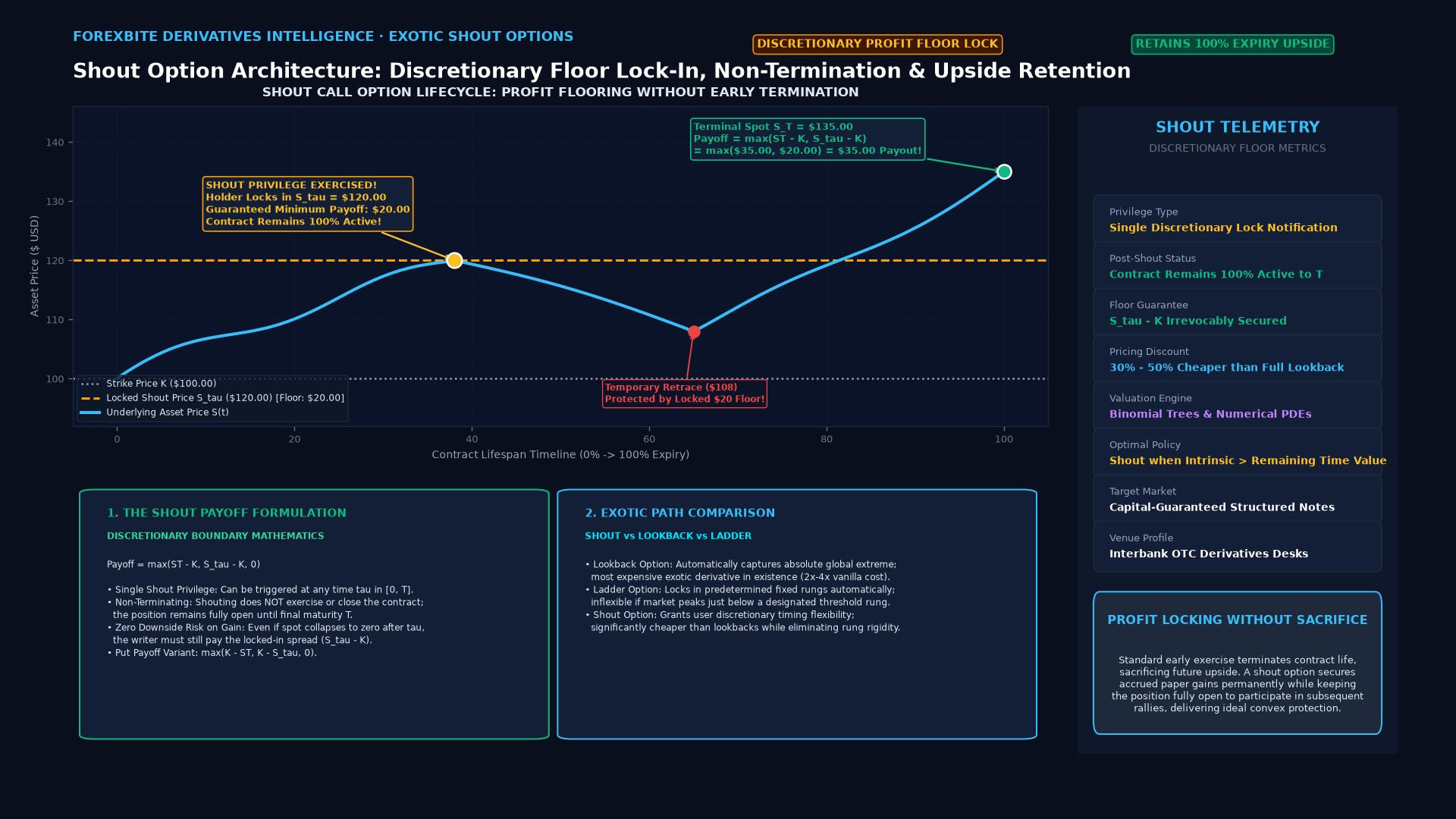 Figure: Shout option lifecycle demonstrating discretionary profit floor locking at S_tau without contract termination and full upside participation to expiration.
Mathematical Formulation of Shout Option Payoffs
The payoff of a shout option depends on whether the holder exercises the shout privilege prior to maturity.
1. Shout Call Option Payoff
If the holder executes a shout at time $\tau$ (where $0 \le \tau \le T$ and the asset price is $S_\tau$), the final terminal payoff at expiration $T$ is:
$$\text{Payoff}{\text{Call}} = \max\left(S_T - K, ; S\tau - K, ; 0\right)$$
- If the price at expiration $S_T$ exceeds the shout price $S_\tau$, the holder receives $S_T - K$.
- If the price at expiration $S_T$ collapses below the shout price $S_\tau$, the holder still receives the locked-in floor of $S_\tau - K$.
- If the holder never shouts during the life of the contract, the option matures as a standard European call: $\max(S_T - K, 0)$.
2. Shout Put Option Payoff
For a shout put option with strike price $K$ and shout price $S_\tau$:
$$\text{Payoff}{\text{Put}} = \max\left(K - S_T, ; K - S\tau, ; 0\right)$$
Shout Option vs. Vanilla European vs. Lookback vs. Cliquet Option
| Derivative Type | Payoff Formula / Rule | Path Dependency | Relative Premium Cost | Investor Advantage |
|---|---|---|---|---|
| Shout Option | $\max(S_T - K, S_\tau - K, 0)$ | Semi-Path Dependent (Choice-based) | Moderate to High (Cheaper than Lookback) | Discretionary control to lock in gains without exiting exposure |
| Vanilla European | $\max(S_T - K, 0)$ | Zero (Terminal value only) | Baseline / Standard | Lowest cost; exposed to late-stage trend collapses |
| Lookback Option | $\max(S_{\max} - K, 0)$ | Completely Path Dependent | Extremely High | Automatically captures the absolute peak price; no shout required |
| Cliquet Option | Series of capped periodic resets | Discrete Path Dependent | Moderate | Systematic ratcheting; locks in returns at predetermined dates |
Pricing Dynamics: Why Shout Options Are Cost-Effective Lookbacks
A pure lookback option is mathematically ideal because it automatically pays off based on the absolute peak price achieved over the contract’s entire life. However, lookback options are prohibitively expensive, often carrying premiums two to three times higher than vanilla options.
A shout option solves this pricing problem:
- Discretionary Barrier: Instead of tracking an infinite continuum of high ticks, the writer only has to hedge against a single, discretionary shout event chosen by the holder.
- Reduced Hedging Burden: Because the holder may shout sub-optimally (shouting too early or failing to shout before a drop), the market maker’s gamma and vega hedging costs are lower.
- Institutional Valuation: Valued numerically using binomial and trinomial lattice trees or Monte Carlo simulations, where dynamic programming determines the optimal shouting boundary as a function of time and implied volatility.
Real-World Institutional Case Study: Capital-Guaranteed Wealth Products
In European and Asian private wealth management, structured product desks frequently deploy shout option architecture to design principal-protected equity notes:
       STRUCTURED EQUITY-LINKED WEALTH NOTE (5-YEAR TENOR)

 Structure:
 - 90% of investor capital placed in AAA sovereign zero-coupon bonds.
   (Guarantees 100% principal return at maturity: €100,000 face value).
 - 10% of capital used to purchase a 5-Year Shout Call Option on the Euro Stoxx 50.

 Market Event:
 - Year 3: Euro Stoxx surges 45% amid global expansion.
 - Wealth Manager "Shouts": Locks in a guaranteed 45% return (€4,500 intrinsic).
 - Year 4–5: Global recession strikes; Euro Stoxx plunges 35% below inception strike.

 Investor Resolution:
 - Vanilla Option Outcome: Matures worthless (€0 return).
 - Shout Option Outcome: Matures with €4,500 gain preserved despite market crash.
 - Total Investor Return: 100% Principal Protection + 45% Protected Capital Return.
Operational Mechanics: How Shouting Is Legally Executed
In institutional over-the-counter (OTC) derivatives governed by the International Swaps and Derivatives Association (ISDA) Master Agreement, shouting requires formal confirmation:
- Notice of Shout: The buyer transmits an electronic message (via SWIFT, designated trading terminal, or recorded dealer line) specifying the exact timestamp of the shout.
- Reference Fixing: The calculation agent verifies the official composite market price of the underlying asset at that timestamp.
- Amended Confirmation: The option confirmation is updated with the locked-in floor strike ($S_\tau$). The contract continues trading or being held until final maturity.
Frequently Asked Questions
Can the holder of a shout option shout more than once?
Standard shout options permit only one shout during the contract’s life. However, customized institutional exotics—termed multi-shout options—can be structured to permit two, three, or periodic shouts, with each shout establishing a successively higher ratcheted floor (at the cost of a significantly higher upfront premium).
What happens if the option holder never shouts?
If the holder reaches contract expiration without ever triggering a shout, the option simply functions as a standard vanilla European option. If the underlying asset is in-the-money at expiration ($S_T > K$), the holder receives $S_T - K$. If it is out-of-the-money ($S_T \le K$), the option expires worthless.
Is shouting the same as exercising the option early?
No. Early exercise (as seen in American-style options) immediately terminates the contract, liquidates the position, and pays out the intrinsic value. Shouting leaves the contract completely active until maturity. The holder locks in a guaranteed minimum cash floor while continuing to participate in any additional future upside without risking their locked floor.
Ready to trade forex?
Open a free demo account with a regulated broker. Practice with virtual funds before risking real money.