Wholesale Price Index (WPI)
The Wholesale Price Index (WPI) is a macroeconomic indicator that measures the average change in prices of goods sold in bulk at the wholesale stage of transaction prior to reaching the retail consumer.
What Is the Wholesale Price Index (WPI)?
The Wholesale Price Index (WPI) measures the average change over time in the selling prices of bulk goods traded at early stages of commercial distribution—specifically between manufacturers, agricultural producers, wholesalers, and corporate intermediaries—prior to arriving at retail consumer markets.
Because wholesale prices react immediately to fluctuations in raw material costs, freight rates, energy tariffs, and international commodity prices, the WPI serves as a crucial leading indicator of consumer inflation. Price increases absorbed by wholesalers are eventually passed down the supply chain to retail storefronts, ultimately appearing in headline Consumer Price Index (CPI) readings with a lag of several weeks or months.
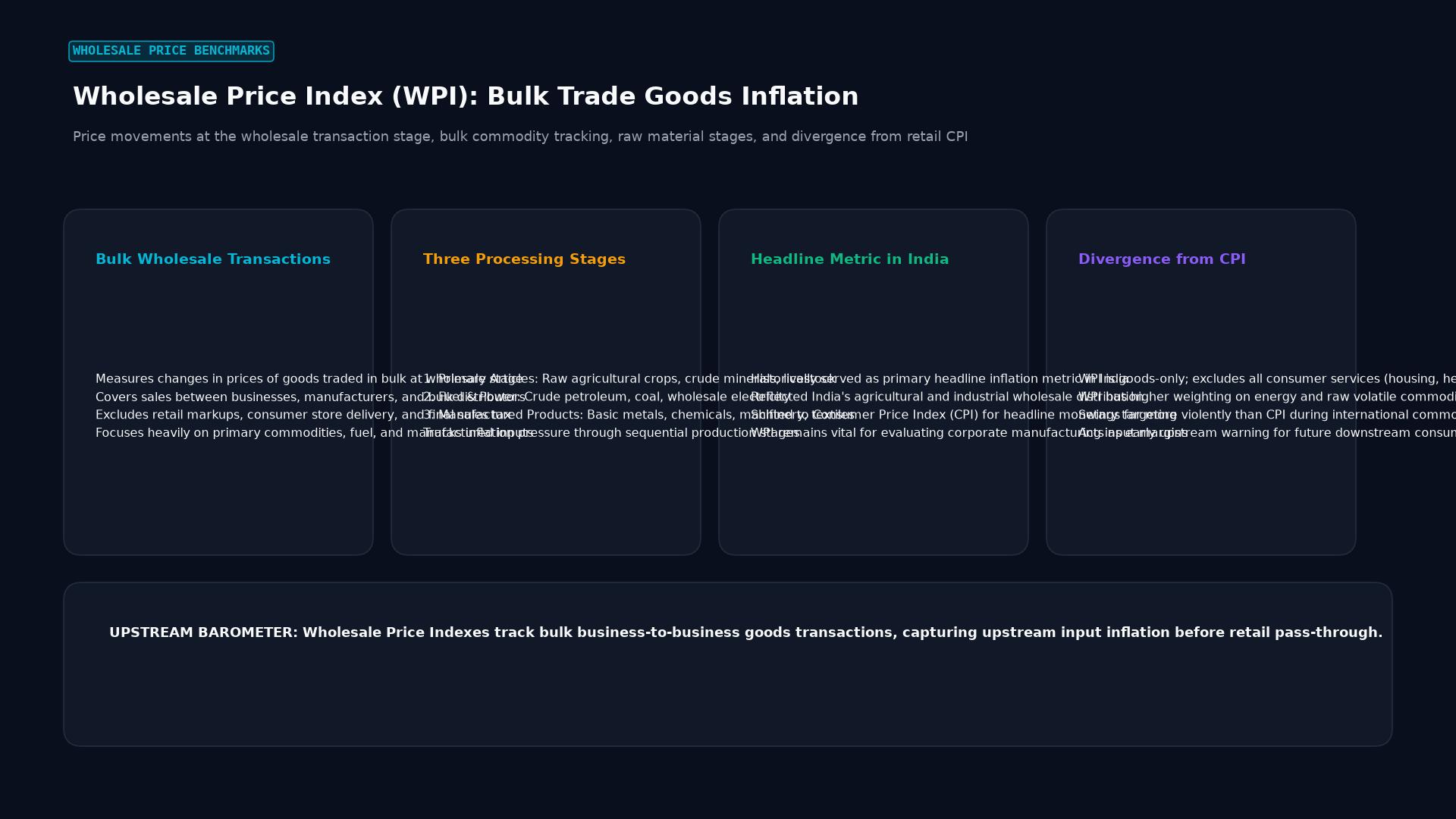 Figure: Price movements at the wholesale transaction stage, bulk commodity tracking, raw material stages, and divergence from retail CPI
Mathematical Formulation: Laspeyres Price Index
Statistical authorities calculate the Wholesale Price Index using the standard fixed-base Laspeyres price index formula:
$$WPI_t = \frac{\sum_{i=1}^{n} P_{i,t} \cdot Q_{i,0}}{\sum_{i=1}^{n} P_{i,0} \cdot Q_{i,0}} \times 100$$
Where:
- $P_{i,t}$: Wholesale price of commodity item $i$ in current evaluation period $t$.
- $P_{i,0}$: Wholesale price of commodity item $i$ during the benchmark base year $0$.
- $Q_{i,0}$: Quantity weighting of commodity item $i$ established in the base year.
- $n$: Total number of wholesale commodities sampled in the national basket.
Econometric Pass-Through Model
The transmission of wholesale price changes into consumer inflation is modeled through a distributed lag regression:
$$\Delta \ln(CPI_t) = \alpha + \sum_{k=0}^{m} \beta_k \Delta \ln(WPI_{t-k}) + \epsilon_t$$
Where $\sum_{k=0}^m \beta_k$ represents the cumulative pass-through elasticity of wholesale price pressures into consumer retail prices over $m$ months.
Comparative Matrix: WPI vs. PPI vs. CPI
| Feature | Wholesale Price Index (WPI) | Producer Price Index (PPI) | Consumer Price Index (CPI) |
|---|---|---|---|
| Transaction Level | Wholesale / Bulk distribution | Factory gate (producer output) | Final retail point of sale |
| Services Inclusion | No (Physical goods only) | Yes (Goods and commercial services) | Yes (Goods, services, housing rents) |
| Taxes & Subsidies | Includes excise and wholesale taxes | Excludes taxes; measures net revenue | Includes consumer sales / VAT taxes |
| Primary Beneficiary | Emerging economies / industrial supply | Advanced economies (US, Eurozone) | Central banks (official inflation targets) |
| Volatile Components | High weighting on commodities & fuel | Moderate commodity exposure | Heavy weighting on housing/shelter |
Real-World Case Study: India’s Record WPI vs. CPI Divergence (2021–2022)
While most Western central banks transitioned from WPI to the broader Producer Price Index (PPI) during the late 20th century, the Office of the Economic Adviser in India continues to publish a widely watched monthly WPI.
Indian WPI Divergence Shock (2021-2022):
- May 2022: Global crude oil and fertilizer prices spiked due to geopolitical conflict.
- WPI Inflation: Indian WPI surged to a multi-decade high of +15.88% YoY.
- CPI Inflation: Over the same period, Indian headline retail CPI stood at +7.04% YoY.
- Margin Compression: A historic 8.84% wedge emerged between wholesale costs and retail prices.
- Corporate Impact: Indian manufacturing firms suffered severe margin compression as intense domestic competition prevented them from passing 100% of input cost spikes to consumers.
Forex traders tracking the Indian Rupee (INR) utilized this massive WPI-CPI gap to anticipate aggressive policy rate hikes by the Reserve Bank of India (RBI) alongside corporate earnings downgrades.
Frequently Asked Questions (FAQ)
Why have most developed economies phased out the WPI in favor of the PPI?
Most advanced economies—including the United States, Japan, and the Eurozone—phased out the WPI because its commodity-heavy basket failed to capture the modern service economy. A standard WPI exclusively tracks physical tangible goods (agriculture, minerals, and manufactured goods). The Producer Price Index (PPI) was adopted because it evaluates both goods and services (healthcare, legal services, transport, banking) from the perspective of the domestic producer’s net revenue.
What does a widening spread between WPI and CPI signal to equity investors?
A widening spread where WPI significantly exceeds CPI indicates that corporate profit margins are under acute pressure. When wholesale input costs for energy, chemicals, and metals rise faster than the retail prices companies can charge consumers, businesses must either absorb the difference through reduced operating margins or risk destroying consumer demand by hiking prices. Conversely, if CPI is higher than WPI, corporate profit margins are expanding.
How do foreign exchange traders trade a WPI release?
Forex traders treat WPI surprises as an early indicator of future central bank policy decisions. A higher-than-anticipated WPI reading signals that wholesale cost pressures are building rapidly inside the industrial supply chain. Anticipating that this will feed into higher CPI prints and prompt the central bank to hike interest rates, traders frequently bid up the domestic currency in the spot market.
Ready to trade forex?
Open a free demo account with a regulated broker. Practice with virtual funds before risking real money.