Zero-Sum Game
A mathematical and economic situation modeled in game theory where the net aggregate gains of all winning participants exactly equal the net aggregate losses of all losing participants, resulting in a net wealth change of zero across the closed system.
Zero-Sum Game
A zero-sum game is a foundational concept in mathematical game theory, formulated by John von Neumann and Oskar Morgenstern in their 1944 treatise Theory of Games and Economic Behavior. In a zero-sum environment, the total wealth or utility across all participants remains strictly constant throughout the interaction. Any wealth gained by one player must be balanced by an exact, equal loss distributed across other participants in the closed system. Mathematically, the sum of all individual net payoffs equals zero:
$$\sum_{i=1}^{N} \Delta W_i = 0$$
Where $\Delta W_i$ represents the change in financial wealth or utility realized by participant $i$ across $N$ total market participants.
In global capital markets, financial instruments divide sharply between zero-sum architectures and positive-sum systems. Secondary trading in derivatives (such as futures, options, and swaps) and spot foreign exchange operates under zero-sum principles. Conversely, broad equity markets and corporate bond investing represent positive-sum environments driven by economic productivity, technological innovation, and cumulative capital formation.
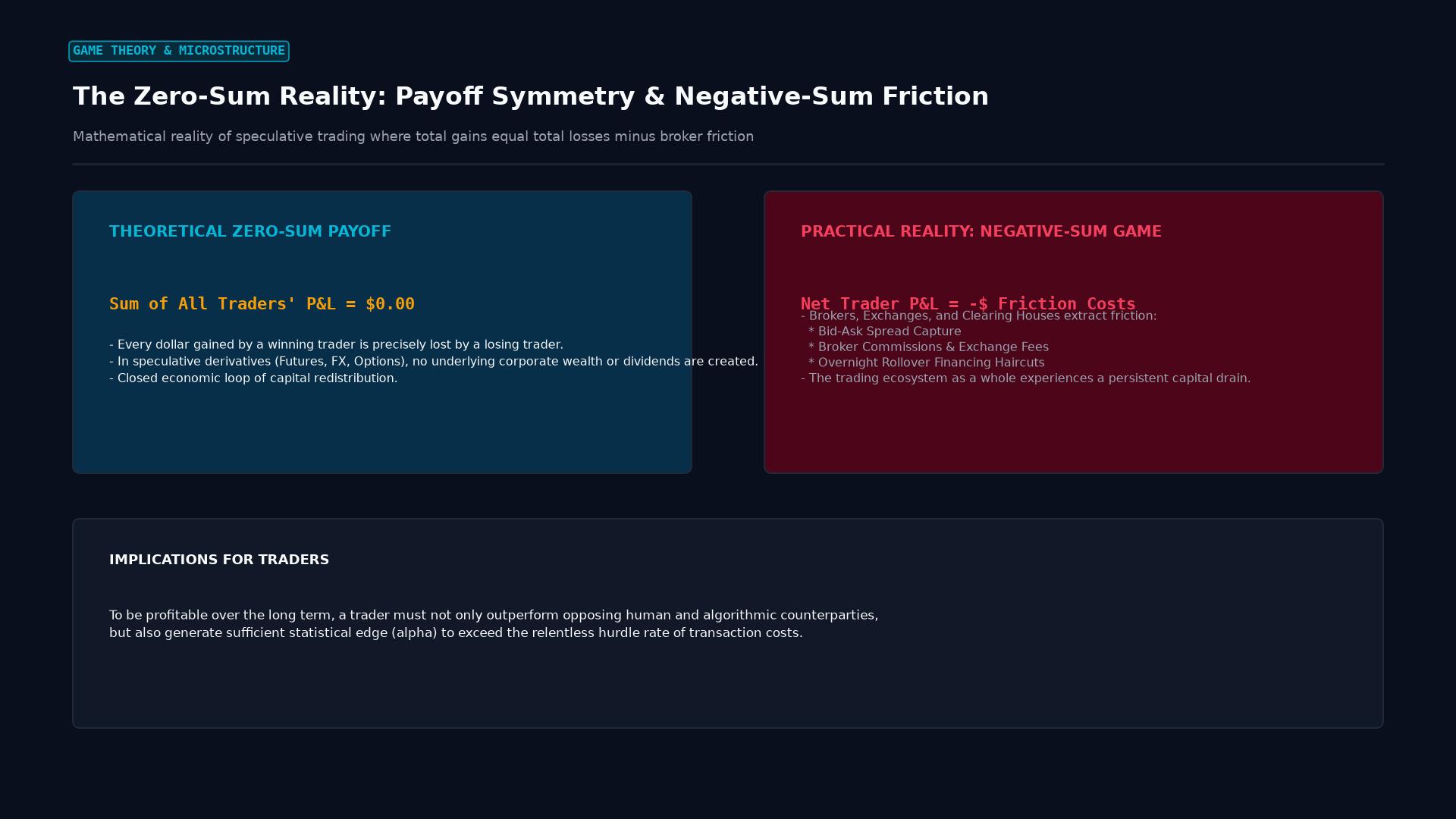 Figure: Trading game theory: speculative payoff symmetry where gross gains equal gross losses, reduced to a net negative-sum game by market friction costs.
The Zero-Sum Mechanics of Financial Derivatives
In financial derivatives, contracts do not represent fractional ownership of productive commercial assets. Instead, they are bilateral legal agreements that transfer financial risk between two counterparties based on the performance of an underlying benchmark.
       Bilateral Futures Payoff Matrix at Contract Expiration
  Profit / Loss ($)
     ^
     |         / Long Payoff: Max(0, S_T - F)
 +$5k|        /
     |       /
   $0+------/----------------------\----------------------------->
     |     /                        \
 -$5k|    /                          \ Short Payoff: Min(0, F - S_T)
     v   /                            \
       $90            $100            $110          Underlying Price (S_T)
                  Strike / Entry
1. Futures and Forward Contracts
Consider an institutional commodities contract where Party A buys a crude oil futures contract at $75 per barrel and Party B sells (shorts) the contract at the same price for delivery in three months:
- If crude oil settles at $85 at expiration, Party A collects a profit of $+$10$ per barrel.
- Party B incurs an identical cash loss of $-$10$ per barrel.
- The net wealth created across both parties equals: $$\Delta W = (+$10) + (-$10) = $0.00$$
2. Options Contracts
Options contracts display identical zero-sum mechanics between option buyers and option writers. When an investor purchases a call option for a premium of $5.00:
- If the option expires out-of-the-money, the option buyer loses $-$5.00$, and the option seller retains $+$5.00$ as net profit.
- If the option expires deep in-the-money with an intrinsic value of $20.00, the buyer realizes a net profit of $+$15.00$ ($20.00 - 5.00$), while the seller suffers an exact loss of $-$15.00$ ($5.00 - 20.00$). Across millions of option contracts cleared through the Options Clearing Corporation (OCC), every dollar credited to a winning margin account originates from a debit to a losing margin account.
Foreign Exchange (Forex) as a Zero-Sum Market
Retail and institutional foreign exchange trading operates as a zero-sum environment. Currencies are priced in relative pairs (such as EUR/USD, GBP/JPY, or AUD/CAD). Unlike corporate equities, which can appreciate simultaneously during macroeconomic expansions, one sovereign currency cannot strengthen without the counter-currency weakening by definition.
+--------------------------------------------------------------------------+
|                  The Closed Currency Valuation Loop                      |
+--------------------------------------------------------------------------+
|  EUR appreciates by +3.0% against the USD.                               |
|  By mathematical necessity, USD depreciates by ~2.91% against the EUR.   |
|  Capital flows into one currency zone require an equal exit from another.|
|  Holding cash reserves does not generate organic corporate earnings.     |
+--------------------------------------------------------------------------+
When an institutional macro fund earns $50 million shorting the British Pound ahead of an economic slowdown, those gains are funded dollar-for-dollar by losses sustained by commercial banks, multinational corporations, or retail traders holding long GBP inventory.
The Market Reality: Why Trading Is Actually a Negative-Sum Game
While theoretical economic models treat derivatives and FX markets as zero-sum, real-world capital markets are strictly negative-sum games for active participants.
Market intermediaries extract substantial fees at every stage of the trade lifecycle. To calculate the actual net returns achieved by traders, friction costs must be deducted from the system:
$$\sum_{i=1}^{N} \Delta W_{\text{traders}} = - \left( \text{Commissions} + \text{Bid-Ask Spreads} + \text{Financing Costs} + \text{Exchange Fees} + \text{Slippage} \right)$$
[ Aggregate Gross Trading Profits ] - [ Aggregate Gross Trading Losses ] = $0.00
                                       │
                                       ▼
       [ Deduct Intermediary Frictions: Liquidity Extraction ]
       - Broker Commissions & Clearing Fees
       - Bid-Ask Spread Capture by Market Makers
       - Overnight Financing Charges (Swap Rollover & Margin Interest)
       - Algorithmic Slippage & Market Impact
                                       │
                                       ▼
             [ Net Trader P&L Across the Market < $0.00 ]
               (Strictly Negative-Sum for Speculators)
1. Bid-Ask Spread Harvesting
Liquidity providers and electronic market makers (such as Citadel Securities, Virtu, and tier-one investment banks) post two-sided quotes. When a retail trader buys at the ask and sells at the bid, the market maker extracts the spread. Over billions of transactions, this continuous friction steadily drains capital from speculative accounts into market-making firms.
2. Overnight Swap and Financing Drag
Leveraged traders borrowing capital to maintain open currency or futures positions pay continuous overnight financing rates. In retail forex, broker financing spreads ensure that the interest paid on negative carry pairs is higher than the interest earned on positive carry pairs. Over weeks or months, financing drag consumes principal balances regardless of underlying price movement.
Why Do Participants Enter a Negative-Sum Game?
If speculative trading is structurally negative-sum, economic theory raises an obvious question: why do rational commercial entities and sovereign institutions participate?
The answer lies in the differing objectives of market participants. Not all market actors seek speculative capital gains:
+--------------------------------------------------------------------------+
|                  Taxonomy of Market Participant Motives                  |
+--------------------------------------------------------------------------+
|  Participant Category    | Primary Strategic Objective                   |
+--------------------------+-----------------------------------------------+
|  Multinational Hedgers   | Lock in operational margins; eliminate FX     |
|                          | volatility; willing to accept expected loss   |
|  Central Banks           | Defend monetary sovereignty; stabilize macro   |
|                          | inflation; indifferent to daily trading P&L   |
|  Electronic Market Makers| Capture high-frequency bid-ask spread volume; |
|                          | avoid directional market risk exposure        |
|  Speculative Traders     | Seek excess alpha; rely on analytical edge to |
|                          | extract wealth from less-informed participants|
+--------------------------------------------------------------------------+
1. Commercial Hedgers (Non-Profit Maximizers)
An aerospace manufacturer selling jetliners denominated in US dollars but paying manufacturing wages in Euros is exposed to severe exchange rate risk. The company enters long EUR/USD forward contracts not to make speculative trading profits, but to guarantee its commercial operating margins.
The corporation views any net trading loss sustained on the forward contract as an insurance premium. In this context, rational commercial participants willingly transfer wealth to speculative traders in exchange for operational certainty.
2. Sovereign Central Banks
Central banks intervening in foreign exchange markets execute multi-billion-dollar trades to stabilize domestic currency volatility, suppress imported inflation, or support strategic export sectors. Because central banks possess money issuance powers and answer to macroeconomic mandates, they do not manage foreign reserves to optimize daily trading P&L. During currency crises, central banks frequently absorb massive losses, subsidizing the profits of counterparty hedge funds.
Positive-Sum Alternative: Equity Capital Formation
Understanding zero-sum dynamics highlights the structural distinction between trading derivatives and investing in real economic enterprises:
| Analytical Dimension | Derivatives & FX Trading | Corporate Equity Investing |
|---|---|---|
| Systemic Wealth Creation | Zero (redistribution of existing capital) | Positive (expansion of real economic output) |
| Primary Return Source | Counterparty losses and market mispricings | Corporate earnings, dividends, and share buybacks |
| Impact of Economic Growth | Neutral (contracts merely track prices) | Direct (higher corporate revenues and cash flows) |
| Long-Term Aggregate Return | Negative after transaction friction | Positive over secular economic horizons |
| Passive Holding Viability | Unviable (contracts expire; financing burns cash) | Highly viable (compounding returns via index funds) |
When an investor purchases shares of a profitable company, the capital funds research, equipment, and workforce hiring. As the company manufactures desirable goods, serves consumers, and expands market share, it generates economic surplus. Shareholders benefit simultaneously from rising stock prices and cash dividend distributions without requiring another investor to suffer a corresponding loss.
Survival and Edge in a Friction-Heavy Environment
For proprietary trading firms and individual traders operating in zero-sum environments, surviving the negative-sum drag requires an institutional approach to risk and execution:
[ Identify Structural Market Edge: Statistical Arbitrage / Macro Flow ]
                                  │
                                  ▼
[ Minimize Execution Frictions: Direct Market Access (DMA) & Zero Commission ]
                                  │
                                  ▼
[ Execute Asymmetric Risk-Reward: Stop-Loss Discipline & Position Sizing ]
                                  │
                                  ▼
[ Extract Capital from Sub-Optimal Market Participants: Retail Whipsaws ]- Transaction Cost Minimization: Professional traders treat execution fees, spread markups, and borrowing rates as direct performance deductions. Securing direct market access (DMA), trading high-volume liquid instruments, and using limit orders to capture rather than pay spreads converts a severe negative-sum environment into a manageable zero-sum playing field.
- Exploiting Structural Inefficiencies: Because corporate hedgers, central banks, and forced index rebalancers execute orders based on non-price factors, agile algorithmic desks design strategies to intermediate these non-economic flows, harvesting steady profits.
- Rigorous Capital Preservation: In a zero-sum environment, capital lost is permanently transferred to a competitor’s account. Traders utilize strict position sizing models (such as fractional Kelly Criterion or fixed-risk fractions) to avoid catastrophic drawdowns that prevent long-term compounding.
Frequently Asked Questions
Is the stock market a zero-sum game?
No. The stock market is a positive-sum game over long horizons. Public corporations generate authentic economic value by producing goods and services, earning corporate revenues, and distributing cash dividends. While short-term day trading in equities resembles a zero-sum contest, all long-term shareholders can experience simultaneous wealth gains as the broader economy expands.
Why is spot forex described as a zero-sum game?
Spot forex trades sovereign currencies in pairs (such as EUR/USD). Because currencies reflect the relative pricing of one national economy against another, one currency cannot appreciate without the opposite currency depreciating. Unlike corporate stocks, holding fiat cash does not generate underlying production or dividend streams, making total currency wealth redistribution zero.
What turns a zero-sum market into a negative-sum game for traders?
Financial friction. In real-world markets, brokers, liquidity providers, and exchanges charge bid-ask spreads, execution commissions, clearing fees, and overnight financing rates. Because these transaction costs are continuously extracted from participant accounts, the aggregate pool of trader capital diminishes with every transaction.
Ready to trade forex?
Open a free demo account with a regulated broker. Practice with virtual funds before risking real money.