Zone of Possible Agreement (ZOPA)
The bargaining range in financial negotiations and transaction structuring where the reservation prices of the buyer and seller overlap, defining the boundary conditions within which a mutually acceptable agreement can be reached.
Zone of Possible Agreement (ZOPA)
The Zone of Possible Agreement (commonly abbreviated as ZOPA or the bargaining range) defines the contractual space in financial negotiations where the settlement terms of two or more counterparties overlap. Formulated within the Harvard Negotiation Project by Roger Fisher, William Ury, and Bruce Patton in their 1981 seminal work Getting to Yes, ZOPA establishes the boundary conditions within which a mutually advantageous agreement is mathematically and economically viable.
In corporate mergers and acquisitions (M&A), private equity deal structuring, sovereign debt workouts, and institutional derivatives transactions, ZOPA analysis provides the analytical architecture for price discovery. Understanding whether a transaction exhibits a positive or negative ZOPA allows investment bankers and corporate treasurers to deploy sophisticated structural instruments, such as earn-outs, contingent value rights (CVRs), and subordinated vendor notes, to bridge valuation gaps that would otherwise abort negotiations.
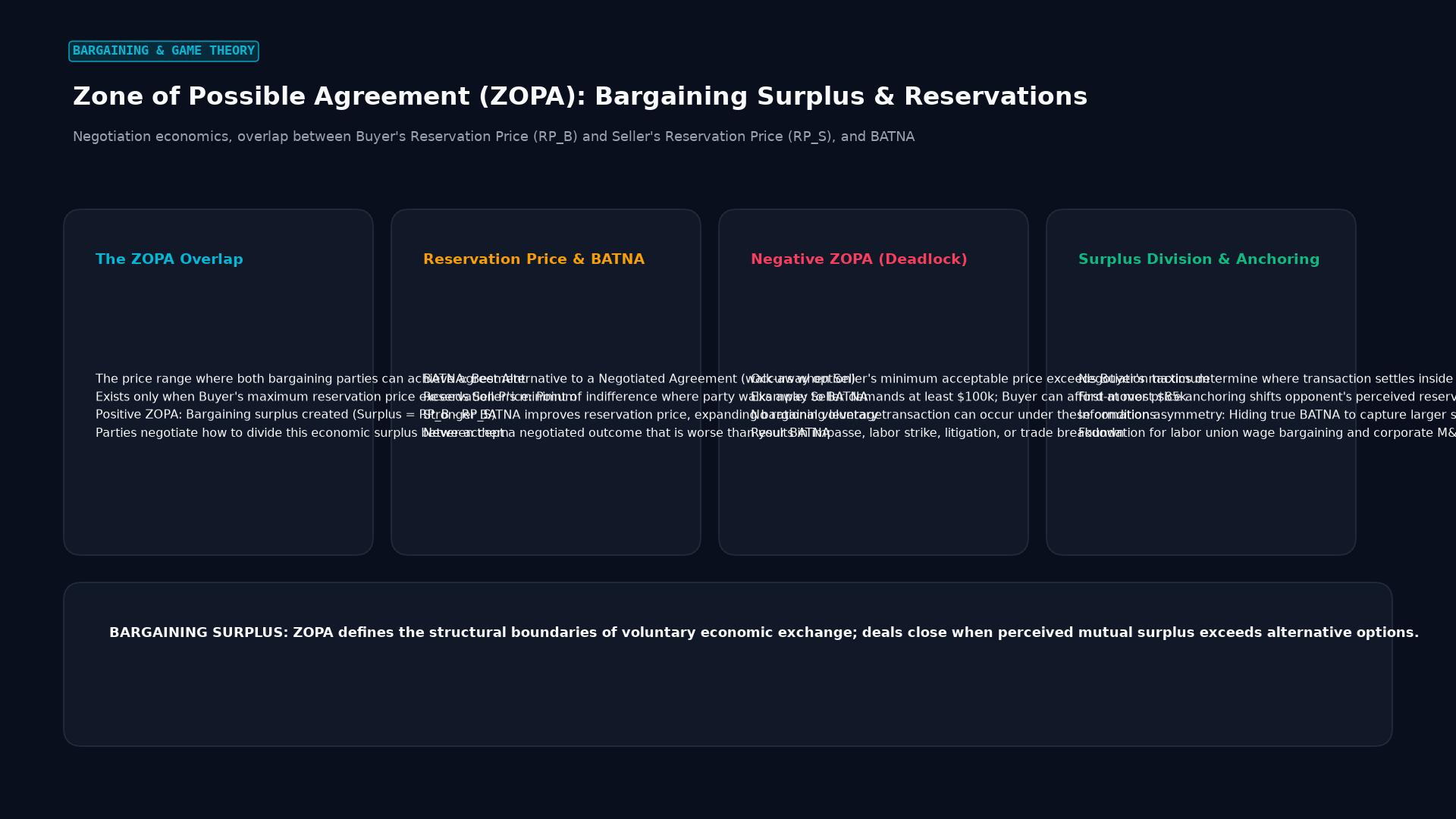 Figure: Negotiation economics, overlap between Buyer’s Reservation Price (RP_B) and Seller’s Reservation Price (RP_S), and BATNA
Core Pillars of Bargaining Theory
ZOPA calculations depend on three interrelated analytical concepts that determine each counterparty’s boundary conditions:
+--------------------------------------------------------------------------+
|                  The Three Anchors of Negotiation Theory                 |
+--------------------------------------------------------------------------+
|  Concept          | Operational Definition in Finance                    |
+-------------------+------------------------------------------------------+
|  BATNA            | Best Alternative to a Negotiated Agreement: the      |
|                   | fallback course of action if current talks collapse  |
|  Reservation Price| The walk-away price: the absolute maximum a buyer    |
|  (RP)             | will pay, or the absolute minimum a seller will take |
|  Target Point     | The optimal aspirational financial outcome a party   |
|                   | aims to achieve through strategic negotiation        |
+-------------------+------------------------------------------------------+
1. BATNA (Best Alternative to a Negotiated Agreement)
BATNA represents the operational baseline that shields a negotiator from accepting unfavorable terms. In an M&A context, a corporate target’s BATNA might be continuing standalone operations, filing an initial public offering (IPO), or pursuing an alternative acquisition bid from a competing private equity sponsor. A strong BATNA elevates a party’s bargaining power, establishing a more aggressive reservation price.
2. Reservation Price ($RP$)
The reservation price translates a party’s BATNA into a quantifiable monetary threshold:
- For a buyer ($RP_{\text{buyer}}$), it represents the maximum enterprise valuation beyond which executing the transaction destroys shareholder value relative to their alternative options.
- For a seller ($RP_{\text{seller}}$), it represents the minimum acceptable net cash proceeds below which walking away and executing their BATNA is superior.
Mathematical Formulation: Positive vs. Negative ZOPA
The structural viability of any financial transaction hinges on the mathematical spread between the parties’ reservation prices:
+--------------------------------------------------------------------------+
|                  ZOPA Boundary Formulations                             |
+--------------------------------------------------------------------------+
|                                                                          |
|  [ Positive ZOPA Condition: Transaction Is Economically Viable ]         |
|  RP_buyer >= RP_seller                                                   |
|  Bargaining Surplus (Deal Surplus) = RP_buyer - RP_seller                |
|                                                                          |
|  [ Negative ZOPA Condition: Structural Impasse ]                         |
|  RP_buyer < RP_seller                                                    |
|  Valuation Gap = RP_seller - RP_buyer                                    |
|                                                                          |
+--------------------------------------------------------------------------+
Positive ZOPA Dynamics
When a corporate buyer is willing to spend up to $100 million for a strategic competitor, and the founder-owners are willing to sell for any cash price at or above $85 million, a positive ZOPA of $15 million exists between $85 million and $100 million.
The $15 million difference represents the bargaining surplus. The final agreed-upon price within this $15 million corridor depends on information asymmetry, negotiation skill, and the perceived urgency of closing. If the price settles at $92 million, the buyer captures $8 million of surplus value ($100\text{M} - 92\text{M}$), while the seller extracts $7 million of surplus value ($92\text{M} - 85\text{M}$).
Negative ZOPA: Structural Impasse
When a prospective acquirer’s maximum budget is capped at $70 million based on discounted cash flow (DCF) synergy projections, but the target board refuses any offer below $80 million due to a lucrative pending licensing contract, a negative ZOPA of $10 million occurs. Under pure cash terms, no rational transaction can occur. Pursuing traditional bargaining within a negative ZOPA produces stalemate.
       Negative ZOPA Breakdown: The Valuation Deadlock
  Valuation ($)
     ^
 $85M|                                Seller Reservation Price ($80M)
     |                                      |
 $80M|                                      v
     |                     +---------------------------------+
     |                     |    NEGATIVE ZOPA / DEADLOCK     |  <--- Valuation Deficit: $10M
     |                     |      (No Cash Overlap Exists)   |
     |                     +---------------------------------+
 $75M|                                      ^
     |                                      |
 $70M|                                Buyer Reservation Price ($70M)
     +-------------------------------------------------------------------->
Bridging Negative ZOPA in Corporate Finance
Investment bankers and structured finance professionals do not abandon transactions when confronted with a negative ZOPA. Instead, they re-engineer the deal architecture, introducing non-linear payout structures that bridge the valuation gap:
[ Negative ZOPA Identified: Buyer Cap = $70M vs. Seller Floor = $80M ]
                                │
                                ▼
         [ Deploy Structural Financial Engineering Levers ]
                                │
    ┌───────────────────────────┼───────────────────────────┐
    ▼                           ▼                           ▼
[ Earn-Out Structures ]   [ Seller Financing Notes ]  [ Contingent Value Rights ]
$65M Upfront Cash +       $70M Cash at Closing +      Traded instrument paying
$20M Milestone Payout     $12M Subordinated Note      cash if FDA approves drug
if EBITDA targets hit     at 9% PIK Interest          or patent is granted
                                │
                                ▼
         [ Valuation Gap Closed: Transaction Consummated ]
1. Earn-Out Provisions
In high-growth technology, biotechnology, and founder-led acquisitions, founders project explosive future revenue while private equity buyers model conservative base-case cash flows. An earn-out bridges the divide:
- The buyer pays $65 million in cash at closing (staying safely below their $70 million cash limit).
- The seller receives contractual rights to additional payouts totaling up to $25 million contingent upon the target company achieving specific forward EBITDA hurdles over the subsequent three years.
- If the company excels, the seller receives a total valuation of $90 million, far exceeding their original $80 million reservation price. If performance falters, the buyer protected capital.
2. Contingent Value Rights (CVRs)
Frequently utilized in public pharmaceutical takeovers, CVRs are transferable instruments issued to target shareholders that pay discrete cash sums upon the attainment of specified regulatory milestones (such as FDA drug approval or commercial launch in the European Union). By segregating binary regulatory risk from upfront enterprise value, CVRs engineer a synthetic positive ZOPA.
3. Seller Financing and Vendor Take-Back Notes
When institutional debt capital markets freeze and private equity sponsors cannot secure cheap leveraged buyout (LBO) debt, the seller can provide subordinated vendor financing. The buyer acquires the company using available senior bank lines, while the seller accepts a 5-year subordinated note paying payment-in-kind (PIK) interest. The seller achieves their target nominal headline price, while the buyer preserves cash reserves and debt-service ratios.
Applications Across Financial Sectors
ZOPA dynamics dictate outcomes across several high-stakes financial domains:
| Sector / Transaction Type | Buyer / Debtor Objective | Seller / Creditor Objective | Mechanism to Expand ZOPA |
|---|---|---|---|
| Sovereign Debt Restructuring | Maximize debt haircuts and extend debt maturities | Maximize present value recovery; avoid nominal losses | State-contingent debt instruments (GDP-linked warrants) |
| Commercial Real Estate (CRE) | Lower capitalization rates; cap equity down-payment | Maximize price per square foot; immediate liquidity | Master leaseback agreements and tenant improvement credits |
| Syndicated Lending Workouts | Avoid immediate Chapter 11 bankruptcy filing | Preserve principal recovery; increase interest spreads | Equity warrants and board observation rights for lenders |
| Venture Capital Financing | Prevent excessive dilution; moderate pre-money valuation | Maximize growth runway; secure elite lead investor | Non-participating liquidation preferences and board seats |
Cognitive Biases and Negotiation Pitfalls
Even when a healthy positive ZOPA exists, human psychological biases can destroy value:
[ Objective Positive ZOPA Exists: Mutual Wealth Creation Possible ]
                                │
                                ▼
         [ Cognitive Distortions Corrupt Decision-Making ]
                                │
    ┌───────────────────────────┼───────────────────────────┐
    ▼                           ▼                           ▼
[ The Anchoring Trap ]    [ The Winner's Curse ]     [ Overconfidence Bias ]
Opening offer creates     Counterparty accepts       Target board overestimates
rigid psychological       too quickly, sparking      BATNA, rejecting fair bid
anchor, stalling talks    paranoia of hidden flaws   only to liquidate in distress
1. The Anchoring Trap
The first numerical offer presented in a negotiation exerts a disproportionate psychological pull on subsequent discussions. If a seller opens with an absurdly inflated valuation, the buyer may become offended and terminate discussions entirely, ignoring the fact that their true reservation prices could have accommodated a lucrative transaction.
2. The Winner’s Curse
In competitive auctions and corporate bidding wars, the winning acquirer frequently overpays because their bid reflects the most optimistic valuation among all competitors. When an aggressive opening offer is accepted instantly without pushback, the acquirer often suffers immediate buyer’s remorse, wondering what critical balance sheet defect the seller knew that the buyer missed during due diligence.
3. Information Asymmetry and False Impasse
In many private transactions, both parties maintain strict secrecy regarding their reservation prices. When negotiators mistake positional posturing for genuine bottom lines, they often walk away from transactions where a massive positive ZOPA actually existed. Skilled corporate intermediaries expand information sharing through non-binding Indications of Interest (IOIs) and confidential mediation.
Frequently Asked Questions
What happens if there is no ZOPA in a corporate buyout?
If a transaction features a negative ZOPA under conventional cash terms, the parties will reach a deadlock and terminate discussions unless they alter the deal structure. To manufacture a viable bargaining range, investment bankers introduce structured components such as earn-outs, contingent value rights, seller notes, equity rollovers, or performance warrants.
How does a party calculate its reservation price?
A reservation price is calculated by quantifying the economic value of the party’s BATNA (Best Alternative to a Negotiated Agreement), adjusting for execution risks, transaction fees, tax liabilities, and opportunity costs. If a software company has a binding alternative offer to merge with a rival for $50 million in stock, its reservation price for an all-cash acquisition by a tech conglomerate will be calibrated directly against the net present value of that stock merger.
Can an aggressive opening offer shrink the perceived ZOPA?
Yes. Presenting an extreme, unreasonable opening bid can anchor negotiations so counterproductively that the opposing party questions the good faith of the talks and walks away immediately. Professional negotiators recommend anchoring aggressively enough to influence expectations, but within a range defensible by market comparables and rigorous discounted cash flow modeling.
Ready to trade forex?
Open a free demo account with a regulated broker. Practice with virtual funds before risking real money.