ZWD
The historical ISO 4217 currency code for the first-generation Zimbabwean Dollar (1980–2006), which initiated one of the most catastrophic hyperinflations in modern monetary history before undergoing multiple revaluations and total demonetization.
ZWD (Zimbabwean Dollar, Historical)
ZWD was the original ISO 4217 currency code for the first-generation Zimbabwean Dollar, the sovereign legal tender of Zimbabwe from April 18, 1980, until August 2006. Introduced upon national independence to replace the Rhodesian Dollar (RHD) at par (1:1), the ZWD initially debuted as an exceptionally strong currency, commanding an exchange rate of approximately 1.47 US dollars per 1 ZWD.
Over the subsequent two decades, however, the ZWD became the catalyst for one of the most devastating and rapid hyperinflations in modern monetary history. Driven by the collapse of domestic agricultural output, unfunded military interventions, and unconstrained deficit monetization by the Reserve Bank of Zimbabwe (RBZ), the currency suffered total purchasing-power annihilation. This triggered a multi-year revaluation cascade that stripped twenty-five zeros across successive currency iterations before the Zimbabwean government abandoned sovereign currency altogether in 2009.
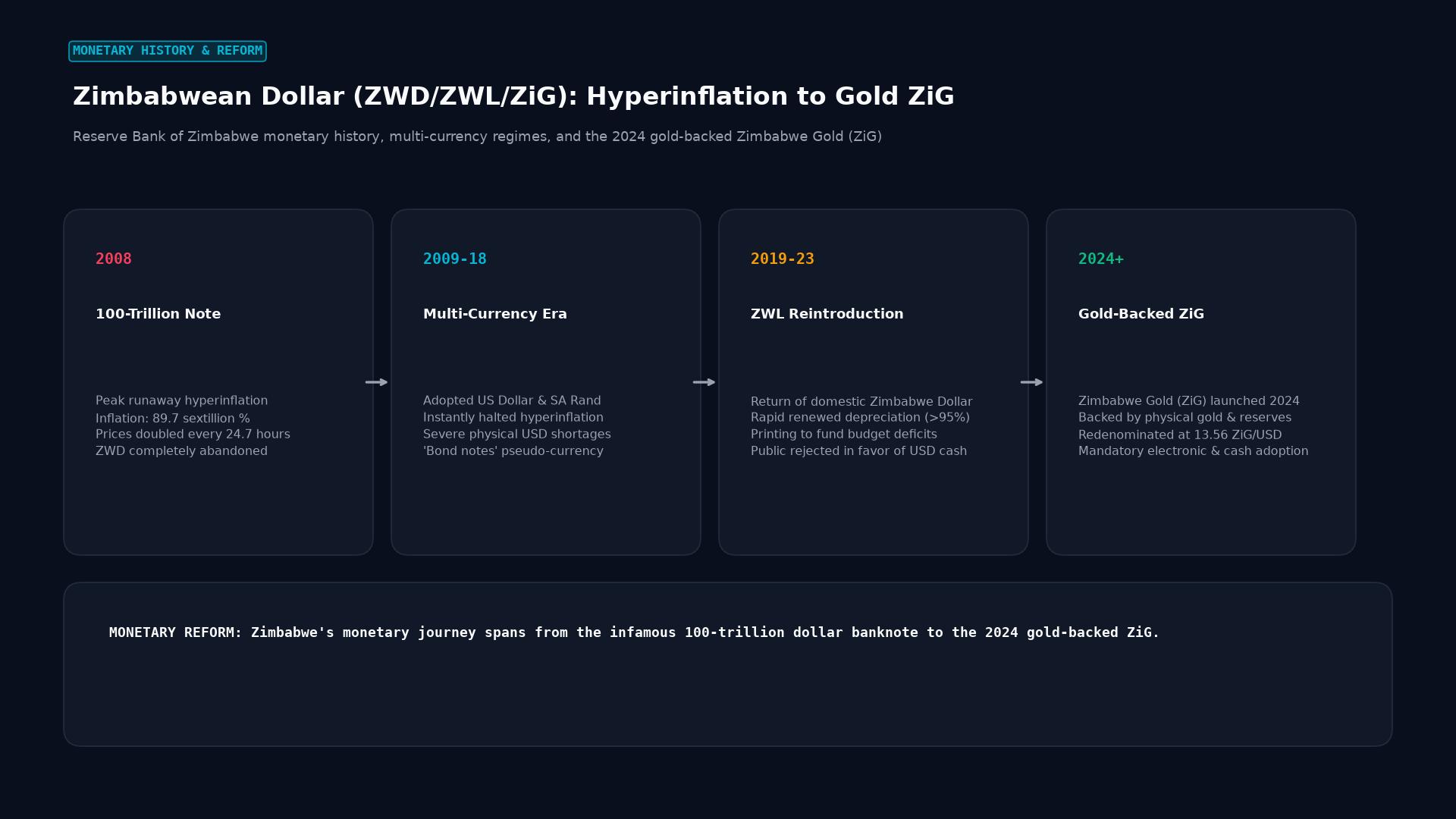 Figure: Reserve Bank of Zimbabwe monetary history, multi-currency regimes, and the 2024 gold-backed Zimbabwe Gold (ZiG)
The Genesis of Economic Collapse
Upon independence in 1980, Zimbabwe was celebrated as the “breadbasket of Africa.” Endowed with advanced commercial agriculture, robust tobacco export revenues, sophisticated manufacturing infrastructure, and rich mineral deposits (including gold, platinum, and chrome), the Zimbabwean dollar held high international standing.
However, several fiscal and structural shocks fractured the macroeconomic foundation of the country:
+--------------------------------------------------------------------------+
|                  Chronology of Macroeconomic Shocks                      |
+--------------------------------------------------------------------------+
|  Date / Milestone       | Event Description & Macroeconomic Fallout      |
+-------------------------+------------------------------------------------+
|  November 14, 1997      | "Black Friday": Unbudgeted pension payments to |
|                         | war veterans trigger a single-day 72% crash    |
|  1998 to 2002           | Second Congo War: Zimbabwe deploys 11,000      |
|                         | troops; war financed via central bank credit   |
|  2000 Onwards           | Fast-Track Land Reform: Seizure of commercial  |
|                         | farms collapses agricultural exports by 60%+   |
|  2003 to 2008           | Quasi-Fiscal Operations: RBZ under Gideon Gono |
|                         | prints money to purchase fuel, food, and forex |
+--------------------------------------------------------------------------+
1. “Black Friday” and Congolese Military Intervention
On November 14, 1997, known in Zimbabwean financial history as “Black Friday,” the ZWD collapsed by 72% against the US dollar in a single trading session. The crash followed President Robert Mugabe’s announcement of unbudgeted lump-sum gratuities of 50,000 Zimbabwean dollars each to approximately 50,000 liberation war veterans.
Months later, Zimbabwe entered the Second Congo War in the Democratic Republic of Congo (DRC). Financing an overseas military expedition consumed hundreds of millions of dollars that the treasury did not possess, forcing the Reserve Bank of Zimbabwe to monetize military expenditures through unbacked balance sheet expansion.
2. The Fast-Track Land Reform Shock
Beginning in 2000, the Zimbabwean government initiated compulsory, uncompensated seizures of thousands of large-scale commercial, largely white-owned farms under the Fast-Track Land Reform Program. Commercial agriculture formed the backbone of Zimbabwe’s foreign exchange earnings, dominated by flue-cured Virginia tobacco, maize, and wheat:
- Agricultural production collapsed by more than 60% over three seasons.
- Food processing factories shut down due to agricultural supply shortages.
- Commercial banks holding mortgages secured by farm titles faced systemic bad-loan defaults.
- Foreign capital fled, and Western institutions (including the IMF and World Bank) suspended credit lines.
The Monetary Engine of Hyperinflation
With tax revenues decimated and foreign credit lines severed, the government faced a catastrophic fiscal deficit. Rather than cutting spending or restructuring the economy, the Reserve Bank of Zimbabwe under Governor Gideon Gono engaged in aggressive quasi-fiscal operations:
[ Collapse of Real Commercial Output & Tax Revenue (Q_real Drops) ]
                                 │
                                 ▼
[ Government Faces Massive Deficits for Civil Service Payrolls ]
                                 │
                                 ▼
[ Central Bank (RBZ) Monetizes Deficits via Massive Banknote Printing ]
                                 │
                                 ▼
[ Domestic Money Supply (M) Surges Exponentially ]
                                 │
                                 ▼
[ Public Loses Faith: Money Velocity (V) Explodes: P = (M * V) / Q ]
                                 │
                                 ▼
[ Hyperinflation: Prices Double Daily; Local Currency Becomes Worthless ]
The economic dynamics of the collapse follow the classical Quantity Theory of Money:
$$M \cdot V = P \cdot Y$$
Where:
- $M$ represents the nominal money supply.
- $V$ is the velocity of money (how frequently a single dollar unit changes hands).
- $P$ is the general price level.
- $Y$ is real economic output (GDP).
In Zimbabwe, real output ($Y$) contracted sharply, while money supply ($M$) grew at astronomical rates. More destructively, once the public realized that holding paper currency guaranteed purchasing power destruction, velocity ($V$) exploded. Consumers rushed to spend newly received wages within hours, exchanging paper banknotes for canned food, fuel, or black-market US dollars. This velocity panic drove price inflation ($P$) far faster than even the rate of physical money printing.
The Revaluation Cascade: 25 Zeros Slashed
Between 2006 and 2009, the Zimbabwean monetary authorities executed three successive currency revaluations, slashing zeros from banknotes in a desperate attempt to keep accounting computers, retail cash registers, and ATMs functional:
+--------------------------------------------------------------------------+
|                  The Complete Zimbabwean Revaluation Timeline            |
+--------------------------------------------------------------------------+
|  Currency Code | Active Dates      | Revaluation Formula                 |
+----------------+-------------------+-------------------------------------+
|  ZWD (1st)     | 1980 to Aug 2006  | Baseline Currency                   |
|  ZWN (2nd)     | Aug 2006 to Aug 08| Slashed 3 Zeros (1,000 ZWD = 1 ZWN) |
|  ZWR (3rd)     | Aug 2008 to Feb 09| Slashed 10 Zeros (10B ZWN = 1 ZWR)  |
|  ZWL (4th)     | Feb 2009 to Apr 09| Slashed 12 Zeros (1T ZWR = 1 ZWL)   |
|  Total Zeros   | Cumulative        | Exactly 25 Zeros Removed in 3 Years |
+--------------------------------------------------------------------------+
The 100 Trillion Dollar Peak
By mid-2008, the hyperinflation reached surreal proportions. In November 2008, according to calculations by economist Steve Hanke, Zimbabwe’s month-over-month inflation peaked at 79.6 billion percent, equivalent to an annualized rate of $89.7 \times 10^{21}%$. Prices were doubling approximately every 24.7 hours.
To keep pace with daily retail transactions, the RBZ issued increasingly astronomical banknotes. The culmination of this monetary printing was the 100,000,000,000,000 (100 Trillion) Zimbabwean Dollar banknote, issued in early 2009. At the time of its release, this single banknote could not even buy a loaf of bread or a public bus fare across Harare.
+--------------------------------------------------------------------------+
|             Anatomy of the 100 Trillion Dollar Note (ZWR)                |
+--------------------------------------------------------------------------+
|  Face Value             | $100,000,000,000,000                           |
|  Issuing Authority      | Reserve Bank of Zimbabwe (2008 Series)         |
|  Front Imagery          | Chiremba Balancing Rocks, Epworth              |
|  Street Value at Launch | Less than $0.40 US Dollars                     |
|  Modern Status          | Highly Prized Global Collector's Item          |
+--------------------------------------------------------------------------+
Demonetization and the Multi-Currency Era (2009 to Present)
On April 12, 2009, the Zimbabwean government surrendered to market reality, officially suspending the Zimbabwean dollar and demonetizing all domestic currency.
The national economy transitioned to a multi-currency regime:
- The United States Dollar (USD) became the primary unit of account, pricing, and bank deposits.
- The South African Rand (ZAR), Botswana Pula (BWP), and British Pound (GBP) circulated freely in commercial trade.
[ Complete Hyperinflationary Annihilation: April 2009 ]
                           │
                           ▼
[ Official Demonetization: Domestic Currency Completely Abandoned ]
                           │
                           ▼
[ Dollarization (2009-2015): Inflation Collapses to Zero Instantly ]
                           │
                           ▼
[ Cash Shortages Emerge: RBZ Introduces "Bond Notes" (2016) ]
                           │
                           ▼
[ Synthetic Currency Slides: Launch of RTGS Dollar (2019) ]
                           │
                           ▼
[ April 2024: Launch of Zimbabwe Gold (ZiG) Backed by Physical Gold ]
Dollarization immediately cured hyperinflation. Supermarket shelves filled with imported goods, commercial planning resumed, and annual inflation plunged from billions of percent to near zero.
However, subsequent monetary experiments highlighted the difficulty of restoring monetary credibility. Facing severe US dollar liquidity shortages, the RBZ introduced surrogate instruments: “Bond Notes” in 2016, the RTGS Dollar (Real Time Gross Settlement) in 2019, and the re-introduced Zimbabwean dollar (ZWL), all of which experienced rapid secondary-market depreciation. In April 2024, the government launched Zimbabwe Gold (ZiG), a structured currency backed by physical gold reserves and foreign exchange, representing the nation’s sixth attempt at sovereign monetary stabilization.
Macroeconomic Lessons for Capital Markets
The trajectory of the ZWD provides essential principles for currency analysts and macro investors:
- Monetary Financing Incompatibility: Central bank monetization of sovereign fiscal deficits is the single most destructive policy failure in macroeconomics. Once an economy uses the printing press to replace taxation and bond market borrowing, hyperinflation becomes mathematically inevitable.
- The Limits of Price Controls: When the Zimbabwean government enacted strict retail price controls in 2007, deploying police to arrest business owners for raising prices, goods disappeared from grocery stores within days, moving entirely into informal black markets. Administrative laws cannot override supply and demand.
- The Destruction of Institutional Wealth: Hyperinflation wiped out domestic pension funds, life insurance endowments, and bank savings accounts across Zimbabwe. An entire generation of citizens who worked forty years found their retirement accounts transformed into pennies, underscoring the vital importance of hard-asset diversification and foreign exchange hedging.
Frequently Asked Questions
What was the difference between ZWD, ZWN, ZWR, and ZWL?
They represent the four successive generations of the Zimbabwean dollar. ZWD was the original currency (1980–2006). ZWN was the second dollar (2006–2008), which dropped three zeros. ZWR was the third dollar (2008–2009), which dropped ten zeros and produced the 100 trillion note. ZWL was the fourth dollar (2009), which dropped twelve zeros before being demonetized.
How high did Zimbabwe’s inflation reach at its peak?
Zimbabwe’s hyperinflation peaked in mid-November 2008 at an estimated monthly rate of 79,600,000,000% (79.6 billion percent), which corresponds to an annualized rate of approximately 89.7 sextillion percent ($89.7 \times 10^{21}%$). Prices doubled approximately every 24.7 hours.
Can historical ZWD banknotes be redeemed at banks today?
No. The Reserve Bank of Zimbabwe officially demonetized all historical Zimbabwean dollar banknotes in 2015, establishing a final redemption window that paid $1 US dollar for every 35 quadrillion old Zimbabwean dollars. Today, notes like the 100 trillion dollar bill trade exclusively as collector’s items in numismatic markets, frequently selling on eBay for $50 to $150 USD.
Ready to trade forex?
Open a free demo account with a regulated broker. Practice with virtual funds before risking real money.