Who Moves the Forex Market? The Key Players Explained
The forex market is a hierarchy of participants — from central banks and hedge funds at the top to retail traders at the base. Learn who the major players are and how their activity shapes prices.
The forex market has no central exchange, no single governing authority, and no place where all trades are consolidated into one transparent order book. What it has instead is a layered hierarchy of participants, each operating at different levels of access, cost, and information. Understanding who these players are — and what drives their activity — explains a lot about why currency prices move the way they do.
Tier 1: The Interbank Market
At the top of the forex hierarchy sits the interbank market — a network of the world’s largest banks trading massive currency amounts directly with each other. Institutions like JPMorgan Chase, Deutsche Bank, Citigroup, UBS, and HSBC form the core of this market, executing billions of dollars in transactions daily.
These banks set exchange rates through their continuous quoting and trading. When you see EUR/USD at 1.0850 on your broker’s platform, that price is derived from what these banks are trading among themselves. The interbank market offers the tightest possible spreads — sometimes fractions of a pip — and executes trades of $10 million or more without moving the market.
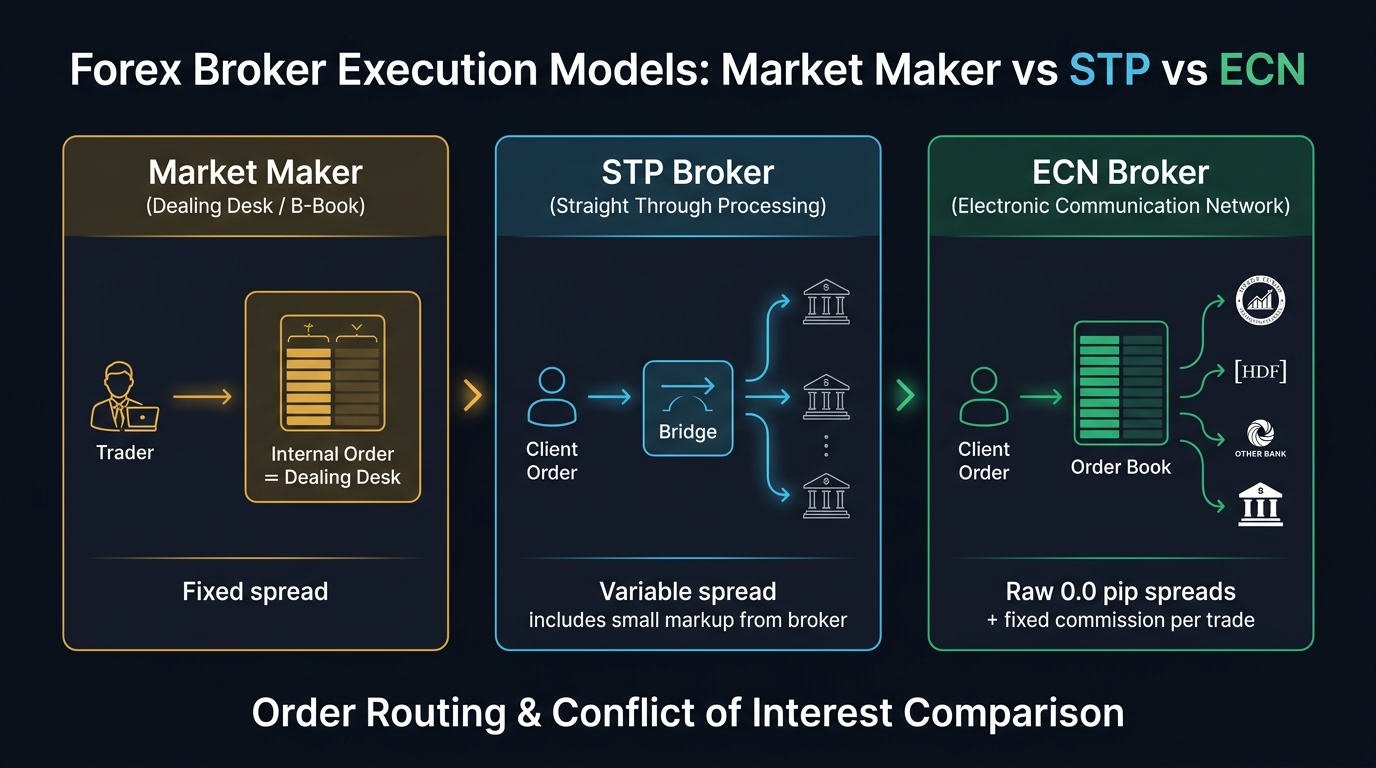
Access to the interbank market is not available to retail traders. Your broker acts as an intermediary, either passing your order to a liquidity provider connected to the interbank network (STP/ECN brokers) or taking the other side of your trade themselves (market maker brokers).
Tier 2: Central Banks
Central banks are unique participants because their goal isn’t profit — it’s policy. The Federal Reserve, European Central Bank, Bank of England, Bank of Japan, and others use the forex market as a tool to manage their economies.
They influence exchange rates through:
Interest rate decisions — the most powerful tool. When the Fed raises rates, it makes dollar-denominated assets more attractive globally, drawing capital inflows and strengthening the dollar without directly buying a single dollar.
Open market operations — central banks buy and sell currencies directly to manage their exchange rate. The Swiss National Bank famously intervened repeatedly in the 2010s to prevent the franc from appreciating too sharply against the euro, at times becoming one of the world’s largest buyers of foreign currency.
Forward guidance — official statements about future policy intentions can move currencies as much as actual decisions. When ECB officials signal future rate cuts, the euro frequently weakens before a single rate change occurs.
Central banks are the only participants that cannot be easily overwhelmed by market forces in the short term — they create the money they use to intervene. In the long run, however, markets generally win: even the most determined central bank intervention can’t prevent a fundamental trend from eventually reasserting itself.
Tier 3: Commercial Banks, Hedge Funds, and Institutions
Below the top-tier interbank players sit a large and diverse group of institutional participants:
Commercial banks handle currency exchange for their corporate and retail clients. A company that sells products in Europe and needs to convert euros to dollars at the end of the quarter creates consistent, predictable demand flows that commercial banks aggregate and execute.
Hedge funds are among the most active speculative participants in forex. Unlike corporations that trade to manage real business exposure, hedge funds trade purely for profit. George Soros’s famous short of the British pound in 1992 — making $1 billion in a single day when the pound was forced out of the European Exchange Rate Mechanism — is the most cited example of institutional speculative power in forex history.
Sovereign wealth funds (Norway’s Government Pension Fund, Abu Dhabi Investment Authority, etc.) manage massive foreign currency reserves and move them according to long-term strategic allocation decisions. Their moves are slow but large.
Pension funds and insurance companies manage currency exposure as part of international investment portfolios. When a US pension fund allocates to European equities, it needs euros — creating demand for EUR.
Tier 4: Retail Brokers
Retail forex brokers serve as the gateway between individual traders and the interbank market. They aggregate their clients’ orders, manage risk internally, and either pass orders to liquidity providers or act as market makers.
The business model differs significantly between broker types:
Market makers take the other side of client trades. They profit primarily from the spread and benefit when clients lose. Potential conflict of interest is real, though regulated market makers are legally required to maintain fair execution.
ECN/STP brokers pass client orders through to the interbank market or liquidity providers, earning a commission rather than the spread. There’s no conflict of interest: their revenue doesn’t depend on client losses.
Choosing between these models is one of the first practical decisions a retail trader makes. For most retail traders, either works adequately — what matters more is regulation, execution quality, and cost structure.
Tier 5: Retail Traders
Individual retail traders — people trading their own capital through broker accounts — are at the base of the hierarchy. They collectively represent a meaningful but not dominant share of daily volume, estimated at 5–6% of total forex turnover.
Retail traders typically have:
- The widest spreads (compared to interbank participants)
- The highest transaction costs relative to position size
- The least access to market intelligence and order flow information
This doesn’t mean retail trading is a futile exercise. It means context matters: retail traders need an edge that’s robust enough to overcome structural cost disadvantages. The edges that work are typically behavioral (disciplined risk management, patience) or informational in the sense of superior analysis of public data.
How These Players Interact
Currency prices emerge from the interactions of all these participants simultaneously. Retail trader activity is too small to move major pairs meaningfully. Even large institutional moves only shift prices temporarily unless fundamentals support the direction.
What does matter for retail traders:
- Institutional order flows create support and resistance at key levels. When banks accumulate large positions, they leave imprints in the market structure that technical analysis can identify.
- Central bank behavior sets the macro backdrop that determines whether trend-following strategies will work or whether markets will range.
- News events create volatility windows where retail traders either capitalize on momentum or get caught in false moves.
Understanding the hierarchy helps you trade with realistic expectations: you’re not going to outmaneuver a Goldman Sachs trading desk, but you also don’t need to. A retail trader looking for 30–50 pip moves on high-quality setups is playing a different game from the one institutions play.
Next: What Affects the Value of a Currency?
Previous: Forex Market Hours
Related dictionary terms: Interbank Market | Central Bank | Market Maker | ECN Broker

Ready to Practice This Strategy?
Test what you learned on a free, risk-free demo account before risking real money.