Risk Management Basics: The Rules That Determine Long-Term Survival
Risk management is the difference between traders who last years and those who blow accounts in months. Learn stop-loss orders, limit orders, position sizing, and the fundamentals of protecting capital.
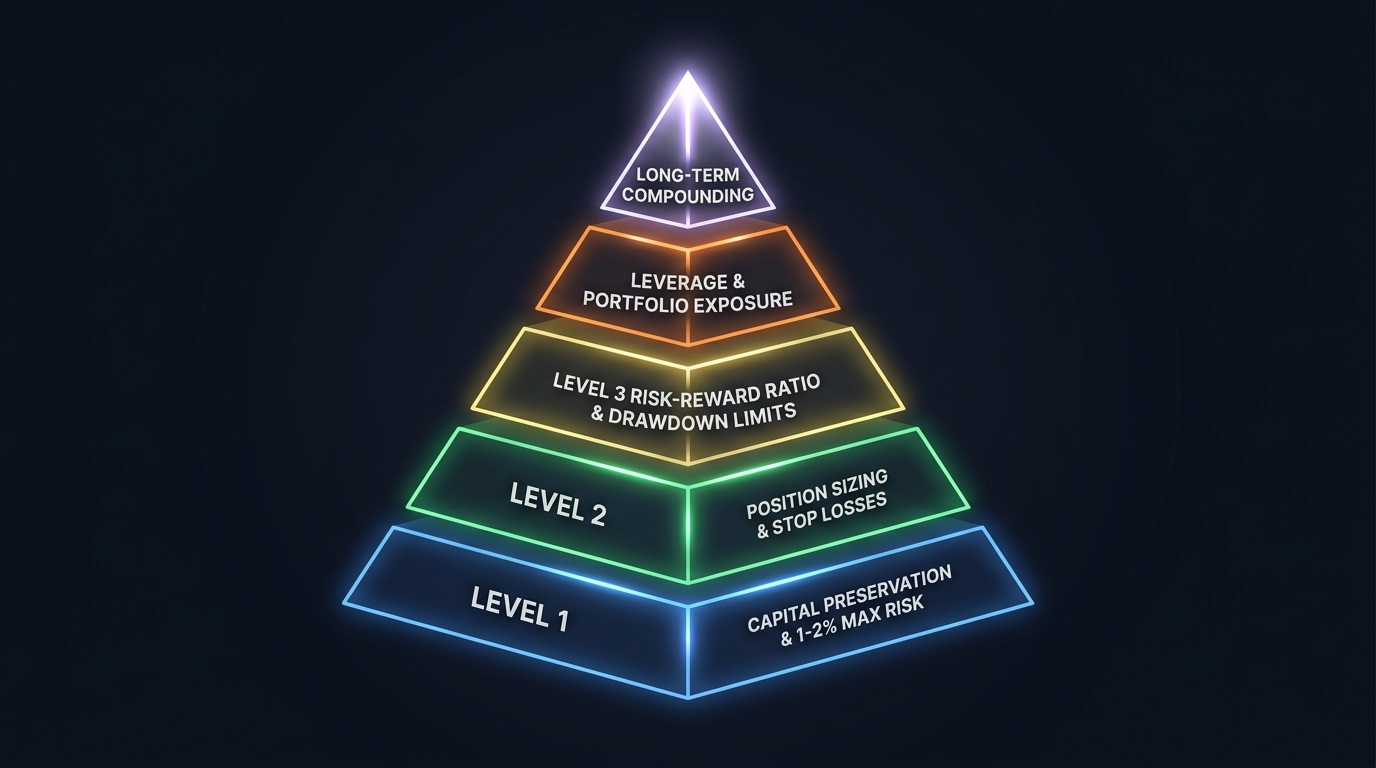
The first thing a professional trader learns isn’t which indicator to use or when to buy. It’s how to lose money slowly when wrong. Every trader who has lasted more than a few years in forex will tell you the same thing: protecting capital is more important than growing it. Without capital, you can’t trade. Without staying in the game, no strategy matters.
Risk management isn’t a sophisticated add-on to trading — it’s the foundation that makes everything else possible.
The Core Problem: Leverage Magnifies Both Directions
The leverage that makes forex accessible to retail traders with small accounts is also the mechanism most responsible for blowing those accounts. A 1% move in a currency pair is completely normal intraday. With 100:1 leverage, that 1% move wipes out 100% of your margin.
This is why mechanical risk controls aren’t optional. They’re the equivalent of a seatbelt: inconvenient, automatic, and irreplaceable when things go wrong.
Stop-Loss Orders: Your First Line of Defense
A stop-loss order instructs your broker to automatically close your position when price reaches a specified level — limiting the maximum you can lose on any single trade.
Stop-loss orders work for two reasons. First, they remove the emotional temptation to “hold and hope” when a trade moves against you. The decision about how much you’re willing to lose is made before you enter, when you’re thinking clearly. Second, they prevent the small losses that are part of normal trading from turning into large losses that damage your account.
How to set them effectively:
Place stops at structurally significant levels — not arbitrary pip distances. If you’re buying EUR/USD because it bounced from a key support zone at 1.0820, your stop goes below 1.0820. Why? Because if price breaks that level, your reason for being long is invalidated. You’re not just losing pips; your analysis was wrong.
Never move a stop further against you — this is where discipline matters most. When price approaches your stop, the urge to move it “just a little further” to avoid being stopped out is powerful. Resist it. Moving stops against position is how small, manageable losses become catastrophic ones.
Use the ATR indicator to calibrate — the Average True Range measures how much a pair typically moves in a given period. A stop placed within a single ATR’s distance is likely to be hit by normal market noise rather than by a genuine reversal.
Limit Orders: Locking In Profits Systematically
A limit order closes a profitable position when price reaches a target level — your planned take-profit. Like stop-losses, limit orders remove emotion from exit decisions.
Without a predetermined take-profit target, traders face the psychological trap of closing winning trades too early (fear of giving back gains) or holding too long (greed to squeeze more out of a move). Both behaviors, applied systematically, erode profitability even when the underlying analysis is sound.
Setting take-profit levels:
- At the next significant support or resistance level (the most common approach)
- At a 1:2 or 1:3 risk-reward ratio from entry (e.g., if your stop is 30 pips, target 60 or 90 pips)
- Using a trailing stop that moves with price, locking in profits as the trade develops
Position Sizing: The Math Behind Risk Control
Stop-loss placement and lot size are inseparable. A stop-loss 100 pips away means nothing without knowing how much each pip is worth — and that depends on your position size.
The calculation:
Lot size = Account risk / (Stop distance in pips × Pip value)
Example: $10,000 account, 1% risk = $100 risk per trade, stop-loss 50 pips, pip value on EUR/USD standard lot = $10/pip
Lot size = $100 / (50 × $10) = 0.2 lots (a 20,000-unit position)
This ensures that if your stop is hit, you lose exactly $100 — 1% of your account — regardless of how many pips that stop was. The lot size adjusts to the stop distance, not the other way around.
Use the position size calculator to run these calculations instantly for any trade.
The Maximum Risk Per Trade Rule
Most professional forex traders risk no more than 1–2% of their account per trade. This might seem overly conservative, but the math compels it:
| Risk per trade | Account loss after 10 consecutive losses |
|---|---|
| 1% | 9.6% drawdown |
| 5% | 40.1% drawdown |
| 10% | 65.1% drawdown |
A 65% drawdown requires a 186% gain just to return to the starting balance. At that point, the psychological pressure to recoup losses often leads to even riskier behavior — the cycle that ends most trading careers.
Conservative risk per trade keeps you in the game through inevitable losing streaks. Once you have a consistently profitable strategy with 6+ months of documented results, you might consider raising position size. Until then, 1% is both discipline and protection.
Managing Multiple Open Positions
Risk compounds across multiple simultaneous positions. If you have three open trades each risking 2%, your total account exposure is 6%. If a correlated event (a major dollar news release, for example) moves all three against you simultaneously, you take a 6% hit in minutes.
Set a maximum total account exposure — typically 5–6% — and don’t open new positions that would breach it. If you’re already at your max, wait for existing positions to close before opening new ones.
Next: Margin and Leveraged Trading: How Leverage Works in Practice
Previous: What Affects Currency Values?
Related lessons: Risk Management Basics (Full Lesson) | What Is a Drawdown?
Tools: Position Size Calculator
Related dictionary terms: Stop-Loss Order | Limit Order | Drawdown | Risk-Reward Ratio

Ready to Practice This Strategy?
Test what you learned on a free, risk-free demo account before risking real money.