What Affects the Value of a Currency? 7 Key Drivers Explained
Currency values aren't random. Seven fundamental factors drive exchange rates — from interest rates and inflation to political stability and market sentiment. Learn what to watch and why.
Currency values move constantly, but they don’t move randomly. Behind every significant shift in EUR/USD or USD/JPY is a set of economic and political forces that market participants are continuously evaluating. Understanding these forces doesn’t require a PhD in economics — it requires knowing which factors matter most and how they interact.
The value of any currency is always relative: the euro doesn’t have an absolute value, it has a value measured against the dollar, the yen, the pound. What you’re assessing when you trade is which economy and monetary policy is more compelling at this particular moment in time.
1. Interest Rates: The Dominant Force
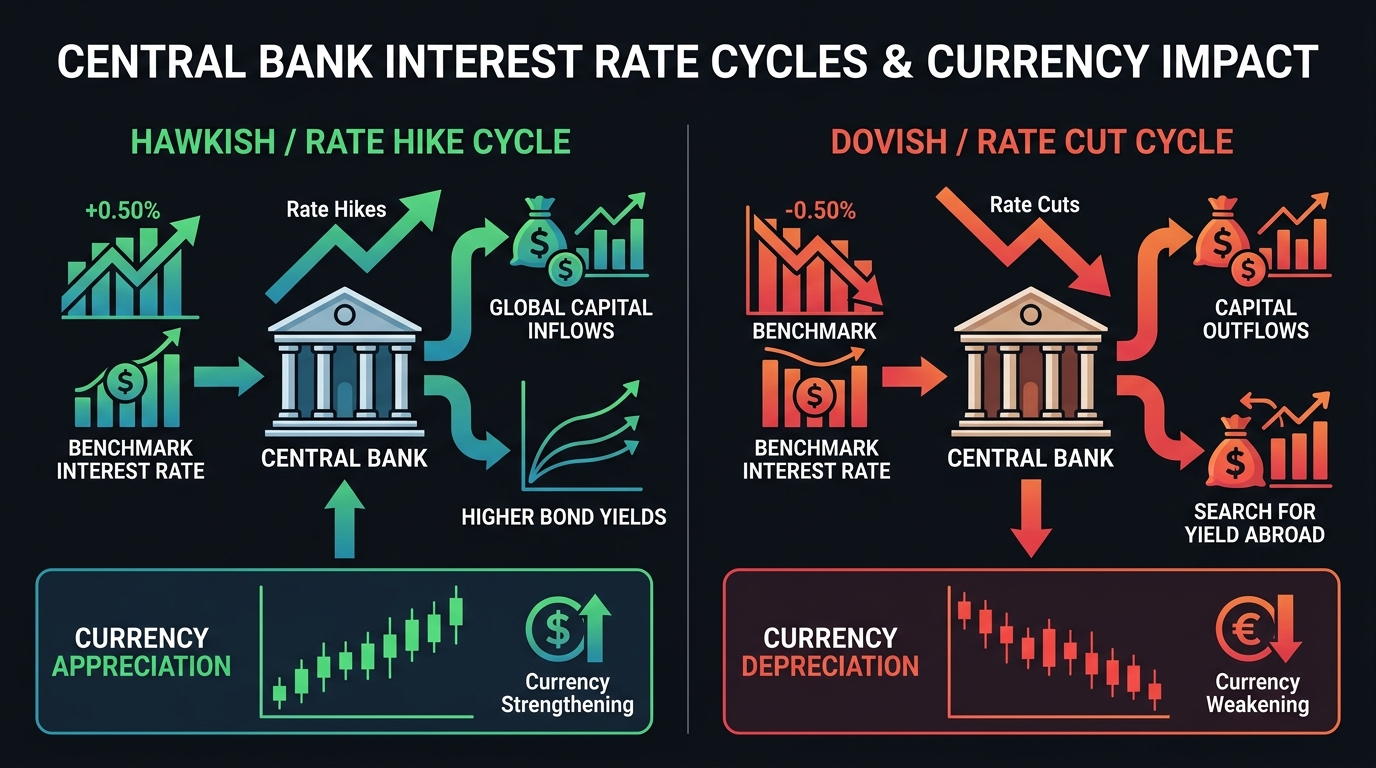
Interest rates are the single most powerful long-term driver of currency values. The relationship is direct: higher interest rates mean higher returns on that country’s bonds and savings instruments. Capital flows from lower-yielding to higher-yielding assets globally — and that capital flow requires buying the higher-yielding currency first.
When the Federal Reserve raises its benchmark rate from 0.25% to 5.25% (as it did between March 2022 and July 2023), dollar-denominated bonds become dramatically more attractive to international investors. To buy those bonds, they need dollars. The resulting demand pushes the dollar higher across almost all pairs.
The key concept here is rate differentials — not the absolute level of interest rates, but the gap between two countries’ rates. EUR/USD is influenced by the difference between ECB rates and Fed rates. When the gap narrows (ECB hikes while Fed pauses), the euro tends to strengthen against the dollar.
Central bank guidance matters as much as the rates themselves. A central bank signaling future hikes (“hawkish”) will often strengthen a currency before any actual rate change occurs.
2. Inflation
Inflation is the rate at which prices rise over time. Its relationship with currency value is complicated because it operates through two channels:
Direct channel: High inflation erodes a currency’s purchasing power. If prices in the US rise 8% annually while prices in Switzerland rise 2%, Americans need more dollars to buy the same goods. Structurally, the dollar’s purchasing power is falling relative to the franc.
Indirect channel (via interest rates): High inflation typically forces central banks to raise interest rates to cool demand. Higher rates then attract capital inflows, which can actually strengthen the currency despite the underlying inflationary erosion.
The net effect depends on context. If a central bank is credibly fighting inflation with rate hikes, the currency often strengthens. If inflation is out of control and the central bank is perceived as behind the curve, the currency can weaken sharply despite high nominal rates. Turkey’s lira is a modern case study in this dynamic.
Traders monitor the Consumer Price Index (CPI) and Producer Price Index (PPI) as the primary inflation gauges.
3. Economic Growth (GDP)
A growing economy generates more jobs, more business investment, and more tax revenue. This signals strength and attracts foreign investment — both in financial assets (stocks, bonds) and in direct business investment. Both require buying the local currency.
Strong GDP growth relative to trading partners tends to support a currency. Recession or stagnation signals capital outflows and currency weakness. Quarterly GDP releases are scheduled events that traders position around, though the market usually has significant GDP expectations priced in before the official release.
Leading indicators that traders watch before actual GDP:
- PMI surveys (Purchasing Managers’ Index) — monthly surveys of business activity, released before GDP
- Retail sales — measures consumer spending, the largest GDP component in developed economies
- Industrial production — tracks manufacturing output
4. Political Stability and Economic Governance
Stable political environments attract investment. Foreign investors allocating capital to a country need confidence that property rights will be respected, contracts enforced, and policy will be consistent. Political turmoil — elections with uncertain outcomes, corruption scandals, geopolitical conflict — triggers capital flight that weakens currencies.
The British pound’s sharp decline following the Brexit referendum in June 2016 is a clear example: the result was a political shock that immediately raised uncertainty about the UK’s economic relationships, and sterling fell 10% against the dollar within hours.
Emerging market currencies are particularly sensitive to political risk. The Nigerian naira, Egyptian pound, and Argentine peso have all suffered multi-year declines driven substantially by governance and institutional credibility concerns.
5. Current Account Balance
The current account measures the difference between what a country earns from exports and what it spends on imports, plus net income from foreign investments and transfers. A persistent current account surplus (exporting more than importing) generates consistent demand for the local currency as foreign buyers purchase it to pay for goods.
Japan and Germany are structurally current account surplus countries — foreign buyers of their goods consistently create yen and euro demand. The United States runs a persistent current account deficit, meaning more dollars flow out to pay for imports than flow in from exports.
In practice, current account dynamics play out over months and years rather than days. They form part of the fundamental backdrop that long-term traders and position traders incorporate into their views.
6. Public Debt and Fiscal Policy
High levels of government debt relative to GDP can undermine confidence in a currency, particularly in smaller or emerging market economies. When debt is very high, investors worry about debt sustainability — the ability to service interest payments and eventually repay principal. This risk is reflected in higher government bond yields (investors demanding more return for more risk), which can paradoxically attract some capital while also signaling fiscal stress.
Fiscal spending decisions matter too. Stimulus programs that expand money supply rapidly can be inflationary and weaken the currency. Austerity that contracts money supply can be deflationary and support it — though at the cost of economic growth.
7. Market Sentiment and Speculation
Currency markets are driven as much by expectations and psychology as by economic fundamentals. Speculative flows — traders and funds betting on future currency direction — can push exchange rates significantly away from “fundamental fair value” for extended periods.
Safe haven flows are a recurring sentiment-driven phenomenon: in times of global uncertainty or financial stress, capital rushes into perceived safe assets — the US dollar, Japanese yen, and Swiss franc — regardless of their countries’ specific economic conditions at the time.
Carry trade dynamics create the opposite pattern when sentiment is positive: traders borrow in low-yield currencies (JPY, CHF) and invest in high-yield ones (AUD, NZD), generating directional flows that can persist for years until risk sentiment reverses.
The Commitment of Traders (COT) report and retail positioning data provide windows into current speculative positioning, which is useful for identifying when sentiment may be at an extreme and vulnerable to reversal.
How These Factors Interact
These seven drivers don’t operate in isolation — they interact and sometimes pull in opposite directions. A country might have high inflation (negative) combined with rising interest rates (positive) and strong GDP growth (positive). The net currency impact depends on which factor the market is focused on at that moment, and that focus shifts over time.
This is why forex trading requires continuous reassessment rather than a static view. The edge comes not from predicting these forces perfectly, but from correctly identifying when the market’s current interpretation of them is likely to shift.
Next: How Forex Trading Works: Mechanics of Opening and Closing Positions
Previous: Key Forex Players
Related lessons: Interest Rates and Currency Value | Inflation Indicators
Related dictionary terms: Current Account | Inflation | Interest Rate | Safe Haven

Ready to Practice This Strategy?
Test what you learned on a free, risk-free demo account before risking real money.