Margin and Leveraged Trading: How Leverage Actually Works
Leverage lets you control large positions with small capital — but it amplifies losses as readily as gains. Learn how margin, leverage ratios, and margin calls work before trading live.
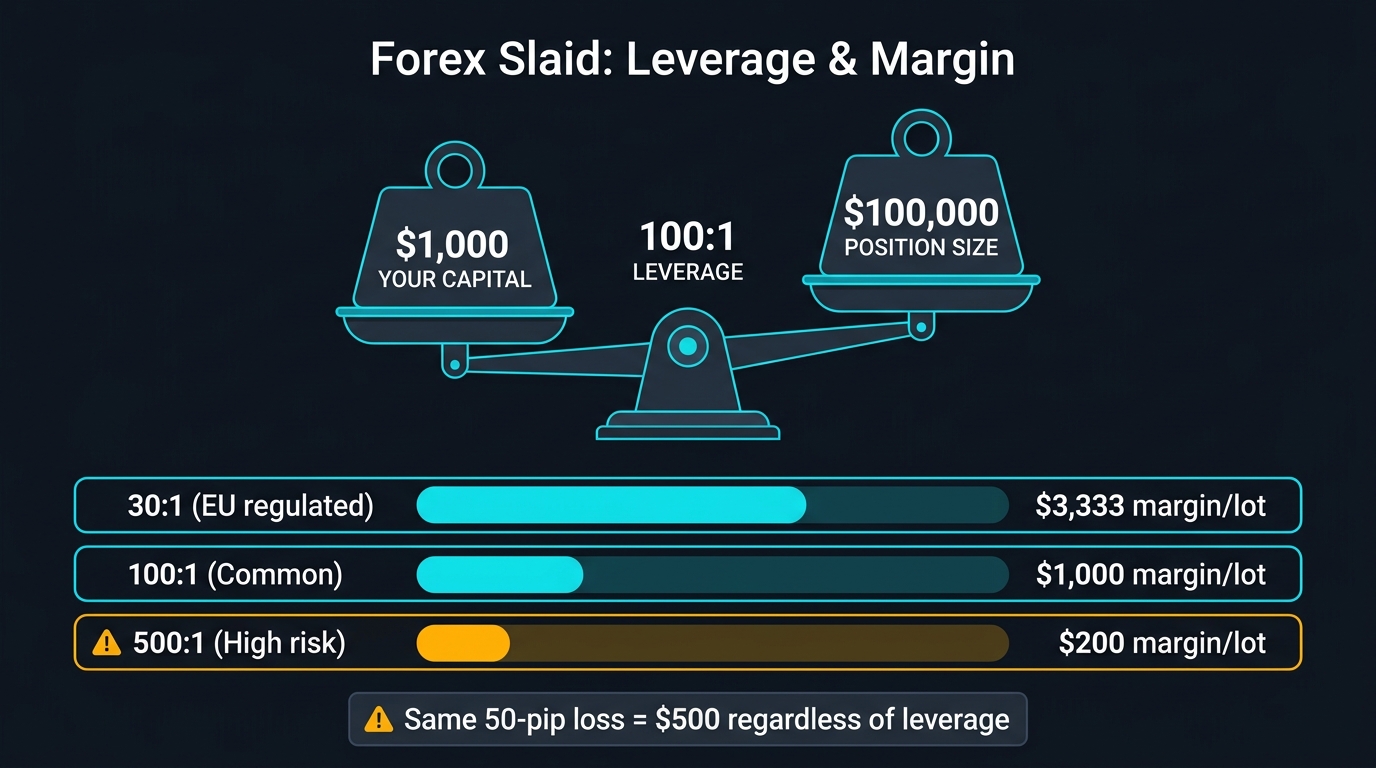
Leverage is the mechanism that makes retail forex trading possible. Without it, controlling even a single standard lot (100,000 currency units) would require $100,000 in your account — accessible only to wealthy institutions. With leverage, a $1,000 account can control the same position.
This is powerful. It is also the primary reason most retail forex accounts lose money. Understanding exactly how leverage and margin work — mechanically, not just conceptually — is essential before you put real capital at risk.
What Leverage Means in Practice
Leverage is expressed as a ratio: 50:1, 100:1, or 500:1. This ratio tells you how much your broker will let you control relative to the funds in your account.
At 100:1 leverage: $1,000 controls $100,000 worth of currency.
That sounds attractive until you do the other side of the math. If EUR/USD moves 1% against your position — a completely ordinary daily move — you lose $1,000 on a $100,000 position. With 100:1 leverage, that’s your entire account balance.
The same leverage that turns a 0.1% favorable move into a 10% account gain turns a 0.1% adverse move into a 10% account loss. Leverage doesn’t discriminate.
What Margin Is
Margin is the collateral your broker holds against your leveraged position — the portion of your account funds locked up while a trade is open. It’s not a fee. It’s a security deposit that’s returned when you close the position.
The relationship between leverage and margin is reciprocal:
- 100:1 leverage = 1% margin requirement
- 50:1 leverage = 2% margin requirement
- 30:1 leverage = 3.33% margin requirement
- 10:1 leverage = 10% margin requirement
Margin requirement formula: Required Margin = Position Size / Leverage
Example: Opening 1 standard lot of EUR/USD (100,000 units) at 100:1 leverage:
- Required margin = 100,000 / 100 = $1,000
This $1,000 is deducted from your usable balance while the trade is open. It’s returned (with your profit or minus your loss) when you close.
Free Margin, Margin Level, and Why They Matter
Your account has two relevant figures while trades are open:
Used Margin — total collateral locked in all open positions Free Margin — account equity minus used margin (available for new trades)
Margin Level = (Equity / Used Margin) × 100%
Brokers set a Margin Call Level — typically 80–100% margin level — at which they warn you to deposit more funds or reduce positions. At the Stop Out Level (often 20–50%), they automatically close your open positions, starting with the least profitable.
Watching your margin level is critical when running multiple positions or when the market is moving against you.
A Worked Example: The Math of a Leveraged Trade
Account balance: $2,000
Position: Buy 1 standard lot USD/JPY at 148.00 (1 USD = 148 Yen)
Leverage: 100:1
Required margin: $1,000 (held as collateral)
Free margin: $1,000 (available for new trades)
Scenario A — 100-pip move in your favor: USD/JPY rises to 149.00. Gain = 100 pips × ~$6.75/pip (on USD/JPY) ≈ $675 profit. Account equity: $2,675. The $1,000 margin is returned plus $675 profit.
Scenario B — 100-pip move against you: USD/JPY falls to 147.00. Loss = 100 pips × $6.75 ≈ $675 loss. Account equity: $1,325. Margin level = ($1,325 / $1,000) × 100 = 132.5% — still above stop out.
Scenario C — 200-pip adverse move (approaching margin call): USD/JPY falls to 146.00. Loss ≈ $1,350. Equity = $650. Margin level = 65% — below typical stop-out threshold. Broker closes position automatically. Actual loss: the position closes at roughly the stop-out point, protecting you from going negative.
Negative balance protection — required by FCA and ASIC-regulated brokers — means your account can’t go below zero. You can never owe your broker money due to a market loss. Verify your broker offers this before trading.
Leverage Regulations by Region
Regulators have capped retail leverage specifically because its misuse is the leading cause of retail account losses:
| Regulator | Major Pairs | Minor/Exotic | CFDs (Indices) |
|---|---|---|---|
| FCA (UK) | 30:1 | 20:1 | 20:1 |
| ASIC (Australia) | 30:1 | 20:1 | 20:1 |
| CySEC (EU) | 30:1 | 20:1 | 20:1 |
| Offshore (various) | Up to 500:1 | Up to 500:1 | Up to 200:1 |
Higher offshore leverage isn’t an advantage — it’s an invitation to catastrophic losses that regulated brokers’ capped leverage prevents. Professional traders regularly work with 10:1 or lower effective leverage on their positions, regardless of the theoretical maximum their broker offers.
The Right Approach to Leverage
The practical advice is counterintuitive: use the minimum leverage necessary.
Decide your position size based on your risk management rules (1% of account per trade, stop-loss distance, pip value) — then use whatever leverage is needed to open that position, no more.
If your risk management calculations say to trade 0.1 lots on a $1,000 account with a 30-pip stop (risking $30 = 3%), the fact that your broker offers 500:1 leverage is irrelevant to that calculation. Your lot size is determined by your risk rules, not by what the broker will allow.
Traders who size positions based on leverage — “the broker lets me open 5 lots, so I will” — are trading without risk management. That approach produces dramatic short-term results in both directions, and eventually ends in a blown account.
Next: Online Forex Trading: Setting Up Your Trading Environment
Previous: Risk Management Basics
Related lessons: Risk of Excessive Leverage | Forex Margin Call
Tools: Margin Calculator
Related dictionary terms: Leverage | Margin | Margin Call | Stop Out Level

Ready to Practice This Strategy?
Test what you learned on a free, risk-free demo account before risking real money.