Online Forex Trading: How to Get Started With a Broker
Opening a forex account is straightforward — but choosing the right broker, setting up your platform, and going from demo to live trading requires knowing what to look for and what to avoid.
The mechanics of getting into the forex market are simpler than most beginners expect. You don’t need specialized software, expensive data feeds, or an institutional connection. A regulated broker, a laptop or phone, and a funded account are sufficient to trade the same EUR/USD pair that trillion-dollar banks execute. What separates professional traders from retail traders isn’t access — it’s discipline, knowledge, and process.
This lesson covers the practical steps: choosing a broker, setting up a trading platform, and transitioning from demo to live trading without making the common mistakes.
Choosing a Broker: The Three Non-Negotiables
Before you look at spreads, platforms, or bonuses, verify three things:
1. Regulatory Status
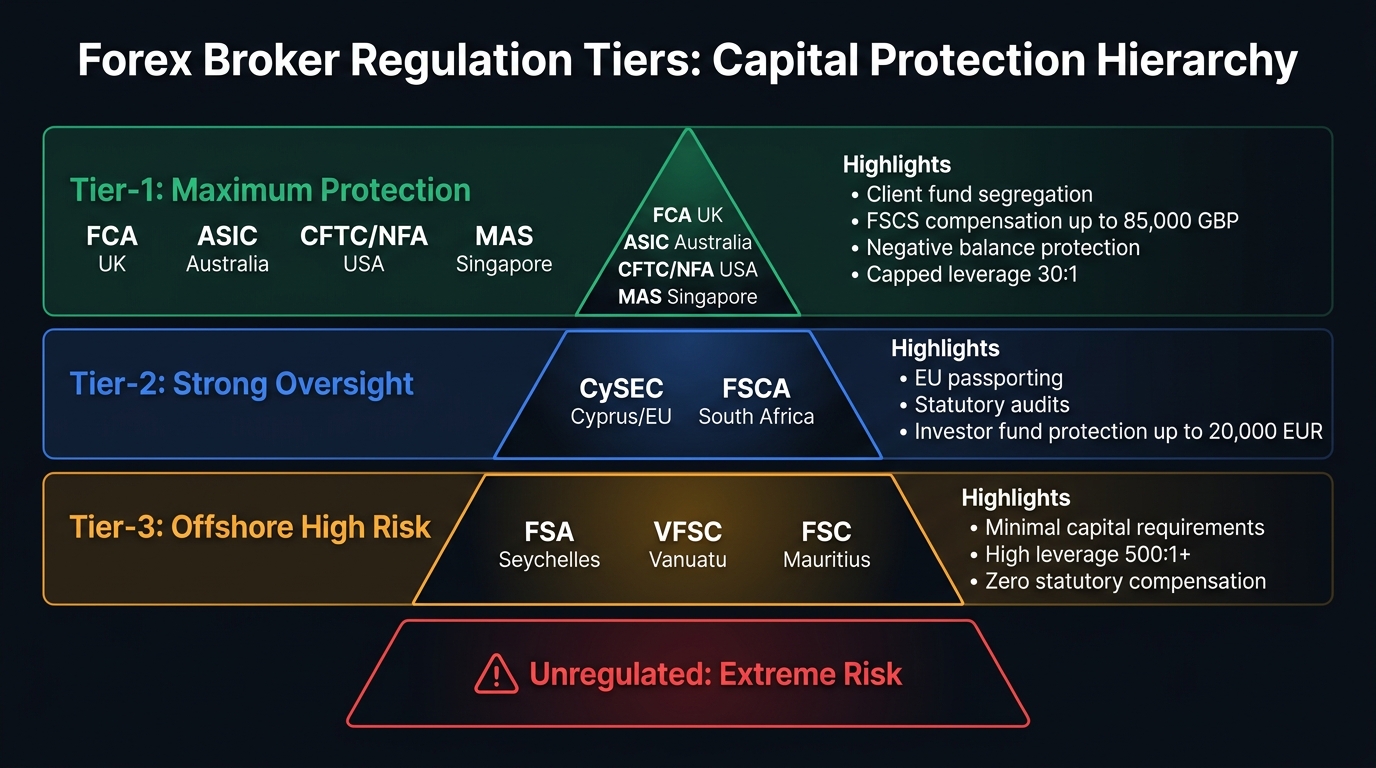
Only trade with brokers regulated by a top-tier financial authority:
- FCA (Financial Conduct Authority, UK) — highest standard globally
- ASIC (Australian Securities and Investments Commission)
- CySEC (Cyprus Securities and Exchange Commission, EU)
- MAS (Monetary Authority of Singapore)
- CFTC/NFA (United States, for US residents)
Regulation means the broker must segregate client funds from operating capital, maintain minimum capital requirements, submit to regular audits, offer negative balance protection, and provide formal dispute resolution.
Offshore brokers registered in Vanuatu, St. Vincent, or similar jurisdictions offer none of these guarantees. If they refuse withdrawals or disappear, you have no legal recourse. This isn’t theoretical — offshore broker fraud is the most common scam targeting new forex traders.
Verify a broker’s regulatory status directly on the regulator’s official register (not on the broker’s website). For the FCA: register.fca.org.uk.
2. Execution Type
Market makers set their own quotes and take the other side of client trades. They profit from the spread and, to varying degrees, from client losses. Regulated market makers operate within legal constraints, but the conflict of interest is structural. Most retail forex brokers operate this model.
ECN/STP brokers pass orders directly to the interbank market or a pool of liquidity providers. They earn a fixed commission rather than the spread. There’s no conflict of interest. Spreads on ECN accounts are often lower (sometimes zero), but commissions add back the cost.
For most beginners, a regulated market maker is fine. For active traders executing dozens of trades per month, ECN execution typically produces better net costs.
3. Account Costs
The total cost of trading includes:
- Spread — the bid-ask difference, paid on every trade
- Commission — only on ECN accounts (typically $3–7 per standard lot per side)
- Swap rates — interest paid or received for holding positions overnight
- Inactivity fees — some brokers charge if you don’t trade for 90+ days
On EUR/USD with a reputable market maker, expect spreads of 0.7–1.5 pips. On ECN accounts, spreads may be 0.1 pips plus $3.50/lot commission. Do the math for your typical trade size and frequency before choosing.
Trading Platforms
MetaTrader 4 (MT4) remains the most widely used retail forex platform globally. It’s available from almost every broker, has a massive library of custom indicators and automated trading scripts (Expert Advisors), and is stable and well-documented. If you’re starting out, MT4 is the default choice.
MetaTrader 5 (MT5) is the successor, with more order types, more timeframes, and access to more markets (stocks, futures). Increasingly offered as a replacement for MT4.
cTrader is popular on ECN brokers, with better execution transparency and a cleaner interface. If your broker offers it, it’s worth exploring.
Proprietary platforms vary widely in quality. Some brokers have built genuinely excellent web-based or mobile platforms; others are clunky and slow. Most also offer MT4 as an alternative.
The platform you choose affects your workflow significantly. Download and try the demo version before committing to a live account.
The Demo Account Phase
Every reputable broker offers a demo account — a simulated trading environment using real-time market prices but virtual money. Use it seriously.
Demo trading serves several purposes:
- Platform familiarization — learn the interface, order types, and charting tools without financial risk
- Strategy testing — run your intended approach in real market conditions
- Process development — establish your pre-trade checklist, journaling habit, and exit discipline
The limitation of demo trading is psychological: there’s no real capital at risk, which means the emotional pressure of live trading is absent. Traders who are disciplined on demo often struggle when live losses produce fear or greed responses they didn’t experience in simulation.
This is why demo trading is a necessary step, not a sufficient one. Aim for 4–8 weeks of demo trading with consistent profitability and proper risk management before going live.
Opening a Live Account
The account opening process is standard across regulated brokers:
- Choose account type — standard (commission-free, wider spread), ECN (lower spread, commission), or mini (smaller minimum deposit)
- Complete KYC verification — upload government ID (passport or driver’s license) and proof of address (utility bill or bank statement)
- Fund the account — bank transfer, credit/debit card, or e-wallets (Skrill, Neteller). Minimum deposits vary: $50–500 is typical for standard accounts
- Start with minimum viable size — resist the urge to fund your initial account with your maximum available capital. Start small enough that early learning losses don’t damage you financially or psychologically
Going Live: The Transition
When you move from demo to live, expect a performance gap. Slippage is real. Spreads occasionally widen during news events. And the emotional weight of real money changes decision-making in ways that simulation doesn’t prepare you for.
Manage this transition deliberately:
- Trade your minimum lot size initially, regardless of what your account technically supports
- Keep a trading journal from day one — note your entry rationale, emotional state, and outcome for every trade
- Review your journal weekly, looking for patterns in your errors
- Don’t evaluate performance over less than 100 trades — you need statistical significance before drawing conclusions about your strategy’s edge
Choosing a broker, setting up a platform, and opening an account are straightforward administrative tasks. The actual work is building the habit of disciplined, systematic trading — and that begins from your very first live trade.
Next: Forex Millionaires: What Successful Long-Term Traders Actually Do
Previous: Margin and Leveraged Trading
Related lessons: Forex Broker Due Diligence | Different Forex Broker Types
Related dictionary terms: Market Maker | ECN Broker | Spread | Demo Account

Ready to Practice This Strategy?
Test what you learned on a free, risk-free demo account before risking real money.