A Consolidating Merger
A consolidating merger (or statutory consolidation) is a corporate restructuring transaction wherein two or more existing business entities dissolve their original legal structures to combine all operational assets, liabilities, and equity into a newly formed corporation.
What Is a Consolidating Merger?
A consolidating merger, formally recognized in corporate law and investment banking as a statutory consolidation, is a structural merger and acquisition (M&A) arrangement in which two or more distinct business entities combine to establish an entirely new legal entity. In this transaction, the constituent predecessor companies are dissolved, and their separate corporate charters cease to exist.
All assets, contractual covenants, liabilities, operational intellectual property, and shareholder equity of the combining firms are legally transferred to the new corporation. Existing stockholders of the consolidating predecessor entities surrender their shares in exchange for newly issued equity securities or debt instruments of the newly formed enterprise, calculated using an agreed-upon valuation exchange ratio.
Consolidating mergers are frequently employed during horizontal consolidations within mature, fragmented industries—such as commercial banking, pharmaceuticals, logistics, and telecommunications—to eliminate redundant corporate overhead, achieve economies of scale, and restructure capital stacks without the legal baggage of either predecessor entity prevailing as the dominant legal parent.
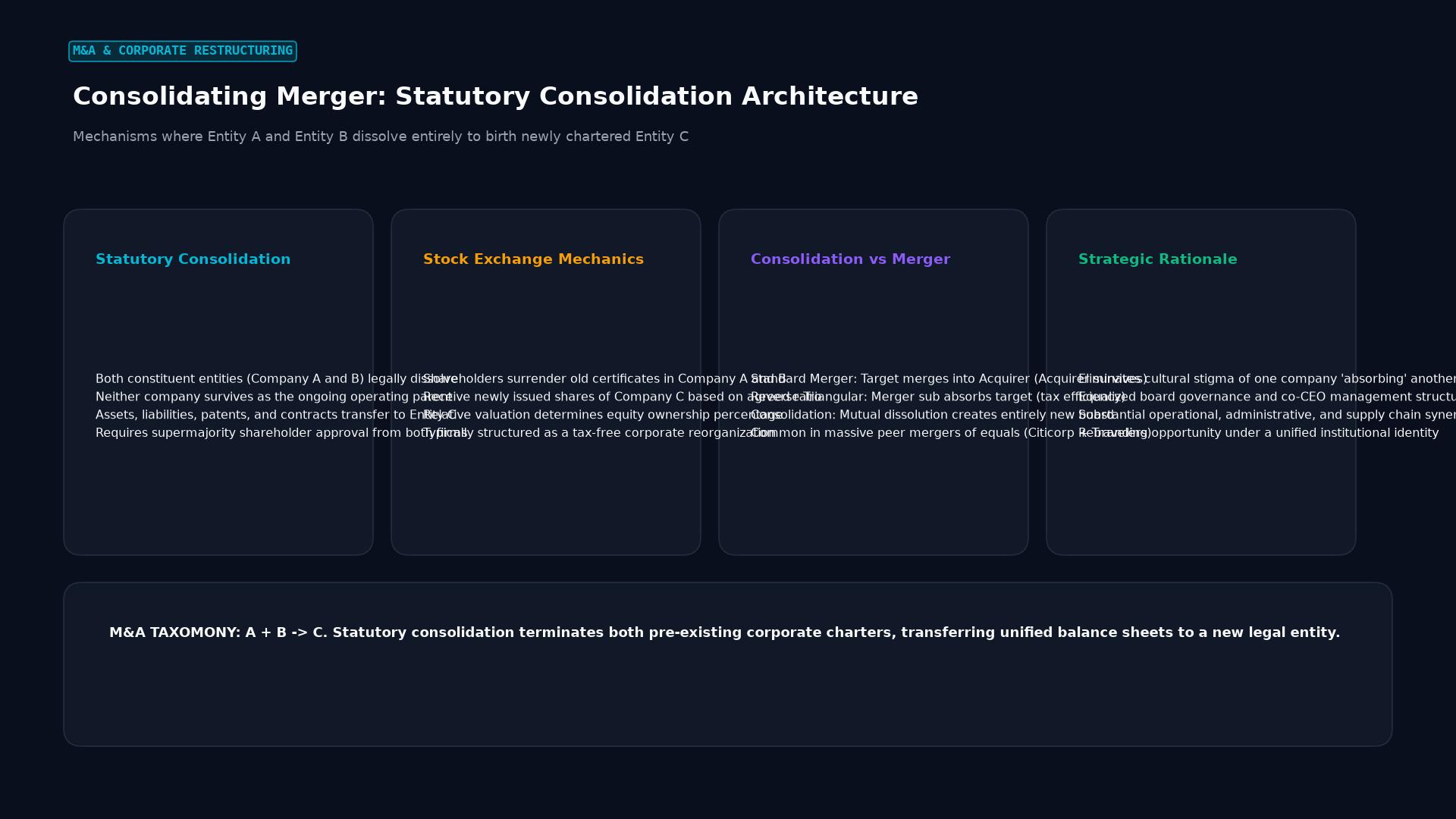 Figure: Mechanisms where Entity A and Entity B dissolve entirely to birth newly chartered Entity C
Technical Mechanics & Financial Consolidation
The execution of a consolidating merger involves three core financial and legal mechanisms:
1. Share Exchange Ratio Calculation
The allocation of ownership in the newly formed corporation depends on the relative fair market valuation of each constituent firm: $$\text{Exchange Ratio}_A = \frac{\text{Agreed Valuation of Entity A}}{\text{Total Combined Valuation}} \times \frac{\text{Total New Shares Issued}}{\text{Existing Shares Outstanding of A}}$$ Similarly for Entity B: $$\text{Exchange Ratio}_B = \frac{\text{Agreed Valuation of Entity B}}{\text{Total Combined Valuation}} \times \frac{\text{Total New Shares Issued}}{\text{Existing Shares Outstanding of B}}$$
2. Balance Sheet Aggregation & Purchase Accounting
Under modern International Financial Reporting Standards (IFRS 3) and US GAAP (ASC 805), one of the combining entities must be designated as the accounting acquirer for financial reporting purposes, even though legally a new corporation is formed: $$\text{Consolidated Assets} = \text{Assets}{\text{Acquirer (Book Value)}} + \text{Assets}{\text{Acquiree (Fair Market Value)}} + \text{Goodwill}$$ Where Goodwill ($\text{GW}$) is established as: $$\text{GW} = \text{Purchase Consideration Paid} - \text{Net Identifiable Assets acquired at Fair Value}$$
Comparative Matrix: Structural M&A Transaction Types
| Restructuring Model | Legal Entity Status | Predecessor Status | Shareholder Consideration | Regulatory & Approval Burden |
|---|---|---|---|---|
| Consolidating Merger | Completely new legal entity chartered | All predecessor entities dissolved | Stock in newly chartered corporation | High; supermajority shareholder vote of all merging parties |
| Statutory Merger | Surviving entity retains legal identity | Target company dissolved into acquirer | Acquirer shares, cash, or notes | High; requires formal proxy filings and vote |
| Asset Acquisition | Acquirer and seller both survive | Target remains alive (often becomes holding shell) | Direct cash or debt paid to seller | Moderate; circumvents unknown target balance sheet liabilities |
| Holding Company Structure | Parent firm created above operating subs | Predecessors survive as operating subsidiaries | Shares in holding company | Moderate; preserves independent licenses and debt covenants |
Real-World Case Study: The 1996 Formation of Novartis AG
One of the largest statutory consolidating mergers in global corporate history occurred in December 1996 between Swiss life sciences giants Ciba-Geigy and Sandoz:
- The Setup: Both companies operated extensive competing pharmaceutical, chemical, and agribusiness units headquartered in Basel, Switzerland, facing rising R&D expenditures and aggressive pricing pressures from US biotechs.
- The Transaction: Rather than one firm executing a hostile or friendly takeover of the other, both corporate boards agreed to dissolve their independent legal entities and form an entirely new corporation: Novartis AG.
- The Equity Distribution: Ciba-Geigy shareholders received 45% of the newly issued Novartis equity, while Sandoz shareholders received 55%, reflecting pre-merger enterprise valuations.
- Synergies & Rationalization: By consolidating corporate infrastructure, eliminating duplicative laboratories, and spinning off non-core chemical divisions into Ciba Specialty Chemicals, Novartis extracted over $1.4 billion in annual operational synergies, rapidly becoming one of the most profitable healthcare multinationals worldwide.
Frequently Asked Questions (FAQ)
How does a consolidating merger differ from a standard merger?
In a standard (statutory) merger, Company A absorbs Company B; Company B ceases to exist, but Company A retains its original legal charter, name, and governance. In a consolidating merger, both Company A and Company B dissolve, and an entirely new Company C is created from scratch with a new corporate charter.
What happens to outstanding bondholder debt during a statutory consolidation?
By operation of corporate law, the newly formed corporation assumes all covenants, indentures, and debt liabilities of the dissolved predecessor entities. If predecessor debt contracts contain “change of control” or acceleration clauses, bondholders may demand immediate repayment or renegotiated coupon rates before the consolidation is finalized.
Why do companies choose consolidation instead of an acquisition?
A consolidating merger is often chosen when both firms are of comparable size (“merger of equals”), where neither management team or board of directors is willing to appear as being “taken over.” It also allows the combined firm to draft an entirely modern corporate charter, reset board governance, and unify corporate cultures on neutral ground.
Ready to trade forex?
Open a free demo account with a regulated broker. Practice with virtual funds before risking real money.