Account Executive
An Account Executive (AE) in institutional finance and brokerage operations is a licensed market professional responsible for managing primary client relationships, onboarding high-net-worth and institutional trading accounts, executing high-volume orders, and coordinating market access.
What Is an Account Executive?
An Account Executive (AE) within brokerage firms, investment banks, and OTC liquidity providers is a licensed financial representative tasked with managing key client accounts, driving institutional sales, and serving as the primary operational liaison between capital market traders and the firm’s execution infrastructure.
Unlike retail customer support agents who address basic operational inquiries, an Account Executive in financial trading handles complex client requirements. These include negotiating institutional margin parameters, structuring custom liquidity bridges, resolving trade breaks, orchestrating API connectivity for algorithmic trading desks, and managing real-time risk during periods of extreme market volatility.
In prime brokerage and institutional foreign exchange (FX), AEs are assigned to hedge funds, proprietary trading desks, family offices, and high-net-worth individuals (HNWIs) to deliver bespoke execution services, tailored rebates, and white-glove credit facilities.
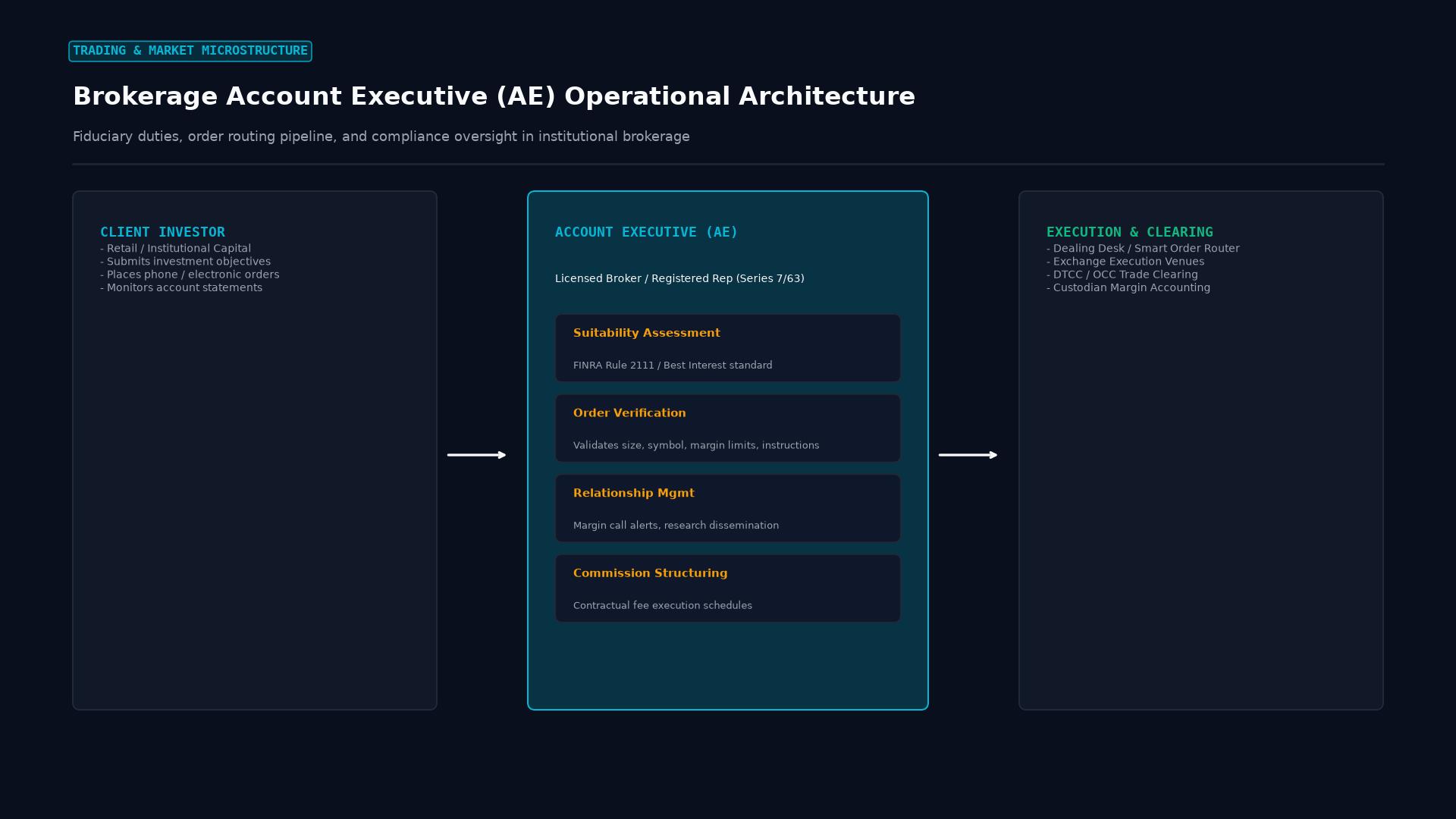 Figure: Institutional brokerage workflow: fiduciary suitability assessment (FINRA Rule 2111), order verification, execution venue routing, and clearing custody reconciliation.
Technical Mechanics & Performance Metrics
Brokerage institutions evaluate the performance and risk exposure of Account Executives through quantitative operational and revenue metrics:
1. Gross Commission Generated (GCG) & Spread Revenue
The primary revenue generated through an AE’s client book: $$\text{GCG} = \sum_{i=1}^{n} (\text{Volume}_i \times \text{Commission Rate}i) + \sum{i=1}^{n} (\text{Volume}_i \times \text{Markup Spread}_i)$$
2. Assets Under Custody & Net New Money (NNM)
The capital inflow generated through account retention and new institutional onboarding: $$\text{NNM} = \text{Total Capital Inflows} - \text{Total Capital Outflows} - \text{Market Asset Depreciation}$$
3. Margin Utilization & Risk Exposure Monitoring
The AE must continuously monitor client leverage against institutional safety thresholds: $$\text{Margin Utilization} = \frac{\text{Maintenance Margin Required}}{\text{Total Account Equity}} \times 100%$$ When Margin Utilization exceeds $90%$, the AE coordinates directly with the risk desk to prompt capital infusions before automated liquidation engines trigger stop-outs.
Comparative Matrix: Account Executive vs Related Industry Roles
| Dimension | Account Executive (AE) | Financial Advisor (FA) | Institutional Sales Trader | Customer Support Agent |
|---|---|---|---|---|
| Primary Objective | Account growth, trade execution, and institutional retention | Long-term financial planning & asset allocation | Direct market execution & algorithmic block orders | Resolving technical tickets and routine account queries |
| Client Base | HNWIs, active traders, corporate accounts, prop shops | Retail individuals, retirees, middle-market wealth | Tier-1 banks, sovereign wealth funds, large asset managers | Broad retail user base |
| Licensing (US) | Series 7, Series 63, Series 3 (Commodities/FX) | Series 65, Series 66, CFP | Series 7, Series 57, Series 63 | General registration / No formal securities licenses |
| Compensation Model | Base salary + commission split / volume bonuses | Percentage fee on AUM (1.0% fee structure) | Discretionary desk bonus based on P&L | Hourly wage or fixed monthly salary |
Real-World Case Study: Prime Brokerage AE During Volatility Spikes
During the March 2020 market turmoil triggered by global liquidity crunches, an Account Executive at a major London prime brokerage managed institutional FX accounts representing over $450 million in daily trading volume:
- The Challenge: Liquidity providers abruptly widened bid-ask spreads on EUR/USD from 0.2 pips to over 3.5 pips, while oil futures plunged toward historic negative pricing, triggering automated margin alerts across 14 hedge fund accounts.
- The AE’s Action: Rather than permitting algorithmic liquidation protocols to dump positions at disastrous off-market prices, the AE liaised in real-time between the chief risk officer (CRO) and client fund managers, securing emergency wire transfers of $18 million in additional collateral.
- The Outcome: The AE re-routed order flows through non-bank liquidity providers with lower slippage profiles, preventing client account insolvency and preserving firm capital without incurring bad debt charges.
Frequently Asked Questions (FAQ)
What regulatory licenses must an Account Executive hold to trade forex and securities?
In the United States, an Account Executive operating in securities must hold FINRA Series 7 and Series 63 licenses, while those handling foreign exchange, futures, and commodities must pass the NFA Series 3 examination. In the UK, equivalent qualifications approved by the Financial Conduct Authority (FCA) are mandatory.
Does an Account Executive provide financial advice or buy/sell recommendations?
Generally, no. Unless specifically registered as an investment advisor representative (IAR) or chartered portfolio manager, an Account Executive functions in an execution-only and account management capacity, facilitating trades and resolving technical needs without offering fiduciary investment advice.
How does an Account Executive handle a client margin call?
When an account’s equity falls below maintenance margin requirements, the AE immediately contacts the client with exact dollar deficit figures, explains available deposit methods (such as same-day Fedwire or cryptocurrency collateral), and outlines the strict timeline before risk algorithms initiate forced liquidations.
Ready to trade forex?
Open a free demo account with a regulated broker. Practice with virtual funds before risking real money.