Activity Dictionary
An Activity Dictionary is a standardized organizational reference document that catalogs, defines, and classifies all business tasks across an enterprise, establishing uniform nomenclature and cost drivers for Activity-Based Costing.
What Is an Activity Dictionary?
In managerial accounting, operations architecture, and enterprise cost management, an Activity Dictionary is a formal, centralized reference directory that catalogs, defines, and categorizes every distinct business activity performed within an organization.
When corporations implement Activity-Based Costing (ABC) or Activity-Based Management (ABM), they often discover that different departments use conflicting, ambiguous terminology to describe identical tasks. For instance, customer support might describe a process as “handling complaints,” while quality assurance calls it “defect logging,” and finance records it as “warranty claim administration.”
The Activity Dictionary establishes a single, definitive source of truth across the enterprise. It standardizes operational vocabulary, establishes clear boundaries for each task, documents assigned cost drivers, and provides the quantitative architecture required for automated Enterprise Resource Planning (ERP) systems to track activity costs accurately.
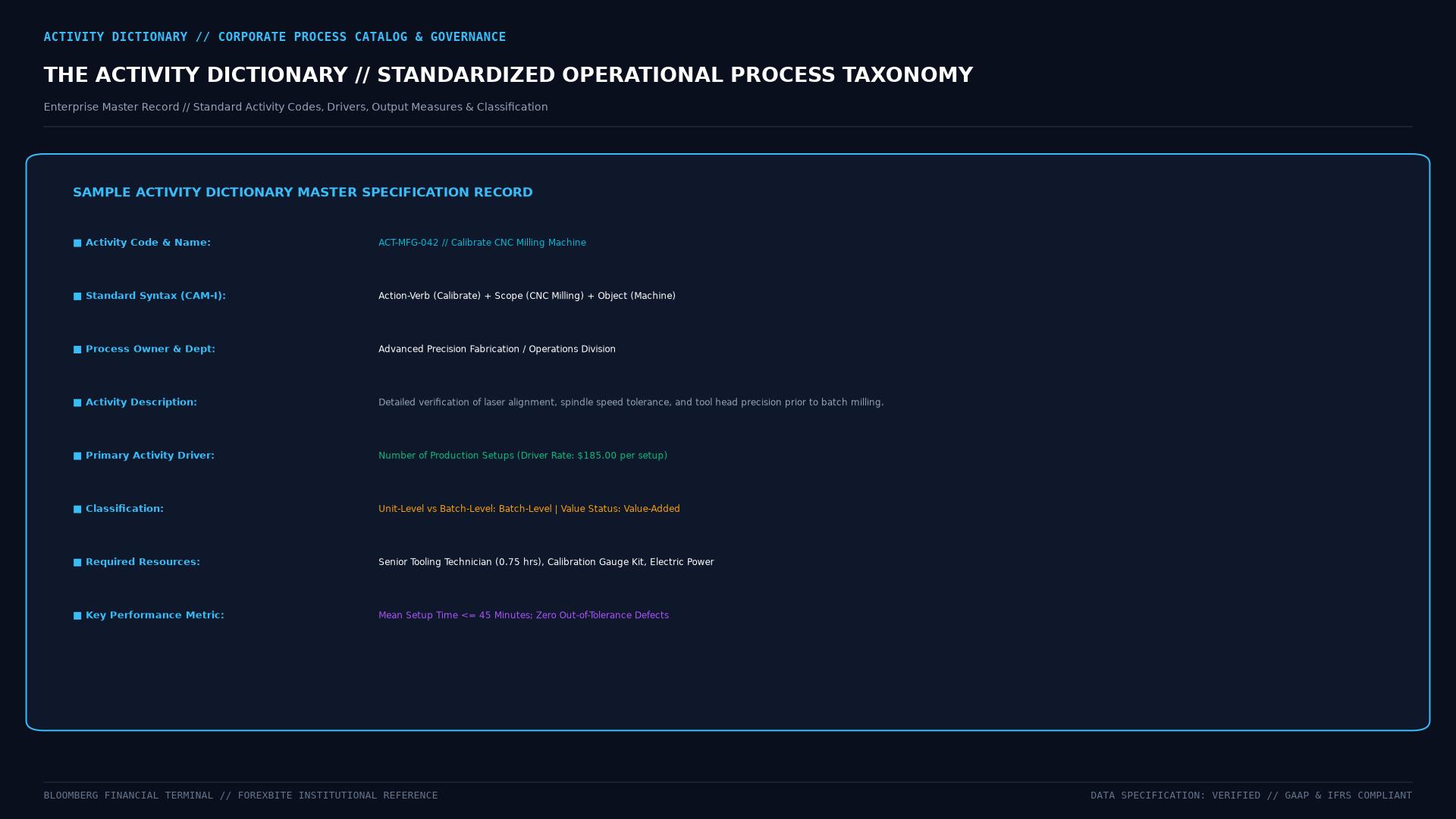 Figure: Standardized Activity Dictionary schema showing hierarchical categorization from business process to primary activity and sub-tasks, along with driver units, value attributes, and system mapping.
Technical Mechanics: Anatomy of a Standardized Activity Record
A robust, enterprise-grade Activity Dictionary structures each recorded business activity across six mandatory descriptive fields:
1. Standardized Nomenclature (Verb-Adjective-Noun)
To maintain structural clarity and prevent vague descriptions, activities must follow standardized linguistic syntax:
- Action Verb: The specific operation executed (e.g., Inspect, Assemble, Reconcile, Negotiate, Program).
- Adjective: Modifies and refines the scope (e.g., Inbound, Electronic, Overdue, Critical).
- Noun / Object: The receiver of the action (e.g., Materials, Invoices, Contracts, Servers). Examples include: Generate Custom Sales Quote, Calibrate Precision Lathe, and Resolve Disputed Credit Charge.
2. Hierarchy and Value Classification
Each activity is classified along two critical managerial dimensions:
- Cost Hierarchy Level: Designated as Unit-level (scales with volume), Batch-level (occurs per run), Product-sustaining (supports specific SKU), Customer-sustaining (supports specific account), or Facility-sustaining (general plant overhead).
- Value Contribution: Categorized as Value-Added (VA) (increases external customer utility), Business-Value-Added (BVA) (mandatory for legal, safety, or governance compliance), or Non-Value-Added (NVA) (wasteful operational friction targeted for eradication).
3. Assigned Activity Driver and Practical Capacity
The dictionary defines the precise quantitative metric that best tracks resource consumption (e.g., Number of Engineering Change Orders, Hours of Press Run-Time, or Number of Customer Inquiries), alongside the department’s verified practical capacity under normal operating conditions.
Comparative Matrix: Activity Dictionary vs. Standard Operating Procedure vs. Chart of Accounts
| Feature | Activity Dictionary | Standard Operating Procedure (SOP) | General Ledger Chart of Accounts |
|---|---|---|---|
| Primary Purpose | Cost tracing, capacity modeling, and ABM | Step-by-step training and quality execution | External statutory accounting and tax filings |
| Organizational Role | Standardizes work for cost and ABC models | Guides frontline employees on task mechanics | Records financial transactions by legal line item |
| Typical Level of Detail | Moderate (typically 50 to 200 activities) | Highly granular (detailed step-by-step rules) | Broad financial categories (Salaries, Rent) |
| Managed By | FP&A and operations architecture teams | Quality assurance, safety, and HR managers | Corporate financial controller and auditing team |
| Output Metric | Activity cost rates, VA/NVA ratio, capacity | Compliance checklist, safety certification | Balance Sheet and Income Statement |
Real-World Case Study: Global Medical Device Enterprise Consolidation
In 2023, an international medical device corporation with manufacturing operations across four countries undertook an enterprise-wide Activity-Based Management overhaul. Prior to the project, each regional plant operated independent cost tracking models, creating severe accounting confusion: the German plant tracked 340 micro-tasks, while the US plant tracked only 18 broad departmental buckets.
Corporate cost management deployed a unified global Activity Dictionary:
- Consolidation: The team rationalized over 600 disparate task descriptions down to 88 standardized enterprise activities spanning four languages.
- Process Standardization: Standardizing the definition of Cleanroom Sterilization Verification revealed that the Mexican facility spent $85 per batch using automated sensors, while the US facility spent $310 per batch using manual chemical swabs.
- Operational Optimization: By standardizing best-practice equipment protocols defined in the Activity Dictionary, the company harmonized operations worldwide, eliminating $6.2 million in redundant quality testing and standardizing global product pricing.
Frequently Asked Questions (FAQ)
How many activities should an effective Activity Dictionary contain?
Experience in corporate ABC implementations demonstrates that simpler models are far more sustainable. Most successful mid-size to large enterprises maintain an Activity Dictionary containing between 50 and 150 activities. Excessive granularity (such as cataloging 500+ micro-tasks) creates an administrative burden that becomes too costly to update and maintain.
Who is responsible for maintaining the Activity Dictionary?
The Activity Dictionary is typically managed by a cross-functional governance committee composed of Financial Planning and Analysis (FP&A) cost accountants, industrial engineers, operations managers, and business unit leaders. Any creation of a new activity or modification of an existing driver requires formal committee approval.
Can an Activity Dictionary be integrated directly into SAP or Oracle ERP?
Yes. Modern enterprise resource planning software contains dedicated Activity-Based Costing and business process management modules (such as SAP CO-ABC) that store the Activity Dictionary directly within the core financial master data architecture, allowing automated cost assignment across purchase orders and shop-floor tickets.
Ready to trade forex?
Open a free demo account with a regulated broker. Practice with virtual funds before risking real money.