Activity-Based Planning
Activity-Based Planning (ABP) is an operational and financial forecasting discipline that models future activity volumes to project required resource capacity, staffing levels, and capital requirements based on anticipated business demand.
What Is Activity-Based Planning (ABP)?
Activity-Based Planning (ABP) is an ongoing operational and financial planning methodology that translates strategic business goals, sales forecasts, and operational targets into detailed projections of future activity volumes and resource requirements.
While traditional corporate planning relies on static financial spreadsheets that extrapolate dollar amounts based on past trends, Activity-Based Planning constructs an operational mathematical simulation of the enterprise. It establishes explicit mathematical relationships connecting customer demand, workload activities, and resource capacity (such as labor hours, equipment run-times, server capacity, and warehouse space).
By simulating how future changes in product mix, customer behavior, or order volume will cascade across operational activities, ABP enables executives to perform robust “What-If” scenario modeling, preventing dangerous operational bottlenecks and eliminating costly over-hiring or equipment over-leasing.
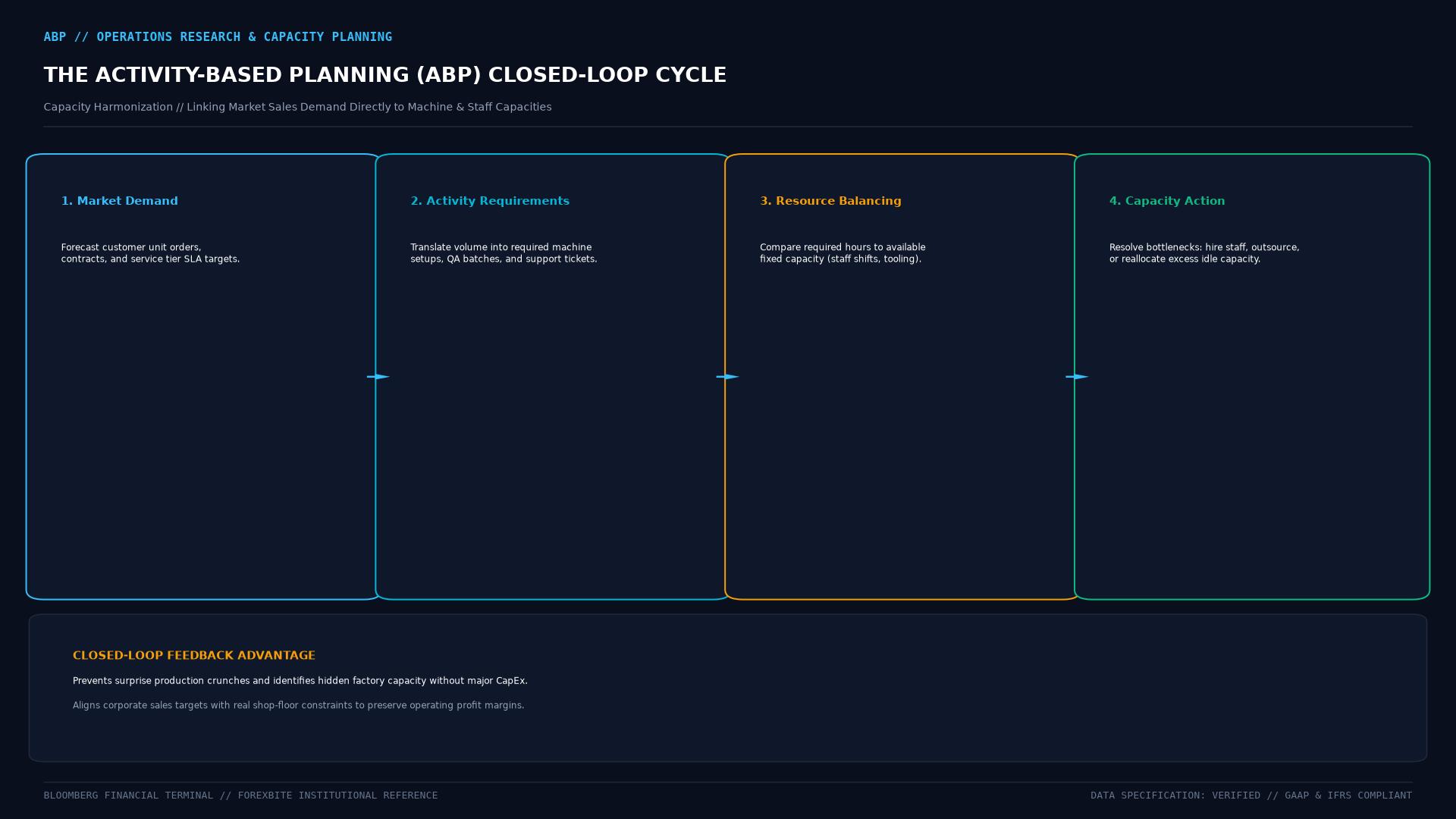 Figure: Closed-loop Activity-Based Planning (ABP) model connecting strategic business goals, resource capacity modeling, workload activity scheduling, and variance feedback analysis.
Technical Mechanics: The Capacity Planning Engine
Activity-Based Planning operates as a forward-looking capacity management system structured across three core computational stages:
1. Workload Translation Matrix
Planning teams utilize verified unit consumption ratios to translate commercial forecasts into required operational workloads:
Required Activity Volume = Sum of (Forecasted Output of Object_i × Activity Consumption Rate_i)For example, if an e-commerce fulfillment enterprise forecasts shipping 150,000 standard parcels and 30,000 hazardous-material parcels:
- Standard parcel packaging requires 0.05 labor hours.
- Hazardous parcel packaging requires 0.20 labor hours.
- Total Required Activity Workload =
(150,000 × 0.05) + (30,000 × 0.20)= 7,500 + 6,000 = 13,500 labor hours.
2. The Capacity Gap Calculation
ABP models compare required activity hours against Practical Resource Capacity (total available hours adjusted for planned vacations, maintenance, breaks, and realistic operational friction):
Capacity Gap = Required Activity Workload - Available Practical Capacity- Positive Gap (Deficit): Signals an impending operational bottleneck. The company must plan for overtime, seasonal temp staffing, or machinery expansion.
- Negative Gap (Surplus/Idle): Identifies wasted resource slack. Management can reallocate staff to growth initiatives, reduce contractor hours, or avoid redundant equipment leases.
3. Dynamic “What-If” Scenario Simulation
Before committing capital, corporate planners use ABP software engines to simulate macro shocks and operational pivots:
- What happens to warehouse logistics hours if customer average order size drops by 20% while order frequency doubles?
- What staffing increases are required in technical compliance if international sales expand by 40% into regulated European markets?
Comparative Matrix: Activity-Based Planning vs. Static Planning vs. Capacity Planning
| Parameter | Activity-Based Planning (ABP) | Traditional Static Planning | Traditional Industrial Capacity Planning |
|---|---|---|---|
| Primary Scope | Complete enterprise (front-office, admin, factory) | High-level financial accounting line items | Factory floor machinery and assembly lines |
| Driver Connection | Explicit causal link: Demand -> Activity -> Cost | Arbitrary historical percentage adjustments | Machine utilization rates and floor throughput |
| Planning Horizon | Rolling dynamic multi-quarter horizons | Annual static calendar year cycle | Short-to-medium manufacturing schedule |
| Output Metric | Workload hours, driver volume, required staff | Approved financial dollar budgets | Machine hours and direct production units |
| Responsiveness | Highly agile; updates as demand forecasts pivot | Rigid; frozen at fiscal year-end | Moderate; adjusted based on shop-floor orders |
Real-World Case Study: Fintech Customer Onboarding Scaling
In 2024, a rapidly growing digital payment platform planned to expand its merchant acquisition campaign, projecting an increase from 10,000 to 45,000 merchant onboarding applications over 12 months. Under traditional static planning, the customer operations director requested a quadrupling of the KYC compliance team (requesting 60 new compliance officers at an annual cost of $4.8 million).
The executive team deployed an Activity-Based Planning framework:
- Activity Modeling: ABP deconstructed the onboarding workflow into four distinct activities: automated document verification, manual fraud review, corporate beneficial ownership vetting, and merchant bank account micro-deposit verification.
- Data Revelations: The model revealed that only 15% of applicant files triggered the manual fraud review activity, while 85% passed automated verification rules.
- Optimized Planning: Rather than hiring 60 generalist compliance officers, the ABP model showed that the team required only 14 specialized fraud analysts paired with an upgraded machine-learning identity verification API costing $240,000 annually.
- Outcome: The platform successfully handled the 350% surge in merchant applications with zero onboarding backlog, saving $3.4 million in recurring annual overhead while cutting merchant onboarding turnaround times from 5 days to 4 hours.
Frequently Asked Questions (FAQ)
What is the primary difference between Activity-Based Planning (ABP) and Activity-Based Budgeting (ABB)?
Activity-Based Planning is the broader, continuous operational forecasting discipline that models workload volumes, process changes, and resource capacity across rolling horizons. Activity-Based Budgeting is the formal financial phase of ABP that converts those validated resource plans into an approved fiscal budget for accounting governance.
How does ABP assist in managing unused resource capacity?
Traditional accounting rolls unused capacity into product costs, creating a death spiral where lower sales lead to higher unit overhead, prompting higher prices and further declining sales. ABP isolates the cost of unused capacity, reporting it directly to executive leadership as an operational management metric rather than penalizing product profit margins.
What software tools are typically used to execute Activity-Based Planning?
Modern enterprises execute ABP using advanced Enterprise Performance Management (EPM) platforms (such as SAP Analytics Cloud, Oracle Hyperion/EPM, Anaplan, and specialized cost-modeling engines) that link operational ERP production logs directly to financial planning databases.
Ready to trade forex?
Open a free demo account with a regulated broker. Practice with virtual funds before risking real money.