Aggregate Risk
Aggregate risk is the total cumulative exposure and vulnerability an investor, financial institution, or brokerage faces across all active positions, asset classes, and counterparty relationships simultaneously.
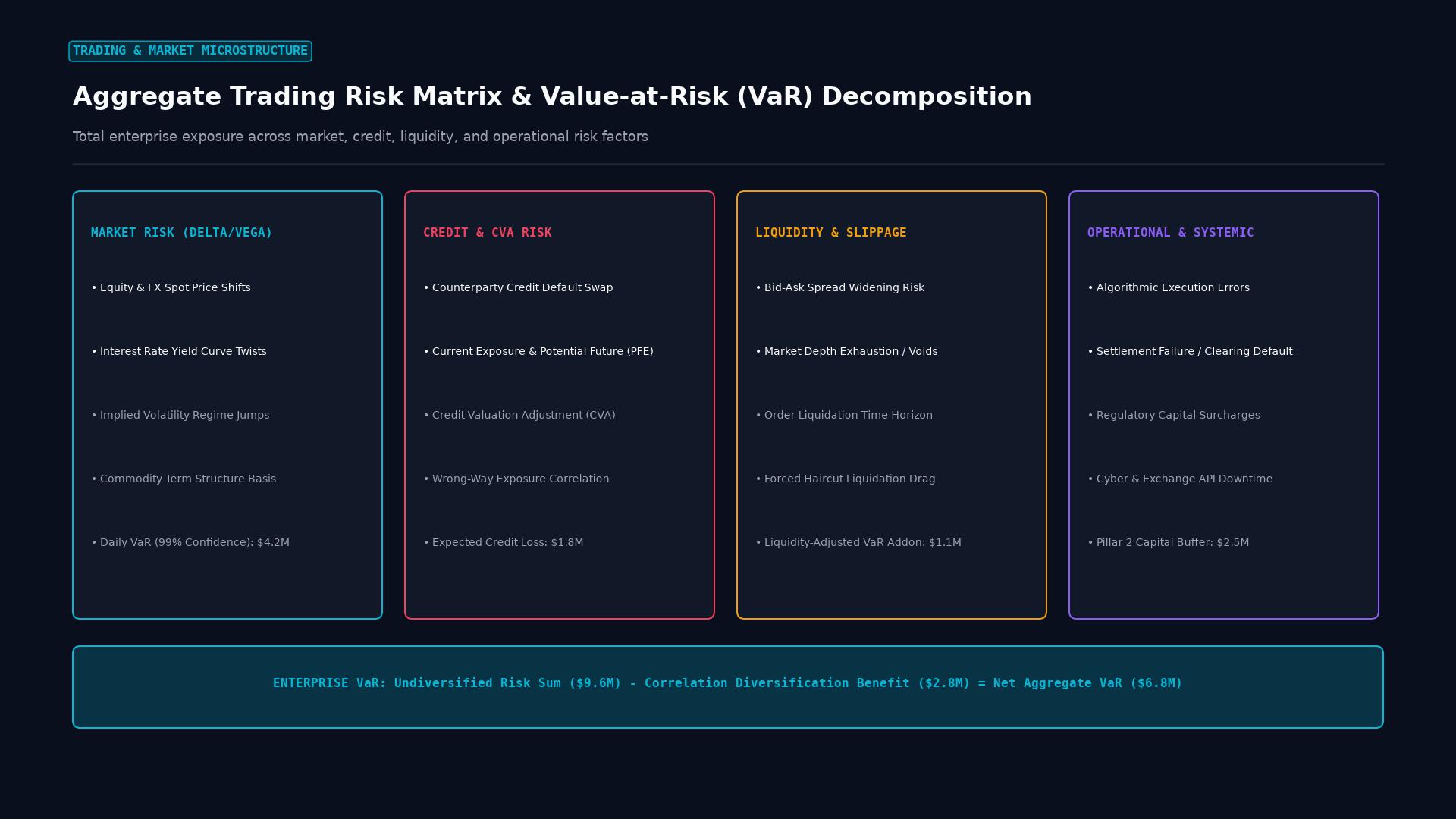
Aggregate risk represents the total, comprehensive financial exposure held across an entire trading portfolio or financial institution. Rather than analyzing risk on a segregated, trade-by-trade basis, aggregate risk evaluates how individual market bets, asset correlations, leverage tiers, and counterparty dependencies interact as a consolidated whole under extreme market conditions.
In foreign exchange trading, assessing aggregate risk is essential because currencies are deeply interconnected through shared base currencies, cross-border banking linkages, and global interest rate regimes. Traders who fail to calculate aggregate risk often believe they hold a diversified portfolio when, in reality, they hold a dangerous, highly concentrated directional bet.
The Three Dimensions of Aggregate Risk in Forex
Aggregate risk encompasses more than just market price movement; it consists of three distinct structural layers:
| Risk Dimension | What It Encompasses | Primary Failure Mechanism | Management Defense |
|---|---|---|---|
| Market Correlation Risk | Cumulative directional exposure across multiple currency pairs | Highly correlated pairs moving in tandem, causing simultaneous stop-outs | Correlation matrices, net currency exposure caps |
| Liquidity & Margin Risk | Total locked collateral relative to available free equity | Simultaneous floating losses devouring free margin and triggering forced stop-outs | Maximum 20% aggregate used margin rule |
| Counterparty Settlement Risk | Solvency and clearing integrity of brokers, banks, and liquidity providers | Broker insolvency, banking default, or cross-border settlement freezes (Herstatt risk) | Segregated Tier-1 accounts, CLS interbank clearing |
The “False Diversification” Correlation Trap
The most common failure of aggregate risk management among retail traders is failing to account for cross-pair correlation.
Consider an inexperienced trader who opens four separate 1-lot positions:
- Long EUR/USD
- Long GBP/USD
- Long AUD/USD
- Short USD/CHF
On the trading terminal, these appear as four independent tickets in four different currencies. However, an institutional risk analysis reveals that all four pairs possess a $+0.80$ to $+0.95$ positive correlation with each other:
- In every trade, the trader is shorting the U.S. dollar.
- Rather than holding four diversified 1-lot positions, the trader actually holds an aggregate 4-lot short position on the U.S. Dollar.
- If a hawkish Federal Reserve announcement causes the U.S. dollar to spike, all four trades will collapse simultaneously, inflicting four times the intended risk on a single market theme.
Quantitative Measurement: Value at Risk (VaR)
Institutional trading desks and bank risk committees quantify aggregate portfolio risk using statistical models like Value at Risk (VaR). VaR measures the maximum dollar loss expected over a given timeframe (e.g., 1 day) at a specified statistical confidence level (e.g., 99%):
$$\text{VaR} = \text{Portfolio Equity} \times Z_{\alpha} \times \sigma_{\text{portfolio}} \times \sqrt{t}$$
Where:
- $Z_{\alpha}$ = The standard normal critical value ($2.33$ for 99% confidence).
- $\sigma_{\text{portfolio}}$ = The volatility of the consolidated portfolio, calculated using the variance-covariance matrix of all constituent pairs: $$\sigma_{\text{portfolio}} = \sqrt{\sum_i \sum_j w_i w_j \sigma_i \sigma_j \rho_{ij}}$$
- $w_i, w_j$ = Weights of respective positions; $\rho_{ij}$ = Correlation coefficient between assets.
By factoring in the correlation coefficient ($\rho$), the formula penalizes traders who concentrate risk in identical directions while crediting portfolios that hold truly market-neutral, unhedged offsets.
Practical Example: Stress-Testing an Aggregate Portfolio
Consider a retail trading account with $25,000 in equity:
- Position 1: Long 1.0 lot EUR/USD ($10/pip risk)
- Position 2: Long 1.0 lot NZD/USD ($10/pip risk)
- Position 3: Long 1.0 lot AUD/USD ($10/pip risk)
The Single-Trade vs. Aggregate View
- Isolated View: The trader risks a seemingly modest 40 pips on each trade ($400 per ticket, or 1.6% of equity).
- Aggregate View: The total capital at risk across the three tickets is $1,200 (4.8% of account equity).
- The Stress Event: Strong U.S. employment figures trigger an aggressive 80-pip dollar rally across all pairs.
- The Aggregate Fallout: Because the positions were identically exposed to USD strength, all three stop-losses trigger simultaneously within ten minutes, wiping out nearly 5% of account capital in a single correlated event.
Key Takeaways
- Consolidated Vulnerability: Aggregate risk evaluates total portfolio exposure across all active positions, correlations, and counterparties.
- Correlation Awareness: Simultaneous trades involving a common currency (e.g., multiple USD pairs) compound risk rather than diversifying it.
- Margin Health: Managing aggregate risk ensures that total used margin never threatens account solvency during sudden market gaps.
- Quantitative Tools: Institutions measure aggregate risk using Value at Risk (VaR) and variance-covariance correlation models.
- Portfolio Level Limits: Professional risk managers enforce strict portfolio-wide maximum daily loss caps (e.g., 3% to 5% total account risk).
Frequently Asked Questions
What is the maximum aggregate risk a retail trader should take?
Most institutional risk management standards recommend capping total aggregate risk at no more than 3% to 5% of total account equity across all open positions at any one time, with individual trades risking no more than 1% to 2%.
How does a currency correlation matrix help manage aggregate risk?
A currency correlation matrix displays the statistical correlation (from $-1.0$ to $+1.0$) between currency pairs. By consulting the matrix before entering new trades, traders avoid opening simultaneous positions in pairs that move in near-perfect lockstep, preventing unintended exposure concentration.
What was the Herstatt risk incident in foreign exchange?
In 1974, German bank Bankhaus Herstatt collapsed after receiving Deutsche Marks from counterparties in Frankfurt, but before it could deliver U.S. dollars to New York due to time-zone settlement differences. This catastrophic settlement default led directly to the creation of the Basel Committee on Banking Supervision and the CLS (Continuous Linked Settlement) system to eliminate interbank aggregate settlement risk.
Ready to trade forex?
Open a free demo account with a regulated broker. Practice with virtual funds before risking real money.