Back-Office
The operational, administrative, and technological division of a financial institution or brokerage responsible for post-trade processing, trade confirmation, clearing, settlement, accounting, and regulatory compliance reporting.
Back-Office
In investment banks, asset management institutions, hedge funds, and retail forex brokerages, the back-office represents the operational engine responsible for everything that occurs after a financial trade is executed. While the revenue-generating front-office negotiates pricing and executes orders, and the middle-office monitors real-time market and credit risk, the back-office ensures that transactions are legally confirmed, accurately recorded, cleared through depositories, settled with cash and securities, and reported to statutory regulatory authorities.
In contemporary electronic finance, the back-office has evolved from a paper-heavy administrative archive into a mission-critical technology and compliance center. Back-office systems handle trillions of dollars in daily gross transactions across global capital markets. Sub-millisecond trade capture, straight-through processing (STP), anti-money laundering (AML) surveillance, and international multi-currency payment-versus-payment (PvP) clearing all depend entirely on back-office architecture.
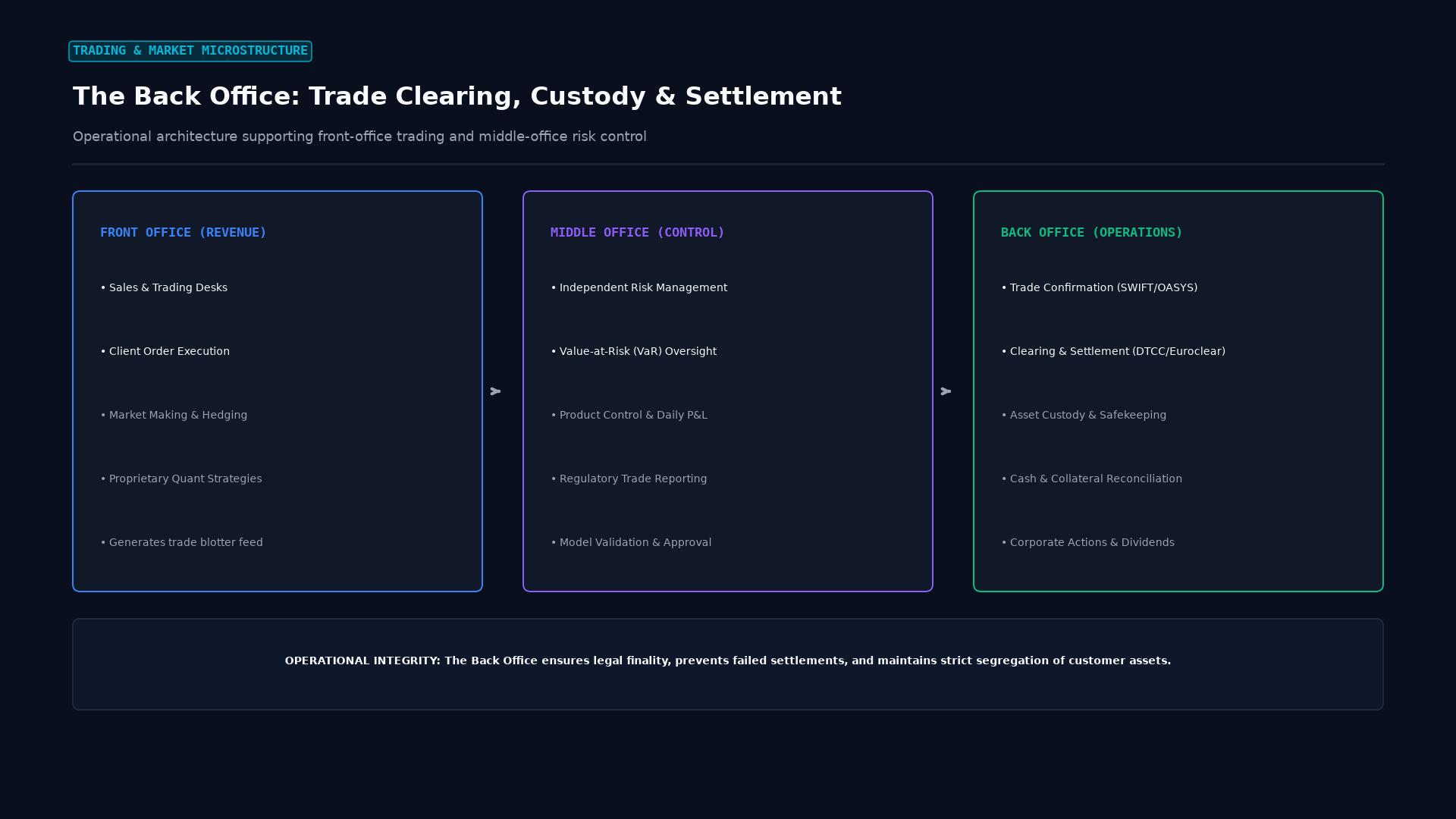 Figure: Trading firm organizational divisions: Front Office order execution feeding Middle Office risk controls, culminating in Back Office clearing, settlement, and custody.
The Post-Trade Processing Lifecycle
From the moment an institutional trader or retail algorithmic bot executes an order, the back-office manages a synchronized, multi-stage processing lifecycle:
+--------------------------------------------------------------------------+
|                  The Five Stages of the Post-Trade Lifecycle             |
+--------------------------------------------------------------------------+
|  Stage                  | Operational Mechanics & Infrastructure         |
+-------------------------+------------------------------------------------+
|  1. Trade Capture       | Ingests raw electronic trade tickets from      |
|     & Validation        | front-office execution platforms (Bloomberg,   |
|                         | Tradeweb, MetaTrader, FIX engines).            |
|  2. Confirmation        | Matches trade parameters (notional, rate,      |
|     & Affirmation       | value date) against counterparty records via   |
|                         | SWIFT messages (MT300/MT304) or Omgeo.         |
|  3. Clearing & Netting  | Aggregates bilateral gross trades into single   |
|                         | net payment obligations via central clearing   |
|                         | counterparties (CCPs like LCH, DTCC).          |
|  4. Settlement          | Executes physical transfer of currency or stock|
|                         | via central bank real-time gross settlement    |
|                         | (Fedwire, TARGET2) or Continuous Linked Settl. |
|  5. Accounting          | Posts journal entries to general ledgers,      |
|     & Reconciliation    | audits custodian statements, resolves breaks.  |
+--------------------------------------------------------------------------+
[ Trade Executed on Front-Office Dealing Screen ]
│
▼
[ Electronic Ticket Exported via Financial Information eXchange (FIX) ]
│
▼
[ Automated Confirmation: SWIFT MT300 Message Dispatched to Counterparty ]
│
┌───────────────┴───────────────┐
▼ ▼
[ Exact Match Confirmed ] [ Mismatch / Break Detected ]
│ │
▼ ▼
[ Route to Netting Engine ] [ Exception Queue: Back-Office Investigates ]
│ (Trade breaks, wrong value date, split accounts)
▼
[ Final Settlement: PvP via CLS Bank or DvP via Euroclear / DTCC ]Settlement Risk and the Legacy of Bankhaus Herstatt
The most critical systemic risk managed by the foreign exchange back-office is settlement risk (historically termed Herstatt risk).
The 1974 Bankhaus Herstatt Collapse
On June 26, 1974, German banking regulators forced the liquidation of Bankhaus Herstatt, an active foreign exchange dealer in Cologne. German banks closed at 4:30 PM Central European Time. Herstatt had already received Deutsche Marks from international counterparty banks in Frankfurt in settlement of foreign exchange contracts.
However, because New York financial markets were opening six hours behind Germany, Herstatt was placed into receivership before its New York correspondent bank could release the corresponding US dollars to counterparty banks. Counterparties sustained catastrophic losses, paying out full Deutsche Marks while receiving zero dollars. This cross-currency time zone mismatch immobilized the global interbank payment grid for days.
+--------------------------------------------------------------------------+
|                  How CLS Bank Eliminates Herstatt Settlement Risk        |
+--------------------------------------------------------------------------+
|                                                                          |
|  In 2002, major global central banks and tier-one foreign exchange       |
|  dealers established Continuous Linked Settlement (CLS Bank).             |
|                                                                          |
|  Payment-versus-Payment (PvP) Mechanics:                                 |
|  - CLS acts as a specialized settlement bank connected directly to       |
|    eighteen national central bank Real-Time Gross Settlement (RTGS) rails|
|    (such as Fedwire for USD, TARGET2 for EUR, and BOJ-NET for JPY).      |
|  - Under CLS settlement, Leg A of a currency trade is paid out IF AND    |
|    ONLY IF Leg B is simultaneously transferred.                          |
|  - If a counterparty fails to fund its currency leg, the transaction is  |
|    instantly aborted, returning original principal to the solvent party. |
|                                                                          |
+--------------------------------------------------------------------------+
Straight-Through Processing (STP) and the T+1 Horizon
Historically, back-office operations required massive clerical armies to manually re-key trade tickets, inspect paper delivery receipts, and cross-reference physical ledgers.
Modern financial institutions operate under Straight-Through Processing (STP):
+--------------------------------------------------------------------------+
|                  Manual Legacy Processing vs. Modern STP                 |
+--------------------------------------------------------------------------+
|  Operational Feature  | Legacy Manual Operations | Straight-Through Proc.|
+-----------------------+--------------------------+-----------------------+
|  Human Touchpoints    | 5 to 8 manual key-ins    | Zero manual entry for |
|                       | per executed trade       | 99%+ of vanilla flow  |
|  Error Rates          | 1.5% to 3.0% trade breaks| Less than 0.05% breaks|
|  Exception Management | Reactive; slow resolution| Automated routing of  |
|                       | via physical phone calls | mismatch exceptions   |
|  Settlement Cycle     | Historically T+5 or T+3  | Standardized T+1 / T+2|
+--------------------------------------------------------------------------+
The Transition to T+1 Settlement (May 2024)
On May 28, 2024, US, Canadian, and Mexican equity and corporate debt markets transitioned from a T+2 settlement cycle (trade date plus two business days) to T+1 settlement under revised SEC Rule 15c6-1.
This acceleration placed immense pressure on international back-offices:
- European and Asian asset managers purchasing US securities have only a few hours after the US market close to confirm trades, match allocations, and secure foreign exchange conversions before the mandatory 9:00 PM Eastern Time affirmation deadline.
- Back-office software must execute automated foreign exchange matching overnight to ensure US dollars are delivered to settle stock purchases the following morning, penalizing institutions with fragmented legacy operations.
Regulatory Compliance and Mandatory Trade Repositories
Following the 2008 global financial crisis, international regulators passed sweeping statutes to eliminate the opacity of over-the-counter (OTC) derivatives:
+--------------------------------------------------------------------------+
|                  Back-Office Regulatory Compliance Framework             |
+--------------------------------------------------------------------------+
|  Regulatory Regime    | Back-Office Operational Mandate                  |
+-----------------------+--------------------------------------------------+
|  European Market      | Mandates electronic reporting of all OTC foreign |
|  Infrastructure       | exchange, interest rate, and credit derivatives  |
|  Regulation (EMIR)    | to registered Trade Repositories (e.g., DTCC)    |
|                       | within T+1, including Unique Trade Identifiers.  |
|  Dodd-Frank Act       | Mandates swap data reporting (CFTC Part 43/45),  |
|  (Title VII, US)      | real-time public dissemination of swap prices,   |
|                       | and centralized clearing for standardized swaps. |
|  Uncleared Margin     | Back-office systems must calculate daily Initial |
|  Rules (UMR)          | Margin (IM) and Variation Margin (VM) using the  |
|                       | ISDA SIMM model, segregating collateral in trusts|
+--------------------------------------------------------------------------+
If a back-office fails to transmit accurate trade reports containing the correct Legal Entity Identifier (LEI) and Unique Trade Identifier (UTI) within statutory deadlines, regulatory authorities (such as the UK FCA or US CFTC) levy multi-million-dollar fines and can suspend broker dealing licenses.
Why Back-Office Quality Matters for Retail Traders
While retail traders focus heavily on advertised spreads, platform charting, and leverage ratios, a broker’s operational back-office directly dictates the safety of client funds:
[ Retail Trader Deposits Capital / Opens Position / Requests Withdrawal ]
                               │
                               ▼
         [ The Broker Back-Office Operational Scorecard ]
                               │
    ┌──────────────────────────┼──────────────────────────┐
    ▼                          ▼                          ▼
[ Client Fund Segregation ] [ Withdrawal Processing ]  [ Margin Liquidation ]
Client funds kept in tier-1  Automated STP approvals   Sub-millisecond margin
segregated trust accounts,   processed within hours;   monitoring; prevents
immune from broker creditors zero artificial delays negative account balances- Client Money Segregation: Professional back-offices enforce strict accounting segregation under regulatory rules (such as FCA CASS rules in the UK). Client funds are isolated in designated trust accounts, preventing the broker from utilizing retail customer deposits to pay internal corporate expenses.
- Withdrawal Friction: When an unethical broker delays customer withdrawals, the cause is rarely technological. Unscrupulous firms utilize manual back-office “compliance reviews” as a delay tactic to discourage capital outflows. Conversely, elite brokers utilize automated back-office STP pipelines that process withdrawal requests to bank rails in minutes.
- Automated Stop-Out Execution: When high-impact macroeconomic news sparks extreme volatility, back-office risk engines calculate client equity in real time. Deficient back-office infrastructure results in delayed margin calls, allowing customer balances to plunge into negative equity.
Frequently Asked Questions
What is the difference between clearing and settlement?
Clearing is the post-trade process that occurs before settlement. It involves verifying trade parameters, matching trade confirmations between counterparties, calculating net obligations, and managing counterparty credit risk (often through a clearinghouse). Settlement is the final operational step where the actual legal exchange of ownership occurs: cash is transferred across bank accounts, and securities are delivered to depository accounts.
What is a trade break?
A trade break occurs when the details submitted by the buyer and seller do not match. If the front-office trader records buying 1,000,000 EUR/USD at 1.0850 for value on October 15, but the counterparty confirms 1,000,000 EUR/USD at 1.0852 or with a value date of October 16, the back-office confirmation system flags a break. The trade cannot settle until operations specialists investigate and resolve the discrepancy.
What role does SWIFT play in back-office operations?
The Society for Worldwide Interbank Financial Telecommunication (SWIFT) provides the secure, standardized financial messaging network used by financial back-offices globally. Back-offices transmit standardized messages (such as MT300 for foreign exchange confirmations, MT103 for customer wire transfers, and MT202 for interbank transfers) or modernized ISO 20022 XML messages to instruct correspondent banks and depositories to move funds and confirm contracts.
Ready to trade forex?
Open a free demo account with a regulated broker. Practice with virtual funds before risking real money.