Front Office
The front office comprises the client-facing, revenue-generating divisions of an investment bank, hedge fund, or brokerage, consisting of sales traders, market makers, proprietary traders, and investment bankers who generate business and assume direct market risk.
What Is the Front Office?
In institutional banking, brokerage operations, and capital markets, the front office designates the primary business units responsible for client interaction, commercial deal origination, and direct revenue generation. Personnel operating within the front office—including institutional sales representatives, foreign exchange market makers, equity derivatives traders, and corporate finance advisors—generate income for the firm through commissions, bid-ask spread capture, advisory fees, and trading profits.
The front office operates as the operational tip of the spear in a three-tier institutional financial architecture, supported behind the scenes by the middle office (risk management and compliance) and the back office (clearing, settlement, and accounting).
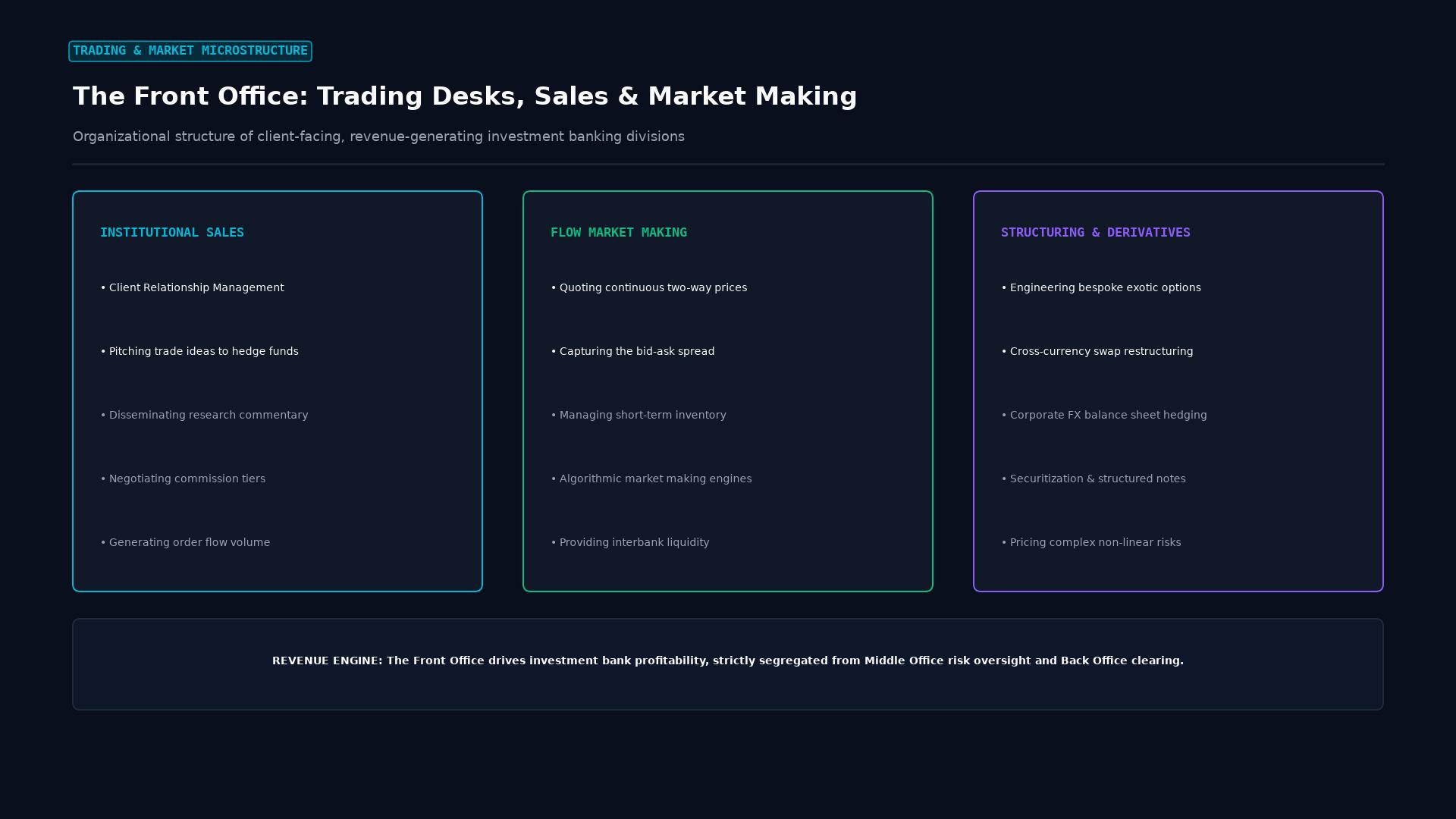 Figure: Investment bank front office organization: Institutional Sales client coverage, Flow Market Making liquidity provision, and Quantitative Structuring revenue generation.
Key Takeaways
- Revenue Engine: The front office is the only division of an investment bank that directly produces gross commercial revenue; middle and back offices operate as cost centers providing critical risk control and operational execution.
- Direct Market Exposure: Front-office traders hold discretionary authority to commit the firm’s capital, execute high-value block transactions, and manage inventory risk across foreign exchange pairs.
- Performance-Driven Compensation: Front-office compensation is heavily weighted toward variable annual performance bonuses tied to deal volume, commission generation, and net trading P&L.
- The Electronic Evolution: Modern front-office foreign exchange desks have largely transitioned from traditional “voice trading” over telephones to automated algorithmic pricing engines and Electronic Communication Networks (ECNs).
Front vs. Middle vs. Back Office: Institutional Comparison
| Dimension | Front Office | Middle Office | Back Office |
|---|---|---|---|
| Primary Mandate | Generate revenue and execute client trades | Control risk and enforce regulatory compliance | Settle transactions and reconcile cash ledgers |
| Core Roles | Sales traders, market makers, structurers, origination | Risk managers (Market, Credit, Operational), Product Control | Settlement clerks, corporate actions, IT support, compliance reporting |
| Client Interaction | High; continuous contact with institutional funds | Internal only (monitors front office) | Minimal; communicates with clearing houses and custodians |
| Technology Used | Bloomberg terminals, FIX APIs, OMS/EMS blotters | Risk valuation engines, VaR models, limit monitoring | SWIFT payment networks, CLS settlement, core ledger ERPs |
| Financial Nature | Profit Center | Cost / Control Center | Cost / Operational Center |
Primary Foreign Exchange (FX) Front-Office Desks
Within an institutional Tier-1 investment bank, the foreign exchange front office is structured into specialized trading desks:
- Spot FX Desk: Focuses on immediate delivery trading across G10 majors (EUR/USD, USD/JPY, GBP/USD). Traders manage massive continuous two-sided liquidity books, making money on fractions of a pip.
- STIR & FX Forwards Desk: Short-Term Interest Rate (STIR) and forward traders manage forward points, cash roll swaps, and cross-currency basis spreads, servicing corporate treasurers hedging future cash flows.
- FX Options & Structuring Desk: Prices plain-vanilla and exotic currency options (barriers, digitals, corridors). Structurers design bespoke hedging solutions for multinational corporate mergers and acquisitions (M&A).
- Emerging Markets (EM) Desk: Trades non-deliverable forwards (NDFs) and illiquid currency crosses across Latin America, Asia, and EMEA, managing wider spreads and heightened sovereign transfer risk.
The “Chinese Wall” Regulatory Safeguard
Because front-office investment bankers work on sensitive, market-moving corporate events (such as impending acquisitions or debt restructuring), financial regulations mandate strict information barriers known as Chinese Walls:
- Investment banking advisory personnel are legally prohibited from sharing non-public material information with front-office sales and trading desks.
- Compliance surveillance software monitors email, phone transcripts, and instant messaging to ensure proprietary traders do not trade ahead of corporate client news (“insider trading”).
Frequently Asked Questions
What skills are required to work on a modern front-office FX desk?
While historical front-office trading relied heavily on interpersonal sales skills and market intuition, the modern front office demands advanced quantitative aptitude. Traders and structurers typically possess degrees in financial engineering, computer science, or mathematics, and frequently program algorithmic pricing engines in Python and C++.
What is the role of an Institutional Sales Trader?
Sales traders act as the bridge between institutional clients (hedge funds, pension managers, sovereign wealth funds) and the bank’s internal market makers. They interpret market intelligence, provide macro trade ideas, and ensure the client receives high-quality execution without tipping off the broader market.
What is an “Execution-Only” broker?
An execution-only brokerage operates a stripped-down front office that provides pure order routing and matching technology without offering personal investment advice, market recommendations, or tailored trade structuring. Most retail online forex brokerages operate on an execution-only model.
Ready to trade forex?
Open a free demo account with a regulated broker. Practice with virtual funds before risking real money.