Basis Trading
Basis trading is a relative-value trading strategy that seeks to capture profit from expected shifts in the spread (the basis) between an asset's spot cash price and its futures contract, rather than betting on outright directional market moves. Popular variants include cash-and-carry and Treasury basis trades.
What Is Basis Trading?
Basis trading is an established relative-value strategy practiced by institutional hedge funds, proprietary trading desks, and commercial hedgers. Rather than forecasting whether an asset’s price will rise or fall, a basis trader focuses exclusively on the mathematical spread between two instruments: the physical spot (cash) price and the derivative futures price.
Because spot and futures contracts track the exact same underlying asset, their price movements are highly correlated. However, temporary imbalances in financing conditions, regulatory capital requirements, seasonal supply bottlenecks, or sudden shifts in speculative order flow can cause the spread between them—the basis—to dislocate from its theoretical fair value.
A basis trader executes simultaneous, offsetting positions in the cash and futures markets, effectively neutralizing outright market risk. The position yields a profit whenever the basis moves toward the trader’s target spread, regardless of whether the broader market surges into a bull market or collapses into a severe crash.
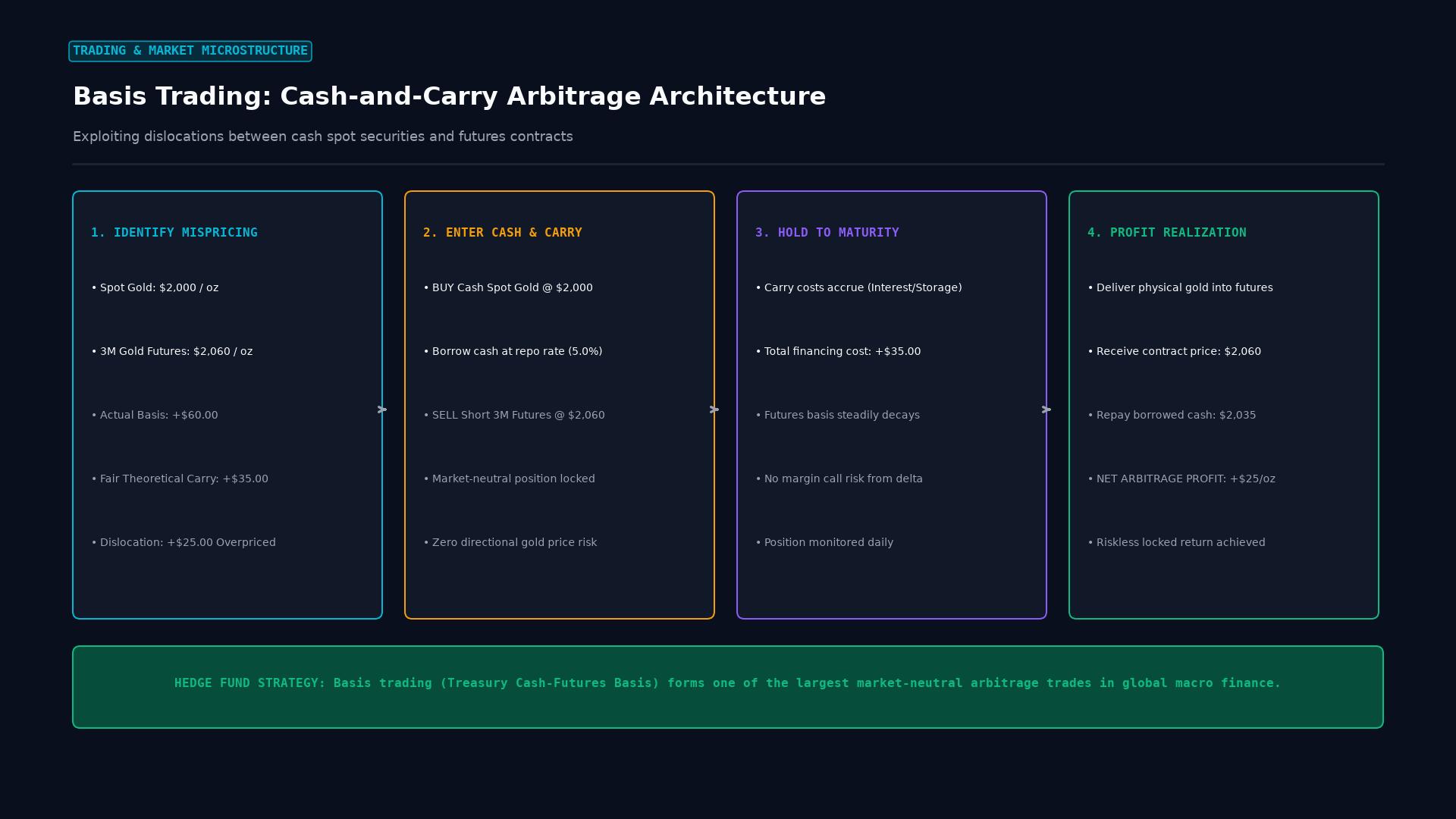 Figure: Market-neutral basis trading cycle: identifying mispriced futures basis, establishing cash-and-carry positions, and locking in risk-free cost-of-carry spreads.
The Two Core Mechanics: Long Basis vs. Short Basis
Depending on whether an analyst anticipates the basis will expand or contract, they construct one of two operational structures:
1. Long the Basis (Cash-and-Carry Trade)
A trader “goes long the basis” when they expect the basis to strengthen (become more positive or less negative):
- Action: Buy the spot asset (cash) and simultaneously sell (short) the futures contract.
- Payoff: If the spot price rises faster than the futures price, or if the futures contract declines toward the spot price as expiration approaches, the trader locks in the convergence spread.
- In physical commodities and currencies, this is traditionally referred to as a cash-and-carry trade. The trader finances the purchase of the spot asset, hedges the price risk by shorting futures, and earns the difference between the futures premium and their total borrowing and storage costs.
2. Short the Basis (Reverse Cash-and-Carry)
A trader “shorts the basis” when they expect the basis to weaken (become more negative):
- Action: Short sell the spot asset and simultaneously buy (long) the futures contract.
- Payoff: The trade profits if spot prices drop faster than futures prices, or if the futures contract expands its premium over the cash asset.
Institutional Basis Trading: The Treasury Basis Trade
In modern global macro finance, the most prominent and closely scrutinized application of this strategy is the Treasury Basis Trade, executed by elite multi-strategy hedge funds.
Institutional funds observe that US Treasury futures traded on the CME frequently trade at a slight premium to physical cash Treasuries. This occurs because mutual funds, foreign central banks, and retail investors prefer holding futures for capital efficiency, bidding up futures prices.
To exploit this subtle mispricing:
- The hedge fund purchases physical cash Treasury bonds in the cash market.
- The fund shorts the corresponding Treasury futures contract.
- The fund finances the physical bond purchase through the overnight repurchase agreement (repo) market, borrowing cash and posting the newly acquired Treasury bond as collateral.
Because the pricing spread between cash Treasuries and Treasury futures is minuscule—often just a fraction of a basis point—hedge funds deploy staggering leverage (typically 20x to 50x) to magnify returns into double digits.
When market volatility abruptly spikes (such as during the March 2020 pandemic onset), repo lenders demand higher collateral margins (“haircuts”). Highly leveraged hedge funds are forced to rapidly unwind both legs simultaneously, triggering severe liquidity dislocations that spill over directly into global currency and interest rate markets.
Basis Trading in Foreign Exchange
Foreign exchange market participants apply basis trading across several dimensions:
Spot vs. Futures Discrepancies
Currency futures traded on exchanges like the CME occasionally deviate from the institutional over-the-counter (OTC) spot forex rate adjusted for interest differentials. High-frequency algorithms detect when CME Euro FX futures trade out of alignment with OTC spot EUR/USD, buying the undervalued venue and selling the overvalued venue to capture riskless convergence.
Cross-Currency Basis Arbitrage
International banks engage in basis trading to monetize dislocations in the cross-currency basis swap. When foreign institutional demand for US Dollar funding drives the JPY/USD or EUR/USD basis deeply negative, institutions with surplus US Dollar reserves can lend dollars in the swap market, converting synthetic funding into substantial risk-adjusted yields.
Practical Trading Example: Cash-and-Carry Convergence
Consider a simplified agricultural and currency commodity basis setup:
- Current Date: October 1
- Spot Gold Price (XAU/USD): $2,600.00 per troy ounce
- December Gold Futures (60 days to expiry): $2,625.00
- Prevailing Basis: $$ \text{Basis} = \text{Spot} - \text{Futures} = $2,600 - $2,625 = -$25.00 $$
An institutional arbitrage desk calculates its total 60-day financing and bullion storage cost to hold physical gold at $12.00 per ounce.
- Trade Construction:
- Borrow funds at the institutional repo rate.
- Buy 1,000 ounces of spot gold at $2,600.00 (Total outlay: $2,600,000).
- Simultaneously sell 10 December gold futures contracts (100 oz each = 1,000 oz) at $2,625.00.
- The Holding Period:
- Over the next 60 days, outright gold prices could surge to $3,000 or collapse to $2,000; the desk’s capital is completely shielded from price direction.
- Delivery at Expiration:
- On the December settlement date, the futures price converges directly to the spot price.
- The desk delivers the physical gold into the futures contract at the locked-in price of $2,625.00 per ounce.
- Profit Calculation:
- Gross Revenue: $$2,625 - $2,600 = $25.00\text{ per ounce}$
- Financing and Storage Expenses: $-$12.00\text{ per ounce}$
- Net Risk-Free Profit: $13.00 per ounce ($13,000 total on the position), achieving an annualized risk-free return well above standard money market rates.
Key Takeaways
- Basis trading exploits mispricings in the spread between spot cash prices and futures contracts rather than predicting market direction.
- Long basis trades (cash-and-carry) involve buying spot and shorting futures to capture convergence.
- Short basis trades (reverse cash-and-carry) involve shorting spot and buying futures.
- The US Treasury basis trade utilizes immense repo leverage to monetize micro-spreads, presenting systemic liquidity risks during market stress.
- In forex, basis trading aligns spot exchange rates with currency futures and exploits anomalies in cross-currency funding swap markets.
FAQ
Why is basis trading considered lower risk than directional trading? Because the trader holds equal and opposite positions in two instruments tracking the identical asset, broad market rallies or crashes cancel out across the long and short legs. The trader is exposed only to “basis risk”—the danger that the spread between the two assets does not behave as anticipated.
What is the primary danger of basis trading? The primary danger is liquidity and margin risk. While the positions are hedged economically, a sudden widening of the basis before convergence requires the trader to post additional margin on the losing leg. If credit lines dry up or leverage is excessive, forced liquidation can inflict catastrophic losses before the spread converges.
Do retail traders participate in basis trading? Retail traders rarely execute pure cash-and-carry basis trades because retail margin requirements and financing costs are significantly higher than those available to prime-brokered hedge funds, eroding the thin basis spreads.
Ready to trade forex?
Open a free demo account with a regulated broker. Practice with virtual funds before risking real money.