Basis
In financial markets, basis refers to the mathematical spread between the spot (cash) price of an asset and its corresponding futures or forward contract price. In fixed income and foreign exchange, the term also denotes basis points (bps) and the cross-currency basis spread in interbank swap markets.
Understanding the Concept of Basis
The term basis carries several related meanings across financial disciplines, but at its foundation, it always quantifies the difference between two related prices, rates, or yields.
In commodities and derivative trading, the primary definition of basis is the spread between the local cash (spot) price of an asset and the price of its benchmark futures contract:
$$ \text{Basis} = \text{Spot Price} - \text{Futures Price} $$
Depending on market convention, traders occasionally invert the formula ($\text{Futures Price} - \text{Spot Price}$), particularly in financial index and currency futures. Regardless of convention, the magnitude and behavior of the basis reflect carrying costs—the expenses associated with financing, storing, insuring, and holding the underlying physical asset or currency until the futures contract reaches delivery.
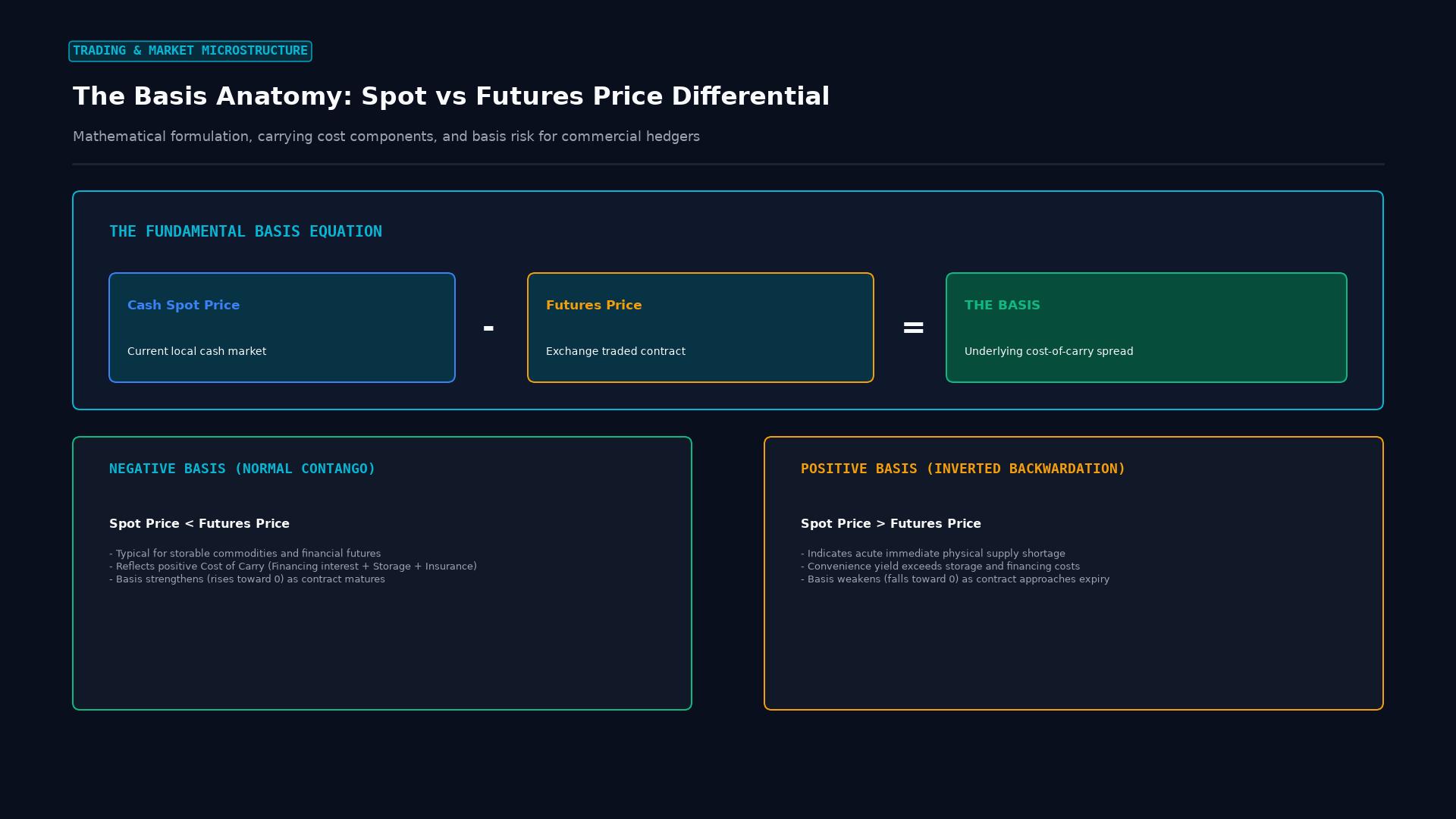 Figure: Components of the financial and commodity basis: Spot minus Futures price relationship, reflecting storage, financing interest, insurance, and convenience yield.
Contango vs. Backwardation: The State of the Basis
The relationship between spot and futures prices dictates the state of the market:
- Contango (Negative Basis): When futures prices trade at a premium to the current spot price ($\text{Futures} > \text{Spot}$). In physical markets, this premium reflects the positive cost of carry: interest on borrowed funds, warehousing fees, and insurance. As the futures contract nears its expiration date, the futures price converges downward toward the spot price, a process known as basis convergence.
- Backwardation (Positive Basis): When spot prices trade higher than futures prices ($\text{Spot} > \text{Futures}$). Backwardation occurs when immediate physical demand severely outstrips available spot supply, creating a “convenience yield” that prompts buyers to pay a steep premium for immediate delivery.
Basis in Foreign Exchange: The Cross-Currency Basis Swap
In institutional foreign exchange markets, “basis” takes on a crucial macroeconomic dimension known as the Cross-Currency Basis.
According to the classical theory of Covered Interest Parity (CIP), the cost of borrowing a currency through the foreign exchange swap market should match the interest rate differential between the two national money markets. However, since the 2008 global financial crisis, this theoretical parity has broken down.
The cross-currency basis measures the extra premium (or discount) that market participants must pay to borrow US Dollars by pledging a foreign currency (such as Euros, Japanese Yen, or British Pounds) as collateral in the FX swap market:
- A Negative Basis: When international banks must pay an additional spread below the standard interest rate swap rate to obtain US Dollars. A deeply negative EUR/USD or JPY/USD cross-currency basis indicates an acute global shortage of US Dollar funding.
- A Positive Basis: Indicates that foreign currency is in higher demand relative to US Dollar liquidity, though this condition is historically rare.
Macro funds and interbank desks monitor cross-currency basis spreads continuously because sudden widenings in the basis serve as an early warning indicator of distress within global banking systems.
Basis Points (Bps) in Everyday Trading
In debt capital markets, central bank policy announcements, and currency swap pricing, the word “basis” is frequently used as shorthand for basis points (abbreviated as bps or “bips”):
- 1 Basis Point = 0.01% = 0.0001
- 100 Basis Points = 1.00%
When financial media reports that the Federal Reserve raised the Federal Funds Rate by “50 basis points,” it means interest rates increased by half of one percentage point (0.50%). In retail forex trading, one basis point on a four-decimal currency pair (like EUR/USD at 1.0850) is equivalent to exactly 1 pip.
Practical Trading Example: Basis Convergence
Consider an institutional agricultural or currency desk monitoring the December Euro FX futures contract traded on the Chicago Mercantile Exchange (CME):
- Date: September 15
- Spot EUR/USD Rate: 1.0800
- December EUR/USD Futures Price: 1.0845
- Initial Basis: $$ \text{Spot} - \text{Futures} = 1.0800 - 1.0845 = -0.0045 \text{ (-45 pips)} $$
The 45-pip negative basis reflects the net interest rate differential between the Eurozone and the US over the remaining 90 days until contract delivery.
Over the next two months:
- By November 15, with 30 days remaining, the basis narrows from -45 pips to -15 pips as time decay erodes the financing component.
- By expiration day in December, spot and futures must settle at the identical price to prevent riskless physical delivery arbitrage. The basis converges precisely to 0.0000.
Traders who specialize in basis trading exploit deviations where the basis widens or narrows faster than the theoretical cost of carry warrants.
Key Takeaways
- Basis is primarily the mathematical difference between the current spot price of an asset and its futures contract price.
- In financial markets, basis is dictated by the cost of carry—interest rates, storage costs, and convenience yield.
- Contango occurs when futures trade at a premium to spot; backwardation occurs when spot trades at a premium to futures.
- In interbank forex, the cross-currency basis quantifies global imbalances and funding premiums in US Dollar liquidity.
- A basis point (bp) equals one-hundredth of a percentage point (0.01%), corresponding to 1 pip in standard four-decimal currency pairs.
FAQ
Why does the basis always converge to zero at futures expiration? On the final delivery date of a futures contract, the futures contract legally represents immediate delivery of the underlying asset. If a price difference existed between spot and expiring futures, arbitrageurs would buy the cheaper venue and deliver into the pricier venue, instantly forcing the basis to zero.
What causes the cross-currency basis to become deeply negative? The cross-currency basis turns deeply negative during systemic liquidity crunches when non-US banks face difficulties rolling over US Dollar-denominated liabilities. Because these banks cannot access direct Federal Reserve lending facilities, they aggressively bid up the cost of synthetic US Dollars in the FX swap market.
Is basis risk the same as market price risk? No. Market price risk is the danger that the outright price of an asset will rise or fall. Basis risk is the danger that the spread between the spot price and the hedging derivative will fluctuate unpredictably, resulting in an imperfect hedge.
Ready to trade forex?
Open a free demo account with a regulated broker. Practice with virtual funds before risking real money.