Basket
A currency basket is a curated portfolio of multiple national currencies, each assigned a specific mathematical weighting. It serves as a benchmark for synthetic indices (such as the US Dollar Index), an international reserve asset (like the IMF's Special Drawing Rights), or an anchor for managed exchange rate regimes.
What Is a Currency Basket?
In international finance, a currency basket is a weighted collection of individual foreign currencies combined into a single composite unit of value. Rather than assessing a currency’s purchasing power solely through a bilateral relationship (such as EUR/USD or USD/JPY), a basket provides a diversified, multidimensional benchmark of currency strength.
Bilateral exchange rates can often produce misleading narratives. If EUR/USD drops from 1.1000 to 1.0700, an observer looking at that single pair cannot determine whether the Euro is suffering from European economic weakness, or whether the US Dollar is experiencing broad institutional buying across global markets. By measuring a currency against a diversified basket of its primary trading partners, market participants isolate true domestic currency strength from bilateral noise.
Currency baskets play three essential roles in global financial architecture:
- Benchmark Indices: Form the basis for trade-weighted market indices like the US Dollar Index (DXY).
- Sovereign Peg Anchors: Serve as the stabilization anchor for nations with managed floating exchange rate regimes.
- Supranational Reserve Assets: Underpin international monetary instruments, most notably the International Monetary Fund’s Special Drawing Rights (SDR).
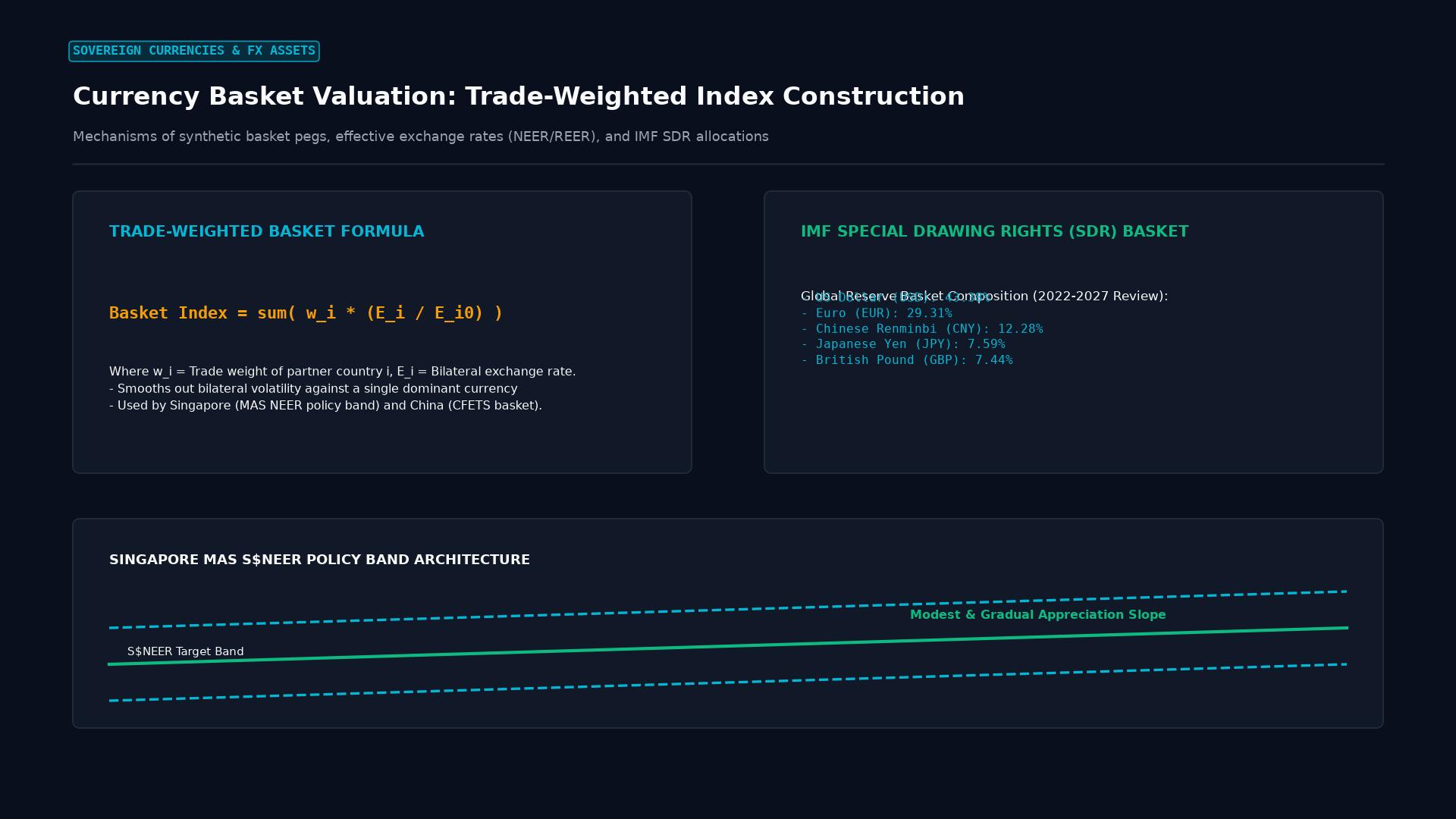 Figure: Trade-weighted index construction: effective exchange rate (NEER/REER) basket weighting, IMF SDR allocation, and Singapore MAS S$NEER policy bands.
Prominent Global Currency Baskets
Several internationally renowned currency baskets anchor global financial markets:
1. The US Dollar Index (DXY)
Created in 1973 following the dissolution of the Bretton Woods fixed exchange rate system, the ICE US Dollar Index (DXY) remains the most widely cited measure of the greenback’s international value. It tracks the US Dollar against a geometrically weighted basket of six major currencies:
- Euro (EUR): 57.6%
- Japanese Yen (JPY): 13.6%
- British Pound (GBP): 11.9%
- Canadian Dollar (CAD): 9.1%
- Swedish Krona (SEK): 4.2%
- Swiss Franc (CHF): 3.6%
Because the Euro constitutes more than half of the entire index weighting, the DXY operates in practice as an inverse proxy for EUR/USD.
2. IMF Special Drawing Rights (SDR)
The Special Drawing Rights (SDR) is an international reserve asset created by the International Monetary Fund (IMF) in 1969 to supplement member countries’ official reserves. The value of the SDR is determined by a daily currency basket reviewed every five years by the IMF Executive Board to reflect the importance of currencies in global trade and financial transactions.
The current SDR basket includes:
- US Dollar (USD): ~43.38%
- Euro (EUR): ~29.31%
- Chinese Renminbi (CNY): ~12.28%
- Japanese Yen (JPY): ~7.59%
- British Pound (GBP): ~7.44%
3. Sovereign Managed Peg Baskets
Rather than fixing their currency to a single foreign currency (which leaves domestic monetary policy hostage to foreign central banks), several nations peg their currency to a trade-weighted basket:
- Singapore (MAS S$NEER): The Monetary Authority of Singapore (MAS) conducts monetary policy not through domestic interest rates, but by managing the Singapore Dollar against an undisclosed trade-weighted basket of its major trading partners within an adjustable policy band.
- China (CFETS RMB Index): In 2015, China introduced the China Foreign Exchange Trade System (CFETS) currency basket—currently tracking the Renminbi against a diversified group of 24 global currencies—to decouple market focus from bilateral USD/CNY quotes.
- Kuwait (Kuwaiti Dinar - KWD): The Kuwaiti Dinar, the highest-valued sovereign currency unit in the world, is pegged to an undisclosed basket of international currencies reflecting Kuwait’s primary trade flows.
Nominal and Real Effective Exchange Rates (NEER and REER)
Macroeconomists and central banks formalize the basket concept through two vital statistical metrics:
- Nominal Effective Exchange Rate (NEER): An unadjusted trade-weighted average of bilateral exchange rates against major trade partners. A rising NEER indicates that the domestic currency is appreciating on average against its commercial competitors.
- Real Effective Exchange Rate (REER): The NEER adjusted for inflation rate differentials between the domestic economy and its trading partners. REER measures true international price competitiveness: if a nation’s REER rises, its export goods are becoming more expensive in real terms relative to foreign competitors.
Basket Trading Strategies in Modern Forex
Institutional hedge funds and algorithmic desks actively trade synthetic baskets to exploit structural imbalances:
The Safe-Haven vs. Commodity Basket Trade
During shifts between global “risk-on” and “risk-off” market regimes, a quantitative fund might buy a basket of high-beta commodity currencies (40% AUD, 30% CAD, 30% NZD) and simultaneously short a basket of defensive funding currencies (50% JPY, 50% CHF). This synthetic structure insulates the fund from isolated country-specific news shocks, capturing pure macroeconomic risk appetite.
Central Bank Band Mean-Reversion
Traders monitoring the Singapore Dollar or Chinese Renminbi construct proprietary models of the central bank’s basket band. When the currency pushes against the upper boundary of the theoretical basket band, traders initiate short positions, anticipating that the central bank will intervene in spot markets to steer the currency back toward the basket midpoint.
Practical Calculation Example: A Simplified 3-Currency Basket
Consider an emerging market central bank establishing a composite basket with the following weights:
- US Dollar (USD): 50% ($w_1 = 0.50$)
- Euro (EUR): 30% ($w_2 = 0.30$)
- British Pound (GBP): 20% ($w_3 = 0.20$)
Assume baseline exchange rates are indexed at 100. Over a six-month period, bilateral exchange rates shift:
- USD appreciates by +5% against the domestic currency (Index = 105.0)
- EUR depreciates by -2% (Index = 98.0)
- GBP appreciates by +10% (Index = 110.0)
The new trade-weighted basket value is calculated: $$ \text{Basket Value} = (0.50 \times 105.0) + (0.30 \times 98.0) + (0.20 \times 110.0) $$ $$ \text{Basket Value} = 52.50 + 29.40 + 22.00 = 103.90 $$
The domestic currency basket has climbed from 100.0 to 103.90, indicating an overall foreign currency appreciation of +3.90% (or an effective domestic depreciation of 3.75%). Even though the Euro weakened, strong gains in the heavily weighted US Dollar dominated the composite index.
Key Takeaways
- A currency basket combines multiple currencies with specific weights to form a composite benchmark.
- Baskets eliminate bilateral distortion, providing a true assessment of a currency’s international purchasing power.
- The US Dollar Index (DXY) is the world’s most recognized currency basket, heavily weighted toward the Euro (57.6%).
- The IMF’s Special Drawing Rights (SDR) is a basket-backed reserve asset comprising the USD, EUR, CNY, JPY, and GBP.
- Central banks in Singapore, China, and Kuwait utilize trade-weighted baskets to manage their currency pegs and guide monetary policy.
FAQ
Why is the Euro weighted so heavily in the US Dollar Index (DXY)? When the DXY was created in 1973, European currencies (the German Mark, French Franc, Italian Lira, etc.) made up the vast majority of US trade. When the Euro launched in 1999, all the legacy European currencies were consolidated into the Euro’s massive 57.6% weight, which has remained largely unchanged since.
What is the difference between a currency peg and a currency basket peg? A single-currency peg fixes a nation’s exchange rate to one specific foreign currency (such as the Hong Kong Dollar pegged strictly to the USD). A basket peg fixes the exchange rate to a weighted composite of several trading partner currencies, dampening volatility caused by fluctuations in any single foreign currency.
Can individual retail traders trade currency baskets? Yes. Retail traders trade the DXY directly via futures, CFDs, and exchange-traded funds (ETFs like UUP). Additionally, advanced trading platforms allow retail traders to construct synthetic basket trades by executing proportional orders across multiple currency pairs simultaneously.
Ready to trade forex?
Open a free demo account with a regulated broker. Practice with virtual funds before risking real money.