Bullion
Bullion refers to high-purity physical precious metals—most notably gold and silver—officially valued strictly by weight and metallic content rather than face value. In foreign exchange, bullion is actively traded as a core monetary asset via spot currency pairs such as XAU/USD and XAG/USD.
What Is Bullion?
In international finance, bullion refers to physical precious metals—predominantly gold (minimum 99.5% purity) and silver (minimum 99.9% purity), along with platinum and palladium—that have been refined to institutional standards and cast into standardized bars, ingots, or official investment coins.
Unlike rare collectible coins whose value depends on historical rarity, condition, or artistic craftsmanship (numismatic value), bullion is valued exclusively by its intrinsic elemental mass and purity. It is priced per troy ounce (equivalent to exactly 31.1034768 grams, slightly heavier than a standard 28.35-gram avoirdupois ounce).
Bullion occupies a unique intersection in global markets: it is simultaneously an industrial commodity, a physical store of value, and an official international reserve currency that carries zero credit or counterparty risk.
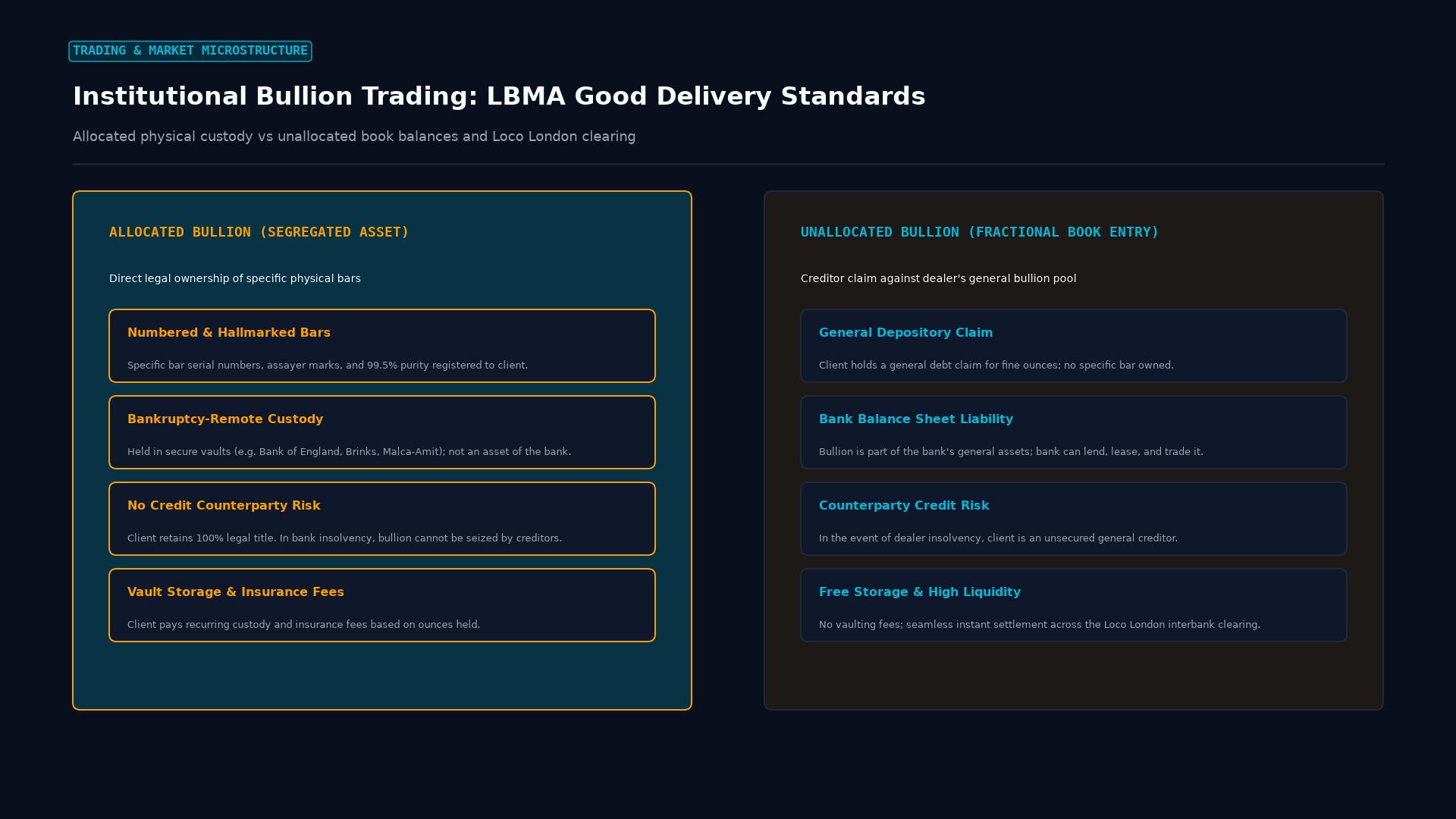 Figure: Physical precious metals market structure: allocated segregated physical bar custody versus unallocated fractional book-entry claims in the Loco London market.
Bullion in the Forex Ecosystem: XAU/USD and XAG/USD
Although gold and silver are physical metals, global financial institutions and retail brokers treat bullion trading as an intrinsic component of the foreign exchange market. Under the international ISO 4217 currency standard, precious metals are assigned formal three-letter currency codes:
- XAU: Spot Gold (one troy ounce of 99.5%+ pure gold)
- XAG: Spot Silver (one troy ounce of 99.9%+ pure silver)
- XPT & XPD: Spot Platinum and Spot Palladium
The premier trading instrument is XAU/USD (Gold priced in US Dollars). When a forex trader opens an XAU/USD position, they are executing a currency transaction: exchanging US Dollars for gold ounces in the same operational manner that EUR/USD exchanges US Dollars for Euros.
Gold exhibits deep liquidity, with daily global turnover exceeding $150 billion across over-the-counter (OTC) spot trades, futures exchanges, and exchange-traded funds (ETFs).
Major Global Bullion Market Centers
Physical bullion pricing and clearing are anchored by two primary institutional hubs:
1. The London Bullion Market (LBMA)
The London Bullion Market Association (LBMA) is the global epicentre of wholesale over-the-counter physical bullion trading. Trading in London involves “London Good Delivery” gold bars (large 400-troy-ounce bars, weighing roughly 12.5 kg each, held in secure commercial bank vaults beneath the City of London and the Bank of England). The LBMA conducts the globally recognized electronic benchmark price auction twice daily: the LBMA Gold Price AM (10:30 GMT) and LBMA Gold Price PM (15:00 GMT), utilized by central banks, mining corporations, and institutional refiners worldwide.
2. COMEX (CME Group) Futures
While London dominates physical spot clearing, the COMEX division of the Chicago Mercantile Exchange (CME) leads global derivative price discovery through standardized 100-ounce gold futures contracts. Interbank arbitrageurs continuously trade the spread between London physical spot and COMEX futures via the Exchange for Physical (EFP) mechanism, keeping the two venues tightly aligned.
Why Central Banks Hoard Sovereign Bullion
Central banks are the world’s largest holders of physical bullion, collectively securing over 36,000 metric tons of gold. Following the global financial crisis of 2008 and the aggressive freezing of Russian foreign exchange reserves in 2022, sovereign institutions—led by the People’s Bank of China (PBOC), the Reserve Bank of India (RBI), and European central banks—accelerated gold accumulation to multi-decade highs.
Sovereign treasuries prioritize bullion for four structural reasons:
- Zero Counterparty Risk: Unlike foreign sovereign bonds or fiat bank deposits, physical gold bullion cannot be defaulted on, frozen by foreign sanctions, or erased by a banking collapse.
- Ultimate Store of Value: Gold has maintained steady real purchasing power over thousands of years, surviving the complete collapse of hundreds of paper currencies.
- De-Dollarization: Emerging economic powers accumulate gold to diversify their foreign reserve portfolios away from exclusive reliance on the US Dollar.
- Crisis Liquidity: During sovereign debt crises, central banks can swap physical bullion for international fiat currencies to defend their financial systems.
Primary Macro Drivers of Bullion Prices
For foreign exchange and precious metals traders, four macroeconomic forces dictate bullion price trends:
1. Real Interest Rates (The Primary Catalyst)
Physical bullion generates no yield, dividends, or interest payments. Consequently, the greatest opportunity cost of holding gold is the prevailing yield on risk-free government bonds after adjusting for inflation (Real Yields, measured by US Treasury Inflation-Protected Securities, or TIPS). When real yields decline or plunge into negative territory, the opportunity cost of holding bullion disappears, sparking powerful bull runs in XAU/USD. When real yields rise, gold faces structural selling pressure.
2. The US Dollar (DXY) Inverse Correlation
Because gold is quoted globally in US Dollars, fluctuations in the greenback exert a mechanical inverse effect. When the US Dollar depreciates, gold becomes cheaper for foreign buyers holding Euros, Yen, or Yuan, increasing global bullion demand and driving dollar-denominated gold prices higher.
3. Inflation Expectations
During periods of aggressive central bank quantitative easing and expanding broad money supply (M2), investors allocate capital into physical bullion as a premier hedge against fiat debasement.
4. Geopolitical “Safe-Haven” Demand
During armed conflicts, international sanctions, or banking panics, investors rush into liquid defensive assets. Gold serves as the ultimate safe haven, rallying sharply when global risk appetite deteriorates.
Practical Trading Example: XAU/USD Position Math
Trading gold through a forex broker differs slightly from currency pairs in contract sizing:
- 1 Standard Lot of XAU/USD: Represents 100 troy ounces of gold.
- Tick / Pip Movement: The standard minimum price increment is $0.01 (1 cent), but traders typically measure moves in $1.00 increments or 10-cent “pips” ($0.10).
- If gold trades at $2,650.00, the total notional value of 1 standard lot is: $$ 100 \times $2,650.00 = $265,000.00 $$
- At a broker offering 1:100 leverage (1% margin requirement), entering 1 standard lot requires $2,650.00 of margin.
- Every $1.00 move in the price of gold equals $100.00 in profit or loss on a 1-lot position: $$ 100\text{ ounces} \times $1.00 = $100.00 $$
If a trader buys 1 lot of XAU/USD at $2,650.00 anticipating safe-haven demand, and price rallies to $2,675.00 (+ $25.00 move), the realized profit is: $$ $25.00 \times 100 = $2,500.00 $$
Key Takeaways
- Bullion refers to refined precious metals (gold, silver, platinum) valued strictly by weight and metallic purity rather than nominal face value.
- In forex, spot bullion is traded like a currency pair under ISO codes XAU/USD (Gold) and XAG/USD (Silver).
- The London Bullion Market Association (LBMA) provides global wholesale OTC clearing and sets the daily London Gold Fix.
- Central banks hold thousands of metric tons of bullion as a sanction-resistant, zero-counterparty-risk reserve asset.
- Real interest rates (TIPS yields) and the US Dollar index represent the two most influential macro drivers of gold prices.
FAQ
Why is gold weighed in troy ounces instead of standard ounces? The troy ounce is an ancient medieval weight standard originating in Troyes, France, preserved specifically for precious metals and gemstones. One troy ounce weighs exactly 31.103 grams, compared to 28.35 grams for an ordinary kitchen (avoirdupois) ounce.
What is the difference between allocated and unallocated gold bullion? In institutional banking, allocated gold means specific, individually numbered physical bars are assigned to the client and stored in a vault as client property with zero balance sheet exposure to the bank. Unallocated gold is simply a general unsecured credit claim against the bank’s general gold inventory, making the investor an unsecured creditor of the financial institution.
Does bullion perform well during stock market crashes? Historically, bullion acts as a dependable hedge over full market cycles. However, during the initial liquidity panic of a severe market crash (such as October 2008 or March 2020), gold frequently experiences sharp temporary pullbacks as hedge funds liquidate profitable bullion positions to meet margin calls on crashing equities. Once emergency liquidity stabilizes, gold typically resumes strong upward outperformance.
Ready to trade forex?
Open a free demo account with a regulated broker. Practice with virtual funds before risking real money.