C Shares (Class C Mutual Fund Shares)
Class C shares are mutual fund share classes featuring a level-load fee structure with no upfront sales charge, a low 1% contingent deferred sales charge (CDSC) that expires after one year, and higher ongoing 12b-1 distribution fees.
What Are Class C Shares?
In mutual fund investing and wealth management, Class C shares (frequently designated as level-load shares) represent a distinct share class of an open-end mutual fund that eliminates upfront front-end sales commissions while imposing higher ongoing annual operating expenses.
When retail investors allocate capital to load mutual funds, fund families offer identical underlying portfolios across different fee architectures:
- Class A shares charge an upfront front-end sales load (typically 3.75% to 5.75%) but carry lower ongoing annual expense ratios.
- Class B shares charge a declining back-end sales load over a multi-year horizon before eventually converting into Class A shares.
- Class C shares charge zero upfront commissions and impose a modest 1.00% Contingent Deferred Sales Charge (CDSC) if redeemed within the first 12 months. However, they carry a permanently higher annual 12b-1 distribution fee (typically 1.00% annually), making them economical for short-term holding horizons but exceptionally expensive over multi-year periods.
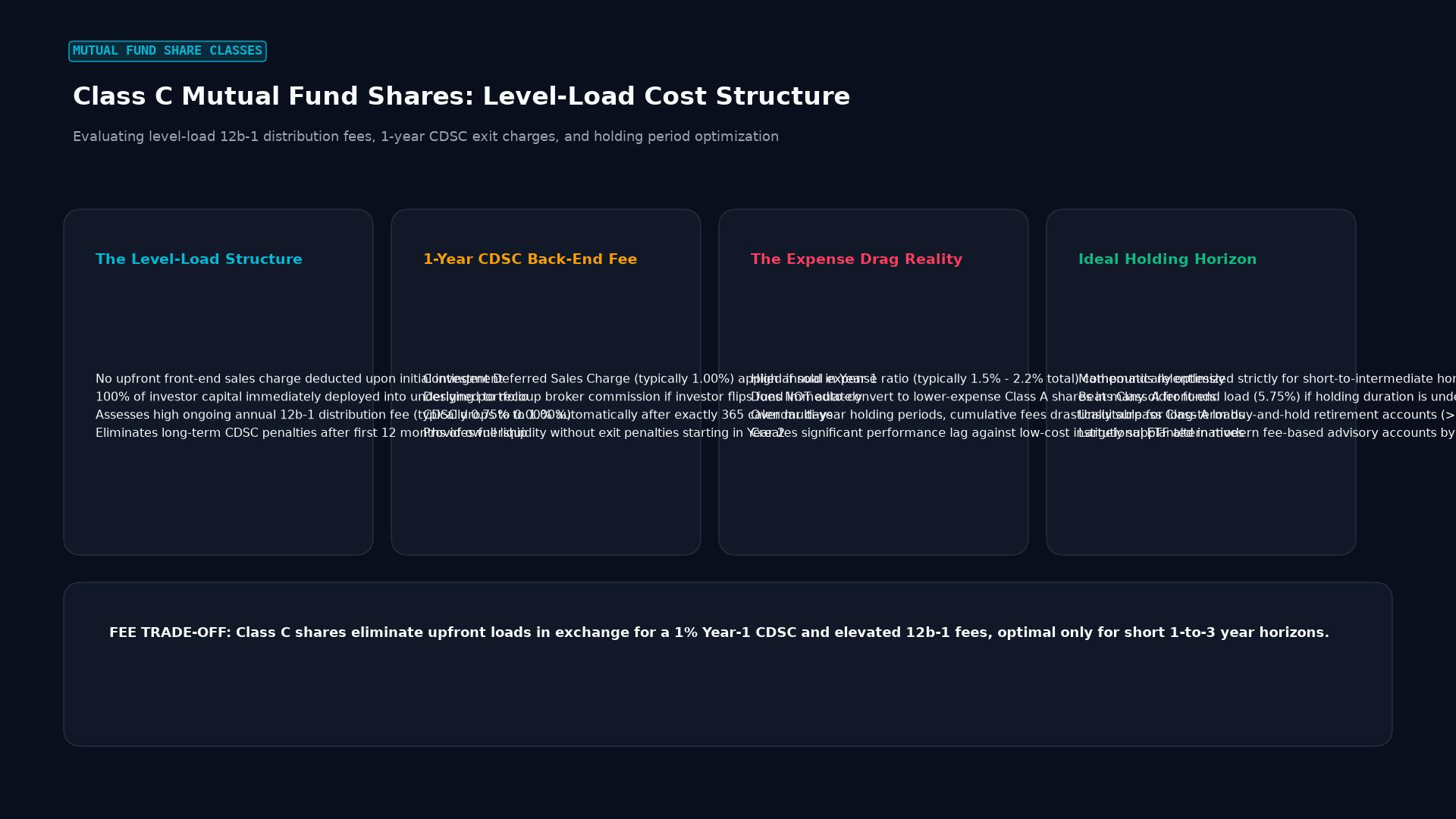 Figure: Evaluating level-load 12b-1 distribution fees, 1-year CDSC exit charges, and holding period optimization
Technical Mechanics & Breakeven Horizon Modeling
To evaluate whether Class A or Class C shares deliver superior net returns, financial analysts calculate the cumulative total expense drag across holding period $T$ (in years).
Total Expense Formulations
Let:
- $L_A$: Front-end sales load on Class A shares (e.g., $5.00% = 0.05$).
- $E_A$: Ongoing annual expense ratio for Class A shares (e.g., $0.75% = 0.0075$, including $0.25%$ 12b-1 fee).
- $E_C$: Ongoing annual expense ratio for Class C shares (e.g., $1.50% = 0.0150$, including $1.00%$ 12b-1 fee).
- $R$: Annual gross portfolio return.
The cumulative terminal wealth multiplier for Class A ($W_A$) and Class C ($W_C$) after $T$ years is modeled as:
$$W_A(T) = (1 - L_A) \times \left(1 + R - E_A\right)^T$$
$$W_C(T) = 1.0 \times \left(1 + R - E_C\right)^T \quad (\text{For } T \ge 1)$$
The Breakeven Horizon ($T^*$)
The breakeven holding period occurs where $W_A(T^) = W_C(T^)$:
$$1 - L_A = \left( \frac{1 + R - E_C}{1 + R - E_A} \right)^{T^*}$$
$$\ln(1 - L_A) \approx T^* \times \left( E_A - E_C \right)$$
$$T^* \approx \frac{-\ln(1 - L_A)}{E_C - E_A}$$
Assuming $L_A = 5.0%$ and the annual expense spread $E_C - E_A = 0.75%$:
$$T^* \approx \frac{0.0513}{0.0075} \approx 6.84 \text{ years}$$
- Horizon < 3 Years: Class C shares deliver superior net performance because the investor avoids the large upfront 5% load deduction.
- Horizon > 6 to 7 Years: Class A shares decisively outperform because the lower annual operating fee ($E_A$) compounds more favorably over time.
Comparative Matrix: Share Class Economics
| Dimension | Class A Shares | Class C Shares | Institutional (Class I / Adv) |
|---|---|---|---|
| Upfront Fee | 2.50% to 5.75% upfront | 0.00% | 0.00% |
| CDSC Redemption Fee | None | 1.00% if sold in Year 1 | None |
| Annual 12b-1 Fee | Capped at 0.25% | Max 1.00% (0.75% distribution + 0.25% service) | 0.00% |
| Breakpoint Discounts | Yes (Discounts at $50k, $100k, $250k+) | None | Institutional minimums ($1M+) |
| Automatic Conversion | N/A | Rare (some convert after 8–10 years) | N/A |
Real-World Case Study: The FINRA 529 Share Class Initiative (2019–2020)
Because Class C shares generate continuous, high 12b-1 trail commissions for retail financial advisors, broker-dealers historically faced perverse incentives to steer long-term clients into Class C shares rather than Class A shares.
The FINRA Regulatory Crackdown:
1. Target: In 2019, the Financial Industry Regulatory Authority (FINRA) launched a nationwide self-reporting enforcement initiative targeting broker-dealers selling 529 college savings plans.
2. The Violation: Registered representatives placed young families (who had 10- to 18-year investment horizons) into Class C shares rather than Class A shares.
3. The Mathematical Harm: Families investing for newborn children paid an extra 0.75% every year for 18 years, eroding thousands of dollars in college savings compared to paying a single discounted Class A load upfront.
4. The Outcome: FINRA sanctioned major Wall Street brokerage houses, ordering over $30 million in direct restitution and mandatory account conversions for affected retail investors.
The enforcement action established that recommending Class C shares to an investor with an investment horizon exceeding five years constitutes a presumptive violation of suitability and Regulation Best Interest (Reg BI) rules.
Frequently Asked Questions (FAQ)
What happens to the CDSC fee on Class C shares after one year?
The Contingent Deferred Sales Charge (CDSC) on Class C shares is typically 1.00% and applies exclusively if the investor sells or liquidates the shares within 365 days of the initial purchase date. Once the holding period reaches day 366, the CDSC drops to 0.00%. From that point forward, the investor can redeem shares without paying any exit fee, although the higher annual 12b-1 fee continues to accrue.
Do Class C mutual fund shares ever convert into Class A shares?
Historically, Class C shares never converted, remaining trapped in their higher expense structure permanently. However, following regulatory scrutiny from the SEC and FINRA, several major fund companies (such as American Funds, Vanguard, and BlackRock) introduced automatic conversion features where Class C shares automatically convert to lower-expense Class A shares after a specified holding period—typically eight to ten years.
What are “breakpoint discounts” and why do they disadvantage Class C shares?
Breakpoint discounts are volume discounts offered on Class A shares that progressively reduce the upfront sales load as the dollar amount invested increases (e.g., dropping from 5.75% to 4.50% at $50,000, and down to 0% at $1,000,000). Class C shares offer zero breakpoint discounts. Therefore, an investor deploying large sums ($100,000 or $500,000) is almost always severely disadvantaged by buying Class C shares compared to taking advantage of Class A breakpoints.
Ready to trade forex?
Open a free demo account with a regulated broker. Practice with virtual funds before risking real money.