Capital Appreciation Fund
A capital appreciation fund is an equity mutual fund or exchange-traded fund (ETF) that seeks long-term capital growth by investing predominantly in high-growth companies, reinvesting earnings, and de-emphasizing current dividend income.
What Is a Capital Appreciation Fund?
A capital appreciation fund is an actively or passively managed investment fund (structured as an open-end mutual fund, unit investment trust, or exchange-traded fund) whose primary investment mandate is maximizing long-term capital growth rather than generating current cash dividend income.
Portfolio managers of capital appreciation funds allocate capital predominantly to expanding, innovative enterprises that reinvest virtually all of their operating cash flow into research, intellectual property, capital expenditure, and market share acquisition. These funds deliberately minimize investments in traditional defensive, dividend-paying sectors (such as utilities, consumer staples, or telecommunications), focusing instead on high-beta sectors including technology, biotechnology, renewable energy, and consumer discretionary.
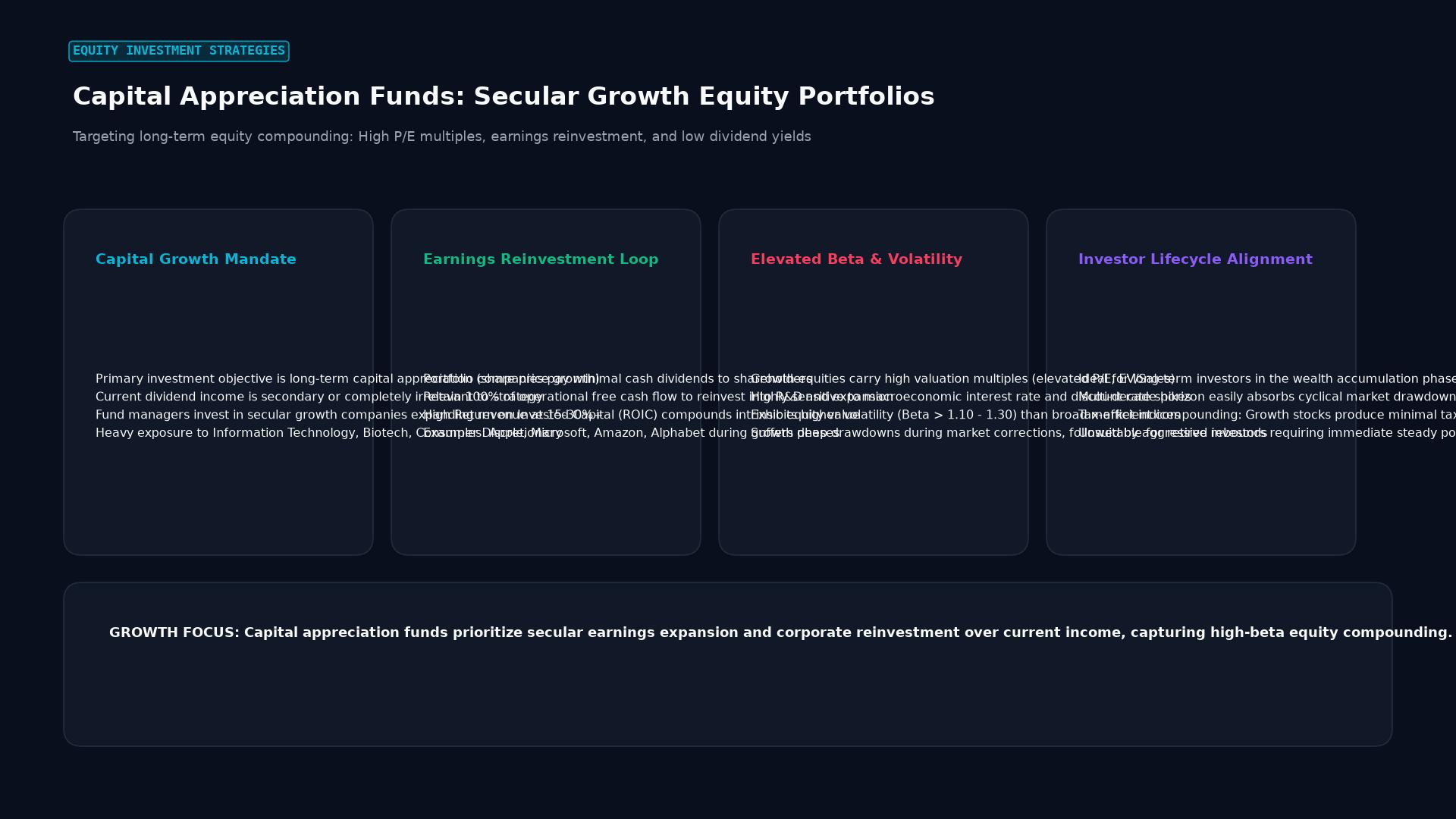 Figure: Targeting long-term equity compounding: High P/E multiples, earnings reinvestment, and low dividend yields
Technical Mechanics & Quantitative Alpha Metrics
Institutional investors evaluate capital appreciation funds using risk-adjusted performance equations:
Jensen’s Alpha ($\alpha$)
Jensen’s Alpha measures the fund manager’s ability to generate excess returns above the benchmark after adjusting for systematic market risk (Beta):
$$\alpha = R_p - \left[ R_f + \beta_p \left( R_m - R_f \right) \right]$$
Where:
- $R_p$: Realized annual return of the capital appreciation fund.
- $R_f$: Risk-free interest rate (e.g., 3-month US Treasury Bill rate).
- $\beta_p$: Portfolio Beta, measuring the fund’s sensitivity to broad equity market volatility: $$\beta_p = \frac{\text{Cov}(R_p, R_m)}{\text{Var}(R_m)}$$
- $R_m$: Return of the benchmark market index (such as the S&P 500 or Russell 2000).
Capital appreciation funds typically carry a portfolio beta significantly greater than 1.0 ($\beta_p \in [1.15, 1.45]$), meaning they capture magnified upside during bull markets but suffer steeper drawdowns during cyclical market sell-offs.
Comparative Matrix: Fund Classifications
| Dimension | Capital Appreciation Fund | Aggressive Growth Fund | Equity Income Fund | Index Tracker Fund |
|---|---|---|---|---|
| Primary Goal | Long-term capital growth | Maximum rapid growth | Regular cash dividend yield | Matching index performance |
| Typical Beta ($\beta$) | 1.10 to 1.30 | 1.30 to 1.80 | 0.70 to 0.90 | Exactly 1.00 |
| Dividend Yield | Very low (0.0% - 1.0%) | Negligible (0.0%) | High (3.5% - 6.0%) | Market average (~1.5%) |
| Valuation Metrics | High P/E, High P/B | Extreme P/E multiples | Low P/E, Low P/B | Market median |
| Target Investor | Long horizon (>7 years) | High risk tolerance | Retirees, Income seekers | Passive, cost-conscious |
Real-World Case Study: Peter Lynch & The Fidelity Magellan Fund (1977–1990)
The most celebrated track record in the history of capital appreciation mutual funds was achieved by Peter Lynch during his tenure as portfolio manager of the Fidelity Magellan Fund.
Anatomy of Magellan's Growth Engine:
1. The Mandate: Pure capital appreciation across mid-cap and large-cap growth equities.
2. The Strategy: Lynch deployed a "growth at a reasonable price" (GARP) philosophy, identifying "tenbaggers"—companies capable of multiplying ten-fold in value (such as Fannie Mae, Ford, and Dunkin' Donuts).
3. The Performance:
   * Annualized Return: 29.2% compound annual return over 13 years (more than double the S&P 500).
   * AUM Growth: Assets under management surged from $18 million in 1977 to over $14 billion in 1990.
4. Capital Appreciation Supremacy: A $10,000 investment made upon Lynch's arrival grew into more than $270,000 by his retirement, generated almost entirely through stock price appreciation.
Frequently Asked Questions (FAQ)
Are capital appreciation funds suitable for investors nearing retirement?
Generally, no. As investors approach retirement, their primary portfolio objective shifts from wealth accumulation to capital preservation and steady cash-flow generation. Because capital appreciation funds exhibit high volatility, aggressive market betas ($\beta > 1.2$), and minimal dividend yields, an investor forced to sell shares during a bear market to cover daily living expenses risks permanently impairing their nest egg. Older investors typically transition capital toward income funds and fixed-income bonds.
How does portfolio turnover impact a capital appreciation fund’s net returns?
Active capital appreciation fund managers frequently rotate holdings as growth catalysts unfold, leading to high portfolio turnover ratios (often exceeding 80% to 150% annually). High turnover generates two significant drags on performance:
- Trading Costs: Substantial institutional bid-ask spread friction and brokerage execution commissions.
- Tax Inefficiency: Frequent share sales trigger net short-term capital gains, which mutual funds are legally mandated to pass through to taxable shareholders at the end of the year, increasing the investor’s tax burden.
What is the difference between a Capital Appreciation Fund and an Aggressive Growth Fund?
While both prioritize capital growth over dividend income, an Aggressive Growth Fund takes significantly higher speculative risks. Aggressive growth funds concentrate heavily in early-stage micro-cap companies, unproven biotechnology firms, and volatile IPOs, frequently deploying leverage or derivative overlays. A standard Capital Appreciation Fund focuses more on established mid-to-large-cap corporations with proven earnings models, established revenue streams, and competitive moats.
Ready to trade forex?
Open a free demo account with a regulated broker. Practice with virtual funds before risking real money.