CAD
CAD is the ISO 4217 currency code for the Canadian Dollar, the official currency of Canada. Informally known across global trading desks as the 'Loonie,' it ranks among the top-ten most liquid currencies and serves as a premier energy commodity currency in foreign exchange markets.
What Is the Canadian Dollar (CAD)?
The Canadian Dollar, designated by the currency code CAD and symbol $ (or C$ to differentiate it from other dollar currencies), is the national legal tender of Canada. It is issued and managed by the nation’s central bank, the Bank of Canada (BoC), headquartered in Ottawa.
According to triennial surveys conducted by the Bank for International Settlements (BIS), the Canadian Dollar consistently ranks as the sixth or seventh most traded currency globally, accounting for roughly 5% of all daily foreign exchange transactions. The Canadian Dollar is also recognized as an official international reserve currency, held by global central banks due to Canada’s AAA sovereign debt rating, political stability, transparent legal framework, and conservative fiscal governance.
On financial trading floors worldwide, the currency is universally referred to by its affectionate nickname: the “Loonie.” This nickname originated in 1987 when the Royal Canadian Mint introduced a bronze-colored one-dollar circulation coin featuring an image of the common loon—a solitary aquatic bird deeply associated with Canadian wildlife—on its reverse side.
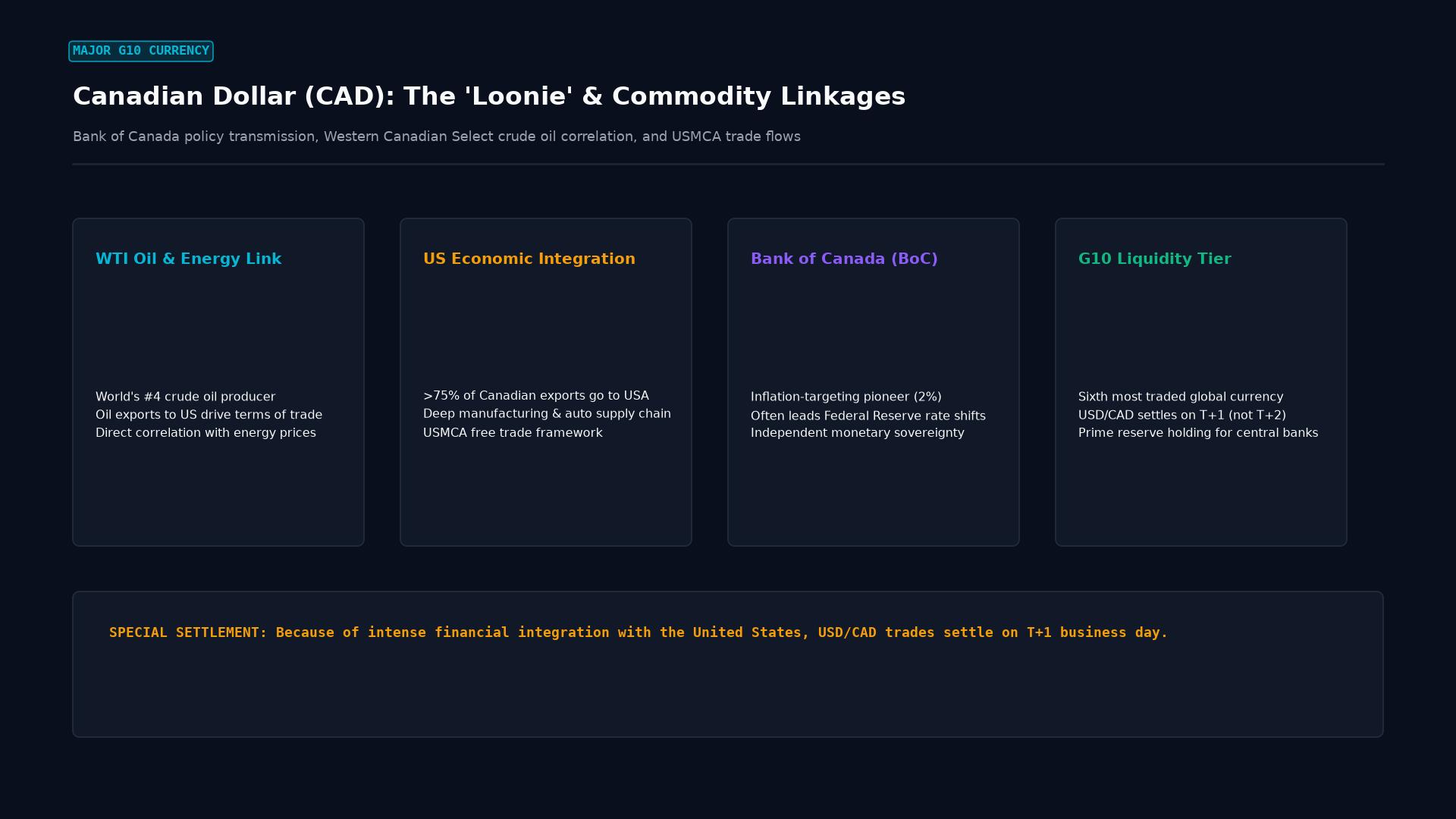 Figure: Resource-backed G10 currency: Bank of Canada monetary policy transmission, crude oil export correlations, and T+1 cross-border settlement with the US.
Key Characteristics of the CAD in Forex
To trade the Canadian Dollar successfully, market participants must understand three dominant economic pillars that dictate its valuation:
1. The Premier “Petro-Currency”
Canada possesses the world’s third-largest proven crude oil reserves, trailing only Venezuela and Saudi Arabia, concentrated primarily in the oil sands of Alberta. Canada is by far the largest foreign supplier of crude oil and petroleum products to the United States, exporting over 3.5 to 4 million barrels per day.
Because oil represents Canada’s single largest source of foreign exchange revenues, the Canadian Dollar functions as an archetypal commodity currency with a powerful positive correlation to crude oil prices (particularly West Texas Intermediate - WTI, and Western Canadian Select - WCS). When global crude oil prices surge:
- Canada’s terms of trade expand significantly.
- Energy corporations convert foreign revenue into Canadian Dollars to fund domestic operations, royalty taxes, and capital investments.
- The Canadian Dollar strengthens against peers, which pushes the USD/CAD exchange rate downward.
Conversely, during global oil price collapses (such as in 2014 or early 2020), the Canadian Dollar faces severe depreciation.
2. Deep Interdependence with the US Economy
Canada and the United States share the longest undefended international border in the world and one of the largest bilateral trading relationships in history, governed by the United States-Mexico-Canada Agreement (USMCA).
More than 75% of total Canadian merchandise exports are purchased by US businesses and consumers. As a result, Canada’s economic health is intrinsically linked to the American business cycle. When US consumer spending and industrial manufacturing are robust, Canadian exporters thrive. However, if the US enters a recession, Canada’s economy almost inevitably follows, dampening demand for the Loonie.
3. Monetary Policy and the Bank of Canada (BoC)
The Bank of Canada sets domestic interest rates to achieve a 2.0% midpoint inflation target. However, the BoC rarely operates in total isolation from the US Federal Reserve. If the BoC permits its policy interest rate to diverge too drastically from the Fed Funds Rate, the resulting interest rate differential can spark extreme exchange rate volatility in USD/CAD, destabilizing cross-border commerce and creating import inflation. Consequently, BoC policy announcements are analyzed in close conjunction with Fed expectations.
Quoting Convention: The USD/CAD Dynamic
A frequent point of confusion for beginner traders is the quoting structure of the primary Canadian Dollar pair: USD/CAD.
In the USD/CAD quotation, the US Dollar is the base currency and the Canadian Dollar is the quote currency:
- A rising USD/CAD chart indicates that the US Dollar is strengthening and the Canadian Dollar is weakening (it takes more Canadian Dollars to buy one US Dollar).
- A falling USD/CAD chart indicates that the Canadian Dollar is strengthening and the US Dollar is weakening (it takes fewer Canadian Dollars to buy one US Dollar).
Therefore, when positive Canadian economic data breaks or oil prices rally, traders looking to profit from a stronger Loonie sell (short) USD/CAD.
Practical Trading Example: The OPEC Oil Supply Cut
Consider an intraday macro trader analyzing USD/CAD ahead of an emergency weekend OPEC+ meeting:
- Context: USD/CAD has been trading steadily around 1.3650. WTI crude oil trades at $72.00 per barrel.
- The Catalyst: Over the weekend, OPEC+ unexpectedly announces an immediate, voluntary production cut of 1.5 million barrels per day to support energy prices.
- Market Reaction: When commodity markets open Sunday evening, WTI crude oil gaps higher by +6.5%, jumping from $72.00 to $76.70 per barrel.
- Forex Execution: The trader anticipates substantial institutional demand for the Canadian Dollar driven by expanding Canadian energy export revenues.
- Trade Setup: At the Asian open, the trader enters a short USD/CAD position at 1.3620 as the pair breaks below local trend line support.
- Risk Management: The stop-loss is placed at 1.3660 (40 pips risk).
- Outcome: As London and New York energy desks digest the supply tightening, crude oil advances further toward $78.50. Sustained CAD buying forces USD/CAD steadily lower throughout the week, reaching a support floor at 1.3500. The trader covers the short position for a +120 pip gain, capturing a clean 3:1 reward-to-risk return.
Key Takeaways
- CAD is the ISO currency code for the Canadian Dollar, officially managed by the Bank of Canada and nicknamed the “Loonie.”
- It ranks among the top-ten most traded currencies in the world and serves as a major global reserve currency.
- As the world’s third-largest crude oil reserve holder, Canada’s currency displays a strong positive correlation to crude oil prices.
- Over 75% of Canadian exports flow to the US, making Canadian economic health dependent on the American business cycle.
- In the USD/CAD pair, the Canadian Dollar is the quote currency: when the Loonie appreciates, the USD/CAD chart moves downward.
FAQ
Why is the Canadian Dollar coin called the Loonie? The one-dollar Canadian coin introduced in 1987 features an engraving of the common loon, a native Canadian water bird known for its haunting calls. Financial markets quickly adopted “Loonie” as shorthand for both the coin and the currency itself.
What is the “Toonie”? In 1996, Canada replaced its two-dollar paper banknote with a bi-metallic coin. In a natural play on words combining “two” and “loonie,” Canadians and financial commentators colloquially named the two-dollar coin the “Toonie” (or “Twonie”).
Does CAD correlate with gold? While Canada is a significant producer of gold and mining minerals, crude oil, natural gas, and forestry products dominate Canadian export values. Consequently, CAD exhibits a far stronger correlation with energy markets than with precious metals (which correlate more closely with the Australian Dollar).
Ready to trade forex?
Open a free demo account with a regulated broker. Practice with virtual funds before risking real money.