Cafeteria Plan (Section 125 Plan)
A cafeteria plan is an employee benefits program governed by Section 125 of the US Internal Revenue Code that allows employees to choose between receiving cash compensation or selecting from a menu of pre-tax qualified benefits.
What Is a Cafeteria Plan?
A cafeteria plan (formally designated as a Section 125 Plan under the United States Internal Revenue Code) is an employer-sponsored employee benefits structure that permits participants to select from a menu of diverse fringe benefits, analogous to choosing items in a cafeteria line.
Under standard tax law, when an employee has the option to receive cash, the entire amount is treated as taxable income under the doctrine of constructive receipt. Section 125 provides an explicit statutory safe harbor: employees can choose between taxable cash wages and a variety of qualified pre-tax benefits without triggering constructive receipt taxation.
Contributions directed toward qualified benefits are deducted from the employee’s gross paycheck before federal income taxes, state income taxes, and Federal Insurance Contributions Act (FICA) payroll taxes (Social Security and Medicare) are assessed, generating immediate tax savings for both the worker and the employing enterprise.
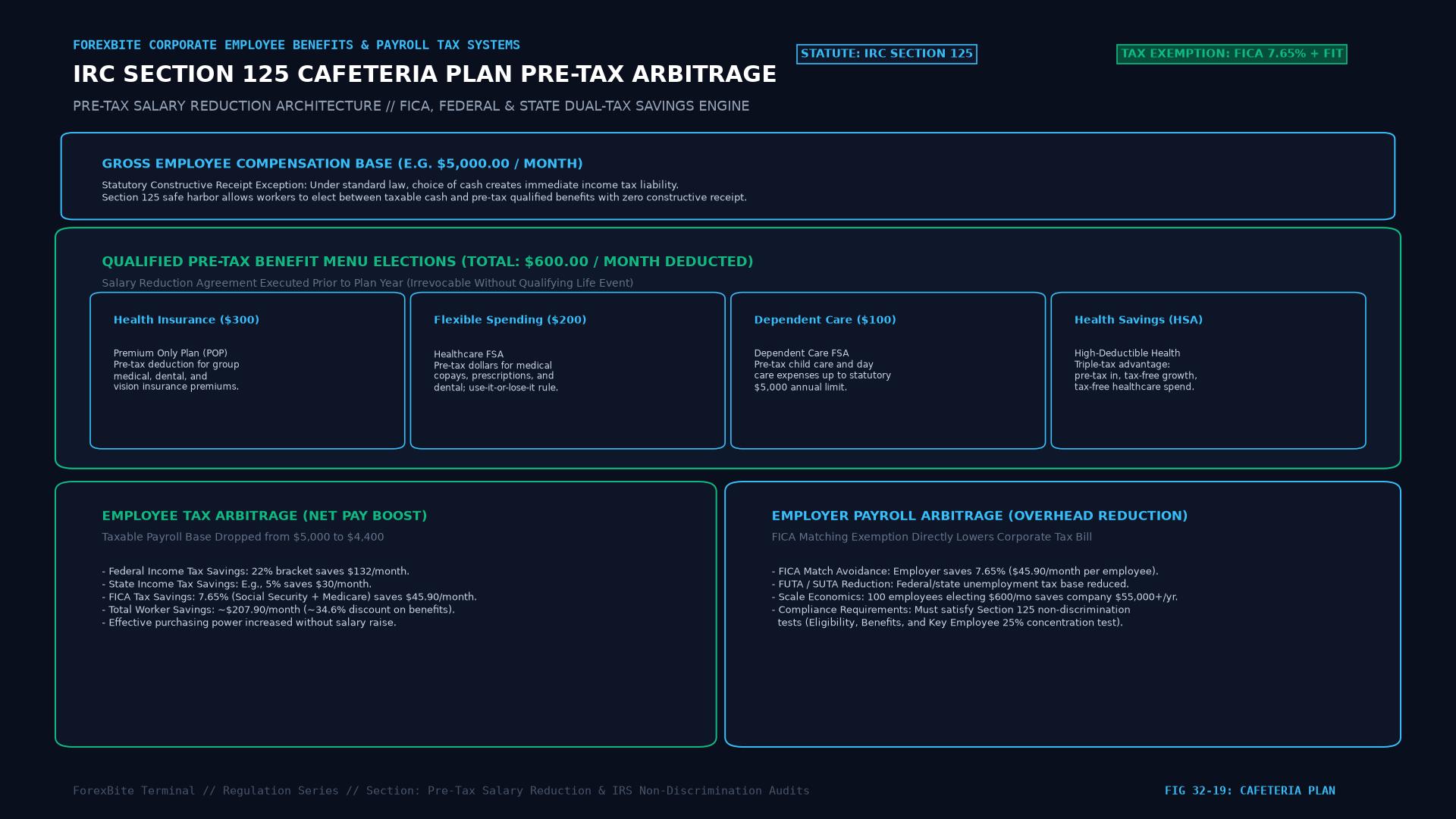 Figure: The IRC Section 125 salary reduction flow showing pre-tax benefit elections, employee income and FICA tax savings, and employer payroll tax reduction.
Technical Mechanics & Quantitative Tax Arbitrage
The financial efficiency of a Section 125 Cafeteria Plan is derived from the concurrent reduction of both individual and corporate payroll tax liabilities.
Employee Tax Savings Formula
Let:
- $C$: Annual pre-tax salary reduction allocated to qualified benefits.
- $t_{\text{fed}}$: Marginal federal income tax rate.
- $t_{\text{state}}$: Marginal state income tax rate.
- $t_{\text{FICA}}$: FICA payroll tax rate ($6.20%$ Social Security up to wage cap $+ 1.45%$ Medicare $= 7.65%$).
The total annual tax shield realized by the employee ($\text{Savings}_{\text{employee}}$) is:
$$\text{Savings}{\text{employee}} = C \times \left( t{\text{fed}} + t_{\text{state}} + t_{\text{FICA}} \right)$$
If an employee in the 24% federal tax bracket and 5% state tax bracket contributes $3,200 annually to a Healthcare FSA:
$$\text{Savings}_{\text{employee}} = $3,200 \times (0.24 + 0.05 + 0.0765) = $3,200 \times 0.3665 = $1,172.80$$
Employer FICA Savings Formula
Employers must match the 7.65% FICA payroll tax on all employee wages. Because Section 125 contributions reduce the taxable wage base, the employer captures direct cash savings:
$$\text{Savings}{\text{employer}} = \sum{i=1}^{n} C_i \times 0.0765$$
For a mid-sized corporation with 500 employees contributing an average of $2,500 annually to cafeteria plans, the employer eliminates:
$$\text{Savings}_{\text{employer}} = 500 \times $2,500 \times 0.0765 = $95,625 \text{ annually}$$
Qualified Benefit Categories & Regulatory Constraints
| Benefit Category | Code Section | Pre-Tax Status | Primary Use Case / Constraints |
|---|---|---|---|
| Premium Only Plan (POP) | IRC §125 | Fed, State, FICA | Pre-tax deduction of employee share of group health insurance |
| Health FSA | IRC §105 | Fed, State, FICA | Out-of-pocket medical, dental, vision; statutory annual contribution cap |
| Dependent Care FSA | IRC §129 | Fed, State, FICA | Child daycare and elder care expenses up to statutory limits |
| Health Savings Account (HSA) | IRC §223 | Fed, State, FICA | Paired with High Deductible Health Plan (HDHP); funds roll over indefinitely |
| Group Term Life Insurance | IRC §79 | Fed, State, FICA | Up to $50,000 in coverage tax-free; excess coverage generates imputed income |
Mandatory Compliance: IRS Non-Discrimination Testing
To preserve tax-advantaged status, Section 125 plans must pass three annual non-discrimination tests to ensure benefits do not disproportionately favor highly compensated employees (HCEs) or corporate executives:
- Eligibility Test: Ensures a sufficient percentage of non-highly compensated employees are eligible to participate.
- Contributions and Benefits Test: Verifies that non-HCEs receive equal access to benefits and employer subsidies.
- Key Employee Concentration Test: Formally mandates that Key Employees (officers with compensation above statutory thresholds or 5% owners) cannot receive more than 25% of total tax-free benefits provided under the plan:
$$\frac{\sum \text{Benefits Received by Key Employees}}{\sum \text{Benefits Received by All Employees}} \le 25%$$
If a plan fails the 25% concentration test, all tax-favored benefits received by key employees lose their exemption and become fully taxable gross income.
Frequently Asked Questions (FAQ)
What is the “Use-It-or-Lose-It” rule in a Cafeteria Plan FSA?
Under standard IRS rules, funds contributed to a Flexible Spending Account (FSA) must be incurred on qualifying healthcare expenses during the designated 12-month plan year. Any unspent funds remaining in the account at the end of the year are forfeited back to the employer to offset plan administrative expenses. However, under IRS Notice 2013-71, employers can adopt one of two optional safety valves: a 2.5-month grace period to spend remaining funds, or an annual rollover carryover (indexed for inflation up to $640+).
Can an employee change their Cafeteria Plan benefit elections mid-year?
Generally, no. Cafeteria plan salary reduction agreements are irrevocable for the entire 12-month plan year. Mid-year election changes are legally permitted only if the participant experiences an IRS-recognized Qualifying Life Event (QLE). Recognized events include marriage, divorce, birth or adoption of a child, death of a spouse, or a material change in employment status (such as moving from part-time to full-time work) that impacts benefit eligibility.
What is a Premium Only Plan (POP) and why is it so widely adopted?
A Premium Only Plan (POP) is the simplest, most fundamental tier of a Section 125 Cafeteria Plan. It allows an employer to deduct the employee’s portion of company-sponsored group health, dental, and vision insurance premiums directly from their paycheck before payroll taxes are calculated. Because it requires minimal administrative tracking compared to flexible spending accounts, virtually every US employer offering group health benefits utilizes a POP to reduce corporate payroll tax overhead.
Ready to trade forex?
Open a free demo account with a regulated broker. Practice with virtual funds before risking real money.