Early Retirement
Early retirement is the planned cessation of primary employment prior to reaching a nation's statutory retirement age or corporate pension milestone, requiring disciplined private capital accumulation and quantitative safe withdrawal rate modeling.
What Is Early Retirement?
Early retirement is the voluntary, permanent withdrawal of an individual from active workforce employment prior to reaching the conventional, state-sponsored statutory retirement age (typically ages 65 to 67 in most OECD nations) or corporate defined-benefit pension eligibility milestones.
In contemporary personal finance and investment management, early retirement has evolved from a rare luxury reserved for corporate executives into a rigorous quantitative discipline popularized by the FIRE (Financial Independence, Retire Early) movement. Achieving early retirement requires decoupling one’s daily living expenses from active labor wages by accumulating an investment portfolio of income-generating and appreciating assets (equities, index funds, real estate, and fixed-income securities) whose sustainable distributions permanently cover all future lifestyle costs.
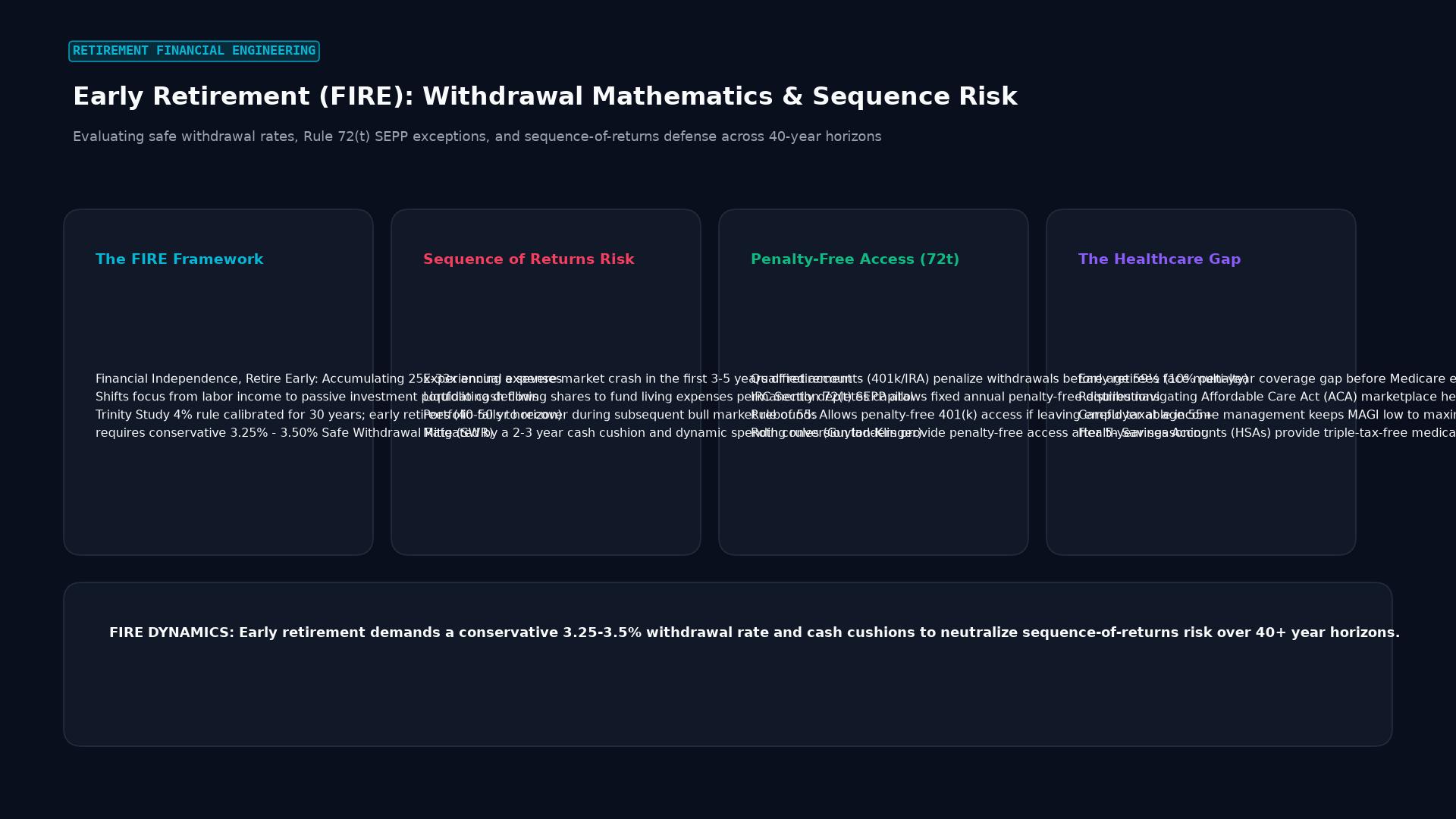 Figure: Evaluating safe withdrawal rates, Rule 72(t) SEPP exceptions, and sequence-of-returns defense across 40-year horizons
Technical Mechanics: The 4% Rule & FIRE Mathematics
The mathematical foundation of modern early retirement planning relies on William Bengen’s groundbreaking 1994 research and the subsequent Trinity Study (Cooley, Hubbard, and Walz, 1998):
The Target Portfolio (FIRE Number) Equation
$$\text{Target Portfolio (FIRE Number)} = \frac{\text{Annual Living Expenses}}{\text{Safe Withdrawal Rate (SWR)}}$$
Under the classic 4.0% Safe Withdrawal Rate (SWR) rule:
$$\text{FIRE Number} = \frac{\text{Annual Expenses}}{0.04} = \text{Annual Expenses} \times 25$$
If a prospective early retiree requires $80,000 annually to cover taxes, housing, and healthcare:
$$\text{FIRE Number} = $80,000 \times 25 = $2,000,000$$
Adjusting SWR for Extended Horizons (40 to 50 Years)
The original Trinity Study evaluated a traditional 30-year retirement horizon (e.g., retiring at 65 to age 95). For early retirees stepping away from work at ages 35 to 45, the capital must survive 45 to 55 years. Modern Monte Carlo simulations indicate that to achieve a 98%+ success rate over a 50-year horizon, the Safe Withdrawal Rate must be adjusted downward to 3.25% to 3.50% (requiring an expenditure multiplier of $28.5\times$ to $30.8\times$).
The Core Danger: Sequence of Returns Risk (SRR)
The greatest mathematical threat to an early retiree is Sequence of Returns Risk (SRR).
Portfolio Wealth Evolution Formula
$$W_t = \left( W_{t-1} - C_t \right) \times \left( 1 + R_t \right)$$
Where:
- $W_t$: Portfolio net wealth at year $t$.
- $C_t$: Inflation-adjusted annual cash living withdrawal.
- $R_t$: Realized investment market return in year $t$.
If an investor suffers a severe bear market ($R_t \in [-20%, -35%]$) during the first five years of retirement, selling depressed shares to fund living withdrawals permanently destroys the capital base. The portfolio will run out of money decades early, even if the stock market experiences a massive bull market in years 15 through 30.
Comparative Matrix: Early Retirement Frameworks
| FIRE Classification | Annual Living Budget | Lifestyle Profile | Primary Asset Strategy | Target Portfolio Size |
|---|---|---|---|---|
| Lean FIRE | $30,000 to $50,000 | Extreme frugality; low-cost geography | 100% Low-Cost Broad Index ETFs | $750,000 to $1,250,000 |
| Traditional FIRE | $60,000 to $100,000 | Standard middle-class lifestyle | 75/25 Equities and Fixed Income | $1,500,000 to $2,500,000 |
| Fat FIRE | $150,000 to $300,000+ | Luxury travel, private health, high-cost city | Multi-Asset: Equities, Real Estate, Private Equity | $4,000,000 to $10,000,000+ |
| Barista FIRE | $40,000 (Subsidized) | Semi-retirement; part-time work for health insurance | Growth Equities + Side Income | $600,000 to $1,000,000 |
Real-World Case Study: Dot-Com Crash vs. The Cash Buffer Strategy
The practical impact of Sequence of Returns Risk was demonstrated by comparing two hypothetical retirees who retired on January 1, 2000, with a $1,500,000 portfolio:
Anatomy of an Early Retirement Sequence Shock (2000-2010):
- Retiree A (No Cash Buffer):
  * Invested 100% in S&P 500 index equities.
  * The S&P 500 dropped 3 consecutive years (2000: -9%, 2001: -12%, 2002: -22%).
  * S&P dropped 49% peak-to-trough while Retiree A continued selling shares to withdraw $60,000 annually.
  * By 2003, the portfolio was cut by over 60%, forcing Retiree A out of retirement and back into full-time employment.
- Retiree B (3-Year Cash Buffer Strategy):
  * Kept $180,000 (3 years of expenses) in risk-free Treasury Bills, with the remaining $1,320,000 in equities.
  * During the 2000-2002 crash, Retiree B withdrew living expenses entirely from the cash reserve, selling ZERO equity shares at depressed valuations.
  * During the 2003-2007 recovery, Retiree B replenished the cash buffer, successfully preserving portfolio longevity through the 2008 crisis.
Frequently Asked Questions (FAQ)
How can early retirees access 401(k) and IRA funds before age 59½ without paying the 10% IRS penalty?
Under US tax law, withdrawing pre-tax funds from a 401(k) or Traditional IRA before age 59½ typically incurs a 10% early withdrawal tax penalty. Early retirees bypass this penalty using three proven strategies:
- The Roth IRA Conversion Ladder: Annually convert pre-tax Traditional 401(k) funds into a Roth IRA. After a mandatory five-year seasoning period, the converted principal can be withdrawn completely tax-free and penalty-free at any age.
- IRS Rule 72(t) (SEPP): Establish Substantially Equal Periodic Payments based on life expectancy for at least five years or until reaching age 59½.
- The Rule of 55: If an employee leaves their job in the calendar year they turn 55 or older, they can withdraw directly from their most recent employer’s 401(k) penalty-free.
What is the biggest unexpected expense for early retirees?
In nations without universal public healthcare (such as the United States), private health insurance premiums and out-of-pocket medical costs represent the single largest unexpected financial shock. Medicare eligibility does not begin until age 65. An early retiree who leaves corporate employment at age 45 must fund 20 years of unsubsidized private health coverage or carefully manage their modified adjusted gross income (MAGI) to qualify for Affordable Care Act (ACA) premium tax credits.
How does inflation affect the Safe Withdrawal Rate over a multi-decade early retirement?
In the 4% rule methodology, the withdrawal amount is adjusted upward annually by the exact rate of Consumer Price Index (CPI) inflation. For example, if an investor withdraws $40,000 in Year 1 and inflation is 5.0%, they withdraw $42,000 in Year 2. If sustained high inflation coincides with stagnant market returns (stagflation), the real purchasing power of the portfolio deteriorates rapidly, requiring early retirees to utilize dynamic spending rules (such as Guyton-Klinger guardrails) that trim spending during high-inflation down years.
Ready to trade forex?
Open a free demo account with a regulated broker. Practice with virtual funds before risking real money.