Calendar Year
A calendar year is a standard consecutive 12-month period beginning on January 1 and concluding on December 31, serving as the benchmark reporting interval for individual income tax, corporate performance, and macroeconomic accounting.
What Is a Calendar Year?
A calendar year is the conventional 365-day annual timeframe (366 days in a leap year) based on the Gregorian calendar that begins on January 1 and ends on December 31.
In global finance, investment management, and taxation, the calendar year serves as the primary benchmark interval against which economic performance, personal tax liabilities, and institutional portfolio returns are calculated. While individual taxpayers almost universally file income taxes on a calendar-year basis, corporations and sovereign governments frequently adopt an alternative 12-month period—known as a fiscal year—to better reflect their specific operational, retail, or budget cycles.
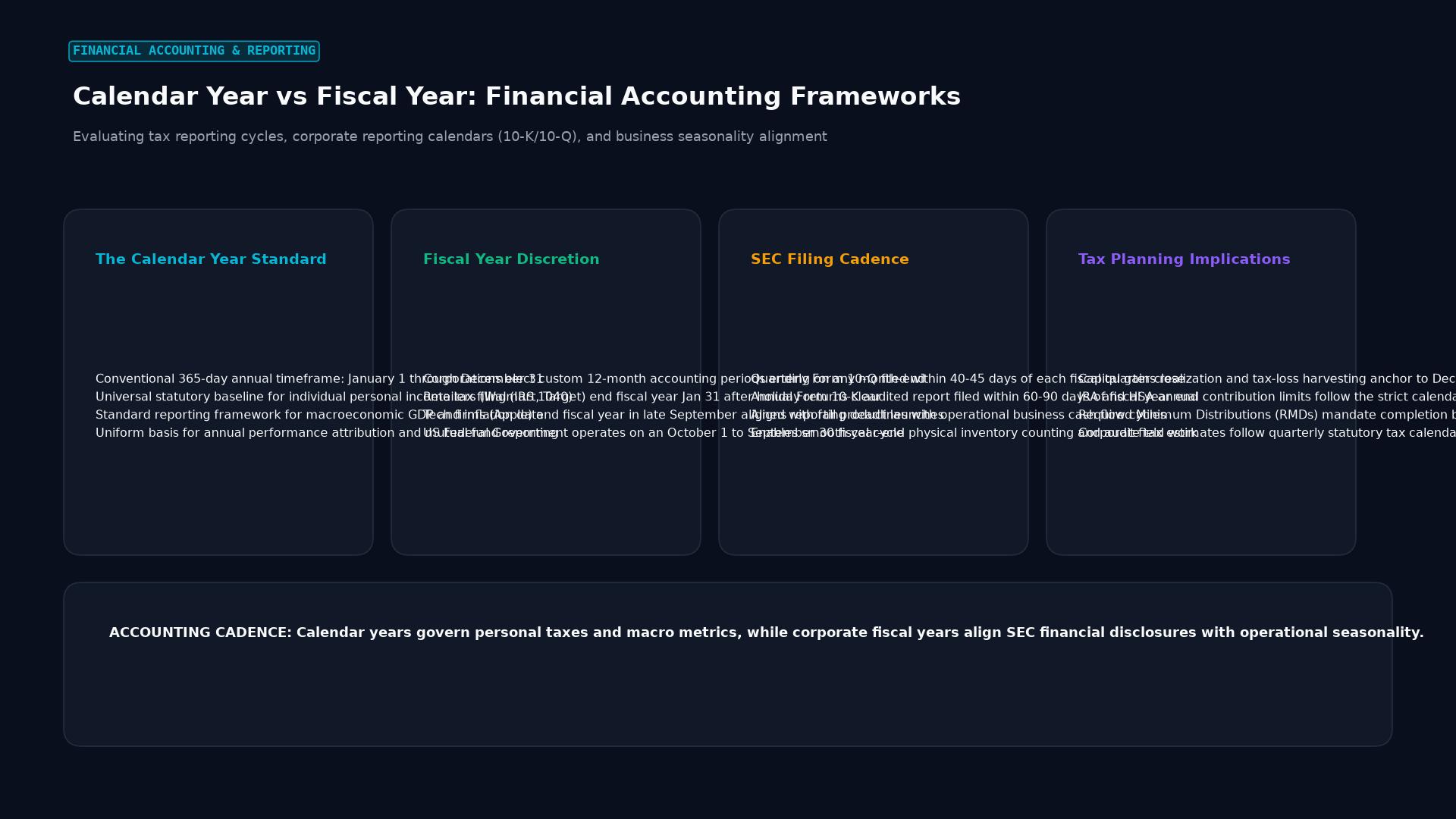 Figure: Evaluating tax reporting cycles, corporate reporting calendars (10-K/10-Q), and business seasonality alignment
Technical Mechanics & Annualized Performance Metrics
In portfolio management, measuring investment returns across discrete calendar years allows investors to compare performance against broad benchmark indices (such as the S&P 500 or MSCI World).
Compound Annual Growth Rate (CAGR)
While simple calendar-year arithmetic averages distort the true compounding effect of volatile returns, institutional analysts compute the Compound Annual Growth Rate (CAGR) across multiple calendar years ($n$):
$$\text{CAGR} = \left( \frac{\text{Ending Portfolio Value}}{\text{Beginning Portfolio Value}} \right)^{\frac{1}{n}} - 1$$
Time-Weighted Rate of Return (TWRR)
To eliminate the distorting impact of client cash deposits and withdrawals occurring mid-year, investment performance across calendar quarters is calculated using the geometric chaining of sub-period holding returns ($R_t$):
$$\text{TWRR}{\text{Calendar Year}} = \prod{t=1}^{4} \left(1 + R_t\right) - 1 = (1 + R_1)(1 + R_2)(1 + R_3)(1 + R_4) - 1$$
Year-End Financial Dynamics: Tax Harvesting & Window Dressing
The arrival of the December 31 calendar year-end triggers major structural behavior across global capital markets:
1. Tax-Loss Harvesting
Under US Internal Revenue Code regulations, capital losses must be realized before the close of the calendar year (December 31) to offset capital gains realized during that tax year. Investors and hedge funds aggressively liquidate underwater positions in late November and December, creating downward price pressure on underperforming assets.
2. Institutional “Window Dressing”
Prior to publishing year-end portfolio statements to clients, mutual funds and institutional asset managers routinely sell embarrassing underperforming stocks and purchase high-flying momentum winners. This practice allows managers to show clients that their portfolios held the year’s top-performing assets as of the December 31 balance-sheet date.
Comparative Matrix: Annual Financial Cycles
| Reporting System | Start Date | End Date | Primary Users | Primary Objective |
|---|---|---|---|---|
| Calendar Year | January 1 | December 31 | Individuals, Public Funds, Macro Indicators | Standardized tax filing & macro GDP comparisons |
| US Federal Fiscal Year | October 1 | September 30 | US Federal Agencies, Defense Contractors | Aligning with federal legislative appropriations |
| UK / Commonwealth Tax Year | April 6 | April 5 | UK HMRC, Commonwealth Taxpayers | Historical English legal and tax tradition |
| Retail Fiscal Calendar (4-5-4) | February 1 | January 31 | Major Retailers (Walmart, Target) | Capturing holiday returns and inventory clearing |
Real-World Case Study: The Retail “4-5-4” Fiscal Year Divergence
In the retail sector, relying on a strict calendar year creates severe accounting distortions because the crucial holiday shopping season ends on December 31, while post-Christmas product returns, gift card redemptions, and inventory liquidations occur throughout January.
Why Major Retailers Reject the Calendar Year:
1. The Problem: A calendar year ending December 31 records holiday sales revenue in one annual report, but pushes post-holiday returns and inventory markdowns into the next calendar year's first quarter.
2. The National Retail Federation (NRF) 4-5-4 Calendar: Major retail corporations (including Walmart, Target, and Macy's) establish a fiscal year running from February 1 to January 31.
3. Accounting Harmony: By closing their annual books on January 31, retailers encapsulate both the holiday shopping surge and the post-holiday return cycle into a single coherent fiscal year.
Financial analysts evaluating retail stocks must adjust reported quarterly earnings dates to ensure they compare identical 13-week operating cycles rather than calendar quarters.
Frequently Asked Questions (FAQ)
Can a corporation choose a fiscal year that differs from the calendar year?
Yes. Under US corporate law and IRS regulations, a business entity can elect to adopt a fiscal year that ends on the last day of any month other than December (or a 52-53-week year). Most companies that deviate from the calendar year do so to align their annual reporting with natural business cycles, seasonal peaks, or inventory replenishment patterns.
How does the calendar year transition impact foreign exchange market liquidity?
During the final two weeks of December, global foreign exchange market liquidity dries up dramatically. Institutional bank trading desks close their annual profit-and-loss (P&L) books, senior traders take annual leave, and risk managers strictly enforce tight risk limits to preserve calendar-year trading profits. This “holiday market” condition leads to widened bid-ask spreads and heightened vulnerability to unexpected flash crashes during thin Asian trading sessions.
What is the difference between a calendar-year return and a rolling 12-month return?
A calendar-year return measures the specific performance from January 1 to December 31 of a single designated year. A rolling 12-month return evaluates performance across any consecutive 12-month window (such as June 1 of one year to May 31 of the next). Institutional risk managers prioritize rolling multi-year returns because calendar-year figures can mask severe intra-year drawdowns or create arbitrary start-date biases.
Ready to trade forex?
Open a free demo account with a regulated broker. Practice with virtual funds before risking real money.