Call Date
A call date is the specified calendar date on or after which the issuer of a callable bond or preferred security possesses the contractual right to redeem the debt prior to its stated maturity date at a predetermined call price.
What Is a Call Date?
A call date is the contractual date specified in a bond indenture or preferred equity prospectus on or after which the issuing entity has the legal right, but not the obligation, to redeem (call back) the security prior to its formal maturity date.
When an investor purchases a callable bond, the issuer compensates the investor by paying a higher coupon interest rate than would be paid on an otherwise identical non-callable (bullet) bond. In exchange for this higher yield, the investor grants the issuer an embedded call option. If prevailing market interest rates fall, the issuer can exercise this option on the designated call date, repay the bondholders their principal (frequently accompanied by a modest call premium), and refinance the debt at lower prevailing borrowing costs.
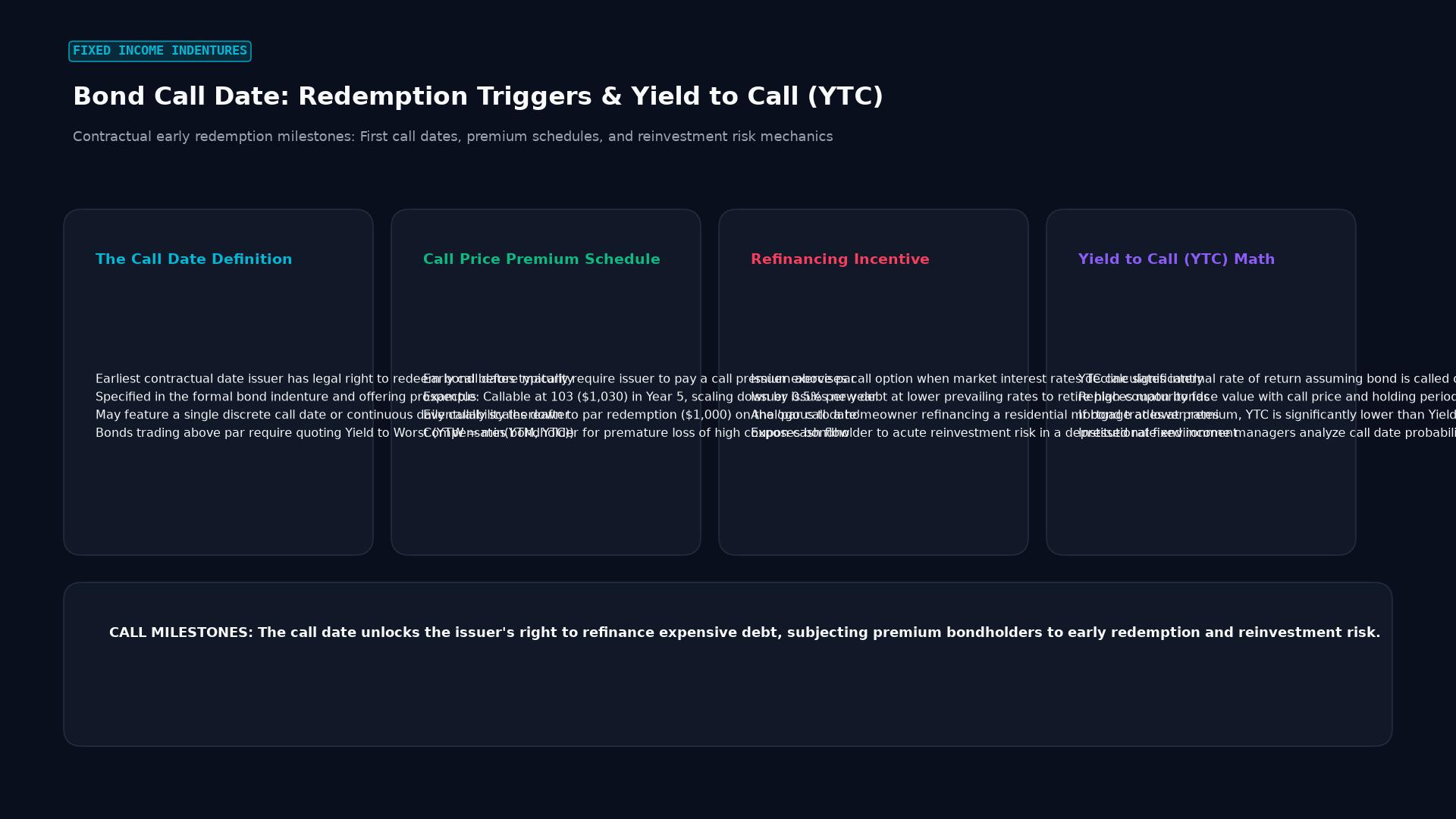 Figure: Contractual early redemption milestones: First call dates, premium schedules, and reinvestment risk mechanics
Technical Mechanics & Yield to Call (YTC) Modeling
Fixed-income investors analyzing callable securities cannot rely solely on the standard Yield to Maturity (YTM). Instead, they calculate the Yield to Call (YTC) for each scheduled call date.
The Yield to Call Formula
The Yield to Call is the internal rate of return that equates the current bond price ($P$) with the present value of all coupon cash flows up to the call date plus the scheduled redemption call price ($P_{\text{call}}$):
$$P = \sum_{t=1}^{N_{\text{call}}} \frac{C}{(1 + \text{YTC})^t} + \frac{P_{\text{call}}}{(1 + \text{YTC})^{N_{\text{call}}}}$$
Where:
- $P$: Current secondary market price of the bond.
- $C$: Periodic coupon interest payment.
- $N_{\text{call}}$: Number of payment periods remaining until the designated call date.
- $P_{\text{call}}$: Call price (often par value of $1,000 plus an initial call premium, e.g., $1,020).
- $\text{YTC}$: Annualized yield to call.
The Decision Metric: Yield to Worst (YTW)
Institutional bond desks operate on the principle of conservatism by evaluating Yield to Worst (YTW), which is the lowest possible yield among all potential outcomes:
$$\text{YTW} = \min\left( \text{YTM}, \text{YTC}_1, \text{YTC}_2, \dots, \text{YTC}_m \right)$$
When a callable bond trades at a substantial premium to par ($P > P_{\text{call}}$), the Yield to Call on the earliest call date is almost always lower than the Yield to Maturity, making YTC the operative metric for investment decisions.
Call Date Structures & Negative Convexity
| Call Structure | Definition | Typical Execution Window |
|---|---|---|
| Discrete (European-Style) | The bond can be called only on specific predetermined dates (e.g., annual coupon dates). | Once per year on coupon anniversary |
| Continuous (American-Style) | Once call protection expires, the bond can be called at any time upon statutory notice. | Daily after first call date |
| Bermudan-Style | The bond can be called on any scheduled interest payment date after the protection period. | Semi-annual or quarterly |
| Make-Whole Call | The issuer can call early, but must pay a lump sum equal to the present value of all future lost coupons. | Any time, but protects investor yield |
The Price Capping Trap: Negative Convexity
As market yields decline, a standard bullet bond experiences accelerated price appreciation (positive convexity). For a callable bond, however, as the market price approaches the call price, price gains flatten because investors recognize the bond will be redeemed on the next call date—a phenomenon known in derivatives math as negative convexity.
Real-World Case Study: The Corporate Refinancing Wave of 2020–2021
In early 2020, in response to the COVID-19 pandemic shock, the Federal Reserve reduced the Fed Funds rate to 0.0%–0.25% and initiated massive corporate bond purchase programs.
The 2020 Call Exercise Wave:
1. The Environment: Corporate borrowing costs for investment-grade and high-yield issuers collapsed to multi-decade historic lows.
2. The Action: Investment-grade corporations (such as AT&T, Ford, and Apple) systematically exercised call provisions on over $600 billion of high-coupon debt on their earliest 2020-2021 call dates.
3. The Reinvestment Squeeze: Institutional bondholders were paid out at par or modest call premiums, only to face a market where replacement yields had collapsed to 2% to 3%.
4. Asymmetric Risk: Investors surrendered their attractive 5% to 7% yields, suffering massive reinvestment risk, illustrating why callable bonds must offer a structural yield premium at issuance.
Frequently Asked Questions (FAQ)
What happens to a bondholder when a bond reaches its call date and is called?
When an issuer exercises its call provision, it publishes a formal Notice of Redemption to bondholders (typically 30 to 60 days in advance). On the designated call date, the issuer transfers the call price (par value plus any accrued interest and call premium) to the clearing custodian (e.g., DTC or Euroclear), which credits the bondholders’ brokerage accounts. From the call date onward, the bond is cancelled, stops paying interest, and ceases to exist.
What is “call protection” and how does it relate to the first call date?
Call protection (also known as a deferred call period) is the contractual window following a bond’s issuance during which the issuer is legally prohibited from calling the bond. For example, a 10-year bond might have 5 years of call protection, meaning the first call date cannot occur until year 5. This guarantees the investor at least five years of uninterrupted coupon payments before facing early redemption risk.
Why do municipal and corporate bonds feature call dates, while US Treasuries do not?
Corporations and municipalities operate under volatile commercial revenues and credit ratings; they require balance-sheet flexibility to retire high-cost debt when interest rates fall or tax receipts surge. The US Department of the Treasury, by contrast, prioritizes issuing the most liquid, standardized benchmark debt in the world. Callable debt introduces complex pricing calculations and reinvestment risk that would reduce the liquidity and primary auction demand of benchmark sovereign Treasuries.
Ready to trade forex?
Open a free demo account with a regulated broker. Practice with virtual funds before risking real money.