Called Bond
A called bond is a callable debt security that has formally been redeemed by its issuer prior to its scheduled maturity date pursuant to an embedded call provision, triggering the immediate cessation of interest accrual and return of principal to investors.
What Is a Called Bond?
A called bond is a bond that has been formally retired and redeemed by its issuer before reaching its stated maturity date. When a corporate borrower, municipality, or sovereign agency exercises the call provision embedded within the bond’s original legal indenture, the security undergoes mandatory early redemption.
Upon calling a bond, the issuer transmits a formal Notice of Redemption through central securities depositories (such as the Depository Trust Company - DTC or Euroclear), specifying the designated call date and redemption price. From that designated date forward:
- The bondholder is legally required to surrender the security in exchange for cash repayment.
- The bond is officially cancelled and removed from secondary trading exchanges.
- All coupon interest accrual terminates completely, regardless of whether the bondholder physically surrenders their certificates or claims their cash proceeds.
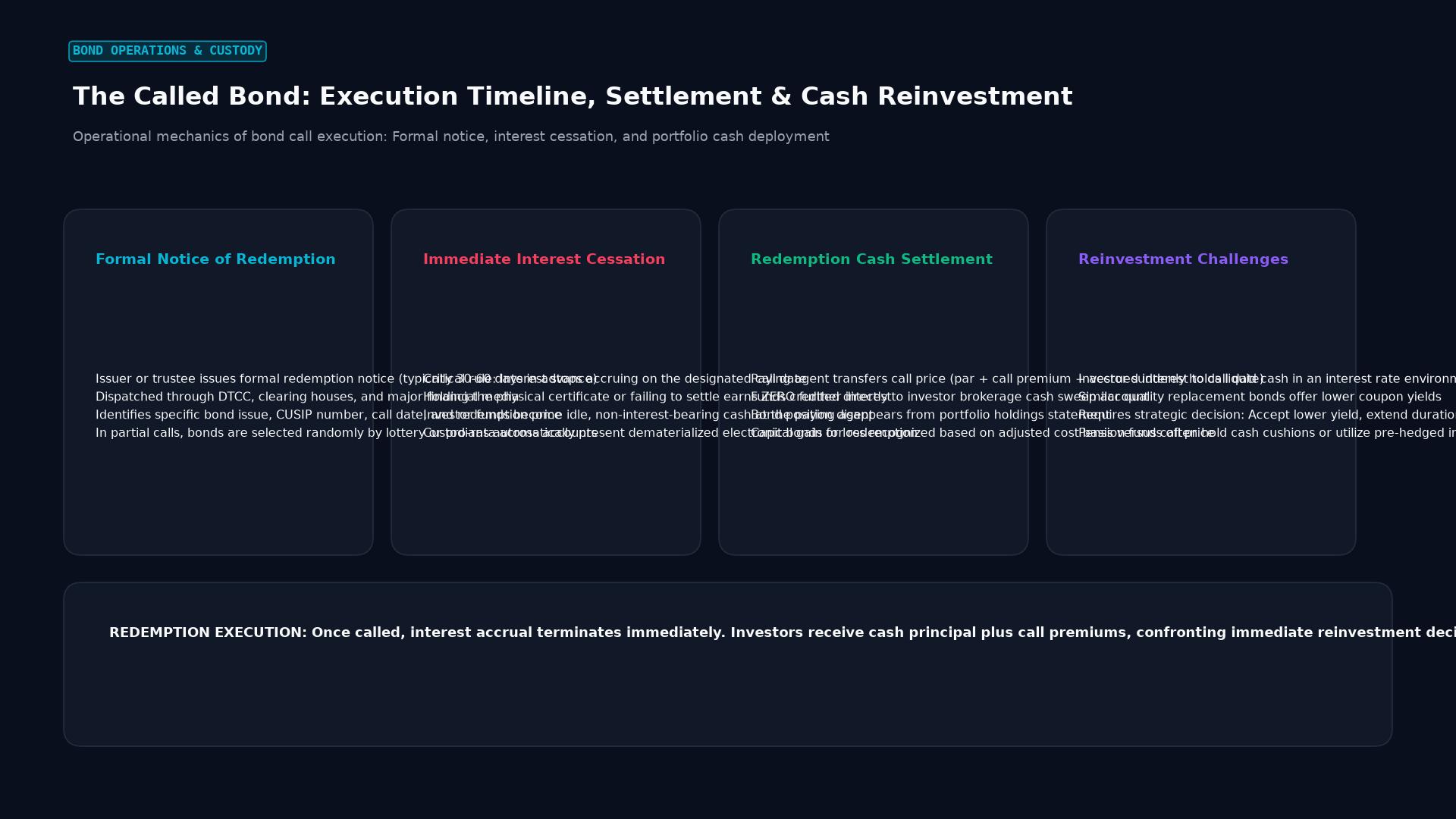 Figure: Operational mechanics of bond call execution: Formal notice, interest cessation, and portfolio cash deployment
Technical Mechanics & Settlement Formulation
When a bond is called between regular scheduled coupon payment dates, the total cash distribution received by the bondholder comprises two distinct financial components: the Call Price and the Accrued Interest.
Total Redemption Settlement Formulation
$$\text{Total Settlement Cash} = P_{\text{call}} + \text{Accrued Interest}$$
Where:
- $P_{\text{call}}$: The contractual redemption price specified in the indenture call schedule (e.g., $1,020 per $1,000 par value).
- $\text{Accrued Interest}$: Pro-rated coupon interest calculated from the last coupon payment date to the designated call date:
$$\text{Accrued Interest} = C \times \left( \frac{\text{Days Elapsed since Last Coupon}}{\text{Days in Coupon Period}} \right)$$
The Unclaimed Proceeds Trap
A major operational pitfall of physical paper certificates or unmonitored accounts is that interest accrual ceases on the call date. If an investor does not realize their bond has been called, the underlying principal sits in a non-interest-bearing custodial account. Over multi-year horizons, inflation severely erodes the purchasing power of this uncollected cash.
Full Call vs. Partial Call Execution
| Redemption Type | Scope of Issue | Selection Algorithm | Investor Outcome |
|---|---|---|---|
| Full Call | 100% of entire bond issue | Universal redemption | All bondholders paid out; issue completely extinguished |
| Partial Call | Fractional tranche (e.g., 25% of issue) | Impartial Lottery or Pro-Rata (DTC) | Some bondholders redeemed; remainder continue earning coupon |
| Defeasance | Economic call; issuer places Treasuries in escrow | Portfolio portfolio substitution | Bonds remain active; backed by sovereign collateral |
Under a Partial Call, the clearing depository utilizes a certified mathematical lottery to select individual serial certificate numbers at random, ensuring fair, non-discriminatory redemption across institutional and retail accounts.
Real-World Case Study: The Municipal Advance Refunding Boom (2016–2017)
Before changes enacted under the US Tax Cuts and Jobs Act (TCJA), municipal governments actively executed advance refunding calls to retire high-coupon civic debt.
Anatomy of a Large-Scale Muni Bond Call:
1. Initial Issuance (2007): The City of Chicago issued $500 million in 30-year general obligation municipal bonds carrying a 5.50% tax-exempt coupon, with a 10-year call provision (Call Date: December 2017 at Par).
2. The Rate Environment (2017): Benchmark municipal borrowing rates plummeted to 2.75%.
3. The Call Announcement: In October 2017, the city issued a formal Notice of Redemption for the entire $500 million issue, effective December 1, 2017.
4. Refunding: The city issued new bonds at 2.80%, slashing annual debt service costs by over $13.5 million annually.
5. Bondholder Reinvestment Trap: Retail and institutional municipal bondholders received their par principal back, but were unable to replace the 5.50% tax-free yield without taking on extreme credit risk in speculative junk debt.
Frequently Asked Questions (FAQ)
What happens if an investor does not surrender a called bond?
If a bond is held electronically in “street name” with a brokerage firm (DTC book-entry), the redemption is fully automated; the broker receives the funds and credits the investor’s cash balance on the call date. However, if an investor holds physical paper certificates and fails to surrender them to the paying agent, the physical bond becomes a non-earning piece of paper. The issuer stops paying interest, and the principal sits in an escrow account indefinitely, eventually escheatmenting to state unclaimed property divisions if abandoned.
Can a bond issuer cancel a Notice of Redemption once it has been published?
Under standard corporate and municipal indentures, an unconditional Notice of Redemption is legally binding and irrevocable once published and delivered to the depository. The issuer is legally obligated to deposit the full call principal with the paying agent on or before the call date. The only exception occurs in “conditional redemption notices,” where the indenture permits the issuer to revoke the call if a planned refinancing debt issuance fails to close.
Is the capital gain from a called bond taxable?
Yes. If an investor purchased a callable bond at a discount in the secondary market (e.g., at $950) and it is subsequently called at par ($1,000) or at a call premium ($1,020), the difference between the call proceeds and the investor’s adjusted tax basis constitutes a taxable capital gain. Depending on whether the holding period was longer than one year, it is taxed at long-term or short-term capital gains rates.
Ready to trade forex?
Open a free demo account with a regulated broker. Practice with virtual funds before risking real money.