Called Away
In options trading and wealth management, 'called away' refers to the mandatory delivery and sale of an underlying asset owned by an option writer following the exercise of a short call option by the option holder.
What Does “Called Away” Mean?
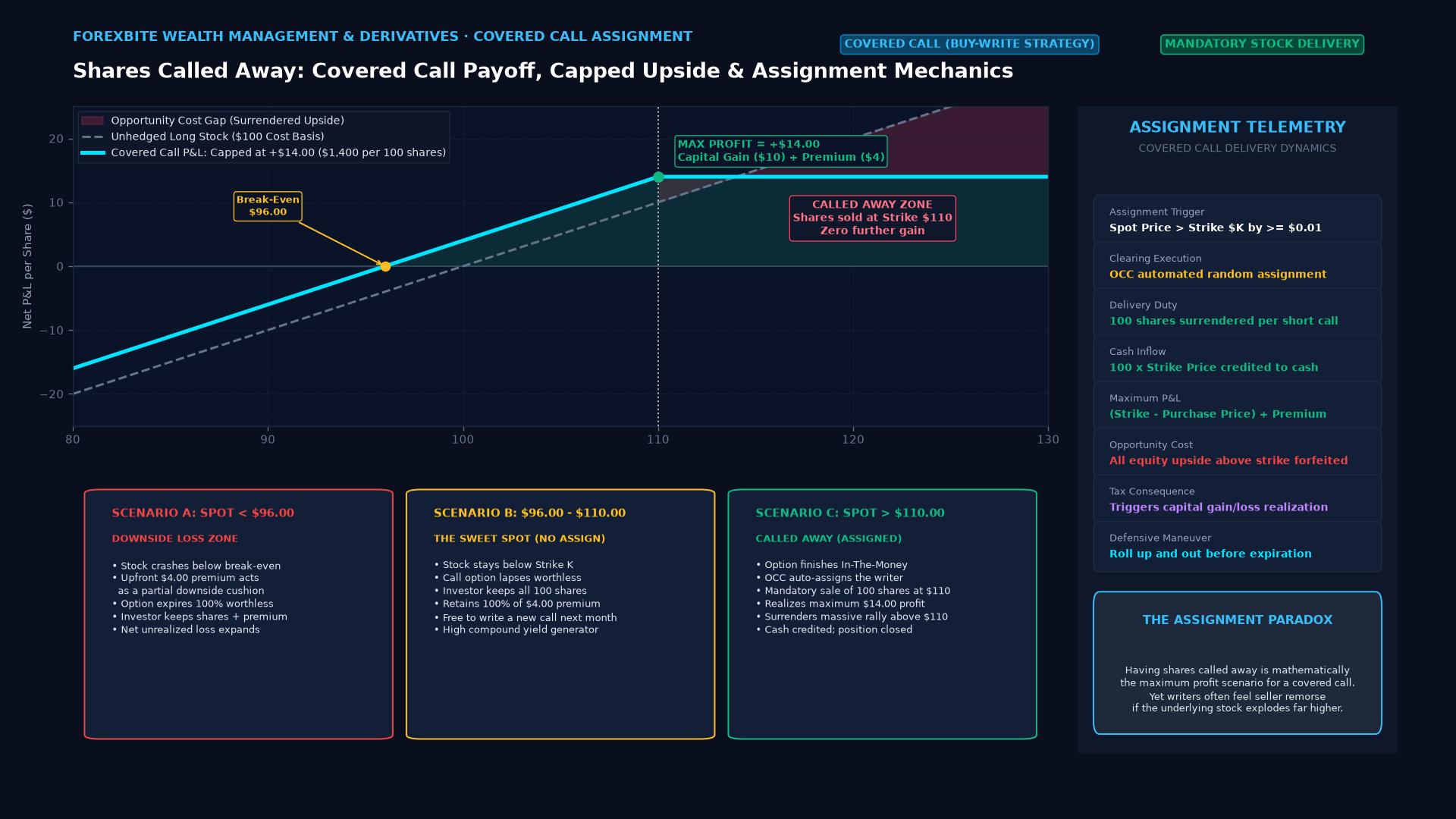
In options trading, private wealth management, and derivatives portfolio management, having an asset “called away” describes the event where an investor who has sold (written) a call option against an underlying long asset is formally assigned by the clearing house, forcing the mandatory delivery and sale of those shares at the contractual strike price ($K$).
This occurrence is the defining operational outcome of the covered call strategy (or buy-write strategy). When an investor writes a call option against 100 shares of stock they already own, they collect an upfront cash premium in exchange for surrendering all capital appreciation above the strike price. If the market price of the stock rises above the strike price by expiration, the call option finishes in-the-money, the option holder exercises their contractual right, and the writer’s shares are automatically transferred out of their brokerage account at the agreed strike price.
Technical Mechanics & Exercise Assignment Equations
When an investor writes an equity call option, the contract is cleared through a central clearing counterparty, such as the Options Clearing Corporation (OCC).
The Assignment Algorithm
Upon expiration (or intraday in American-style options):
- Any option that expires in-the-money by $0.01 or more is automatically exercised under the OCC’s Exercise by Exception protocol.
- The OCC assigns the exercise notices across clearing member brokerages using an automated, impartial random allocation algorithm.
- The broker allocates the assignment to a specific client holding a short call position.
Total Realized Return Upon Assignment
If an investor purchases stock at price $S_0$, writes an out-of-the-money call at strike $K$ for premium $C_{\text{prem}}$, and receives interim cash dividends ($D$):
$$\text{Total Net Profit} = (K - S_0) + C_{\text{prem}} + D$$
$$\text{Total Percentage Return} = \frac{(K - S_0) + C_{\text{prem}} + D}{S_0} \times 100$$
Once shares are called away, the position is completely closed; the investor holds 100% cash and has zero remaining equity risk.
The Pre-Dividend Early Assignment Trap
For American-style options, having shares called away does not only happen on the final expiration date. A primary risk for covered call writers is early assignment prior to an ex-dividend date.
$$\text{Early Assignment Trigger} \iff \text{Dividend Amount } (D) > \text{Put Premium at Strike } K$$
If the upcoming cash dividend exceeds the remaining extrinsic time value of the call option, rational call holders will exercise the option on the day immediately prior to the ex-dividend date. The short call writer will find their shares unexpectedly called away overnight, forfeiting the right to receive the dividend cash payment.
Comparative Matrix: Covered Call Outcomes
| Market Scenario | Underlying Stock Price | Option State | Shares Called Away? | Net Portfolio Result |
|---|---|---|---|---|
| Aggressive Bull Run | $S_T \gg K$ (Deep ITM) | Exercised | Yes (Mandatory sale at $K$) | Maximum profit achieved; miss out on further upside |
| Moderate Rally | $S_T = K$ (At Strike) | Pin Risk | Likely (or cash settled) | Optimal result; maximum time-value capture |
| Flat / Sideways | $S_0 \le S_T < K$ | Expires Worthless | No (Keep shares) | Keep shares + retain 100% of option premium |
| Severe Bear Decline | $S_T \ll S_0$ | Expires Worthless | No (Keep shares) | Premium cushions loss, but suffer net portfolio decline |
Real-World Case Study: Covered Call Writing on Tech Momentum (Apple 2023)
The opportunity cost of having shares called away was vividly illustrated during the tech rally of early 2023.
Anatomy of an Early "Called Away" Opportunity Cost:
- Position: An investor owned 1,000 shares of Apple (AAPL) purchased at $130.00 in January 2023.
- The Covered Call: In February 2023, with AAPL trading at $150.00, the investor sold 10 contracts of June $160 Calls, collecting a premium of $4.50 per share ($4,500 total).
- The Objective: Generate a 3.0% cash yield while allowing for an additional $10.00 per share in capital gains ($14,500 total targeted profit).
- The Outcome: AAPL experienced an explosive rally driven by artificial intelligence momentum and earnings resilience, surging to $185.00 by the June expiration.
- The Assignment: The shares were called away at exactly $160.00.
  * Realized Gain: $30,000 capital gain + $4,500 premium = $34,500 total profit.
  * Opportunity Cost: Had the investor simply held the shares without selling calls, the stock would have been worth $185,000 ($55,000 gain). Selling the calls caused the investor to forfeit $20,500 in unrealized upside.
Frequently Asked Questions (FAQ)
Can an investor prevent their stock from being called away if it rises past the strike price?
Yes, but action must be taken before assignment occurs. To prevent shares from being called away, the trader can execute a “roll” transaction: buying back the existing short call option at a loss and simultaneously writing a new call option with a higher strike price and a further-out expiration date (Roll Up and Out). Once the clearing house issues an assignment notice, however, the process is legally irrevocable and the shares must be delivered.
What are the tax consequences when shares are called away?
When shares are called away, the event constitutes a taxable sale of the underlying stock. The total proceeds of the sale are calculated as the Strike Price plus the Option Premium received. The investor’s capital gain or loss is determined by subtracting their original cost basis from this total amount. If the underlying shares were held for more than one year, the gain qualifies for preferential long-term capital gains tax rates; otherwise, it is taxed as short-term capital gains.
Does the covered call writer have to pay transaction commissions when assigned?
Most modern retail brokerages in the United States (such as Charles Schwab, Fidelity, and Interactive Brokers) offer commission-free options assignment and stock exercise. However, regulatory fees (such as SEC transaction fees and FINRA trading activity fees) apply to the sale of the underlying equity when shares are called away.
Ready to trade forex?
Open a free demo account with a regulated broker. Practice with virtual funds before risking real money.