Call Money Market
The call money market is an interbank segment of the short-term money market where funds are borrowed and lent on an overnight, uncollateralized basis to manage statutory reserve requirements and daily liquidity imbalances, repayable immediately upon demand ('on call').
What Is the Call Money Market?
The call money market (frequently termed the overnight money market) is an integral component of the national wholesale money market in which commercial banks, primary dealers, and central monetary authorities trade ultra-short-term, uncollateralized funds.
Loans transacted in this market are strictly short-term:
- Call Money: Funds borrowed and lent for a single business day (overnight), repayable immediately on the next working day upon the call or demand of either the lender or the borrower.
- Notice Money: Funds borrowed or lent for periods spanning 2 to 14 days without collateral.
- Term Money: Uncollateralized borrowings exceeding 14 days.
The foundational objective of the call money market is the redistribution of day-to-day liquidity reserves across the commercial banking system. Because daily customer withdrawals, loan disbursements, cheque clearings, and RTGS payment settlements create unpredictable surpluses and deficits, banks with excess liquidity lend directly to counterparties facing temporary reserve shortages.
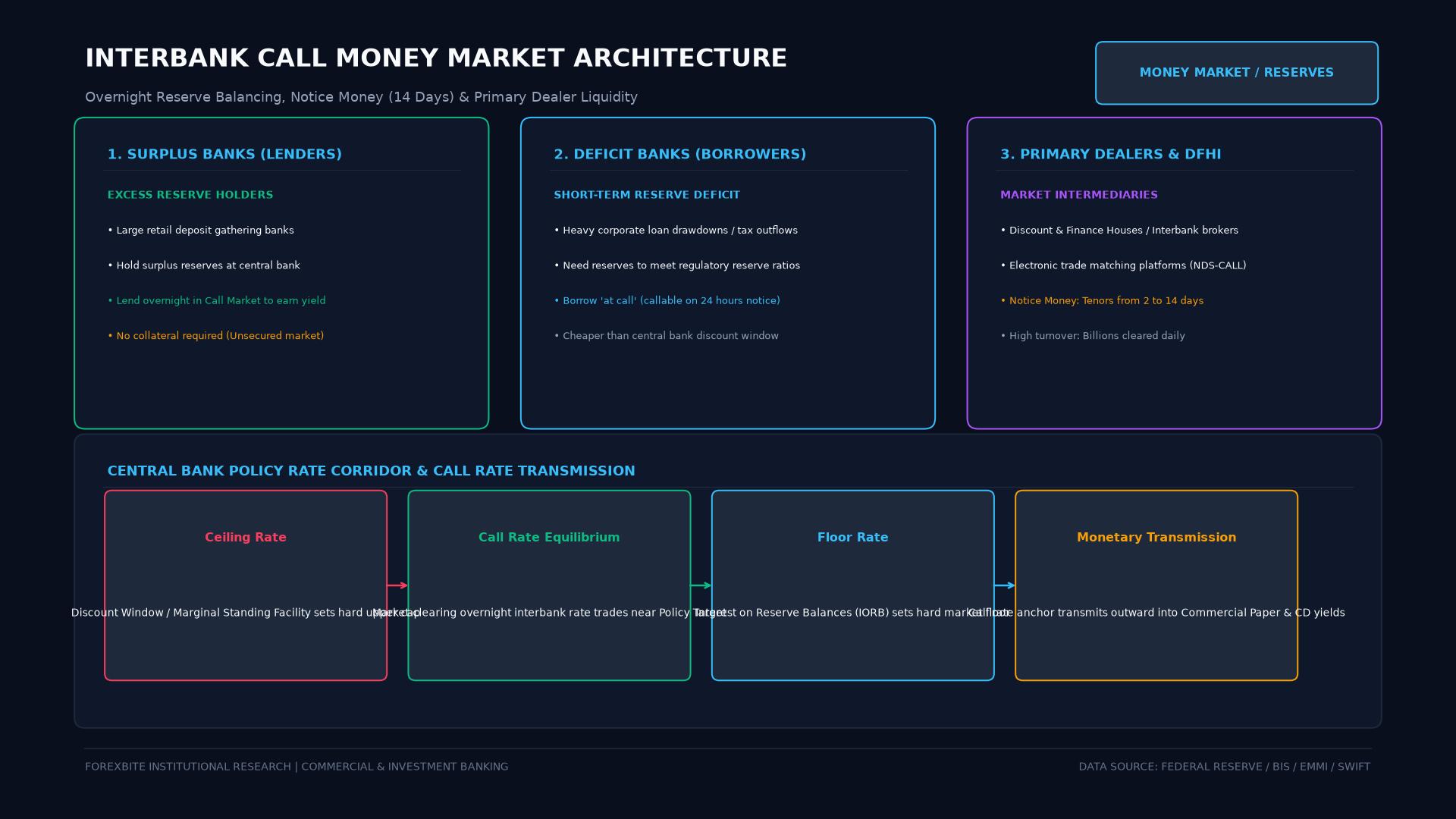 Figure: Overnight reserve clearing dynamics between cash-surplus and cash-deficit commercial banks to satisfy statutory central bank reserve mandates.
Technical Mechanics & Reserve Ratio Management
In many sovereign jurisdictions (such as the United Kingdom, India, and Japan), commercial banks must maintain a mandatory Cash Reserve Ratio (CRR)—a fixed percentage of their Net Demand and Time Liabilities (NDTL) deposited at the central bank:
$$\text{Mandatory Reserve Balance} = \text{NDTL} \times \text{CRR}$$
If a bank fails to satisfy its statutory CRR quota at the close of business, the central bank levies punitive penal interest charges. Rather than paying these statutory penalties or drawing from the central bank’s emergency discount window (which carries reputational stigma), deficit banks borrow uncollateralized funds in the call money market.
Clearing and Settlement Execution
Transactions are settled through the central bank’s electronic Real-Time Gross Settlement (RTGS) system. Because transactions are uncollateralized:
- Credit Limits: Lending institutions establish bilateral, counterparty credit limits for each participating bank based on external credit ratings and CAMELS audit scores.
- Speed: Trades are executed within seconds over interbank dealing terminals (such as the NDS-CALL platform or Reuters Dealing) without the operational delays of pledging and transferring physical securities.
Comparative Matrix: Money Market Segments
| Money Market Segment | Tenor | Collateral Requirement | Primary Participants | Credit Risk |
|---|---|---|---|---|
| Call Money Market | Overnight (1 Day) | Uncollateralized | Scheduled commercial banks & primary dealers | Moderate (Interbank counterparty risk) |
| Notice Money Market | 2 to 14 Days | Uncollateralized | Commercial banks & financial institutions | Moderate |
| Repo Market | Overnight to 1 Year | Fully Collateralized (Bonds) | Banks, mutual funds, corporate treasuries | Very low (Secured by Treasuries) |
| Commercial Paper (CP) | 7 to 365 Days | Unsecured promissory note | Corporations, mutual funds, pension funds | Dependent on corporate issuer rating |
Real-World Case Study: The 1992 Indian Securities Scam & Call Money Turmoil
The structural vulnerabilities of an unregulated call money market were exposed in India during the 1992 Securities Scam, orchestrated by stockbroker Harshad Mehta.
The Call Money Arbitrage Loop:
1. The Loophole: In 1992, Indian commercial banks traded call money and government securities using informal Bank Receipts (BRs)—paper slips confirming that the issuing bank held the underlying securities in its vault.
2. The Exploitation: Mehta colluded with corrupt executives at small banks (such as Bank of Karad and Metropolitan Co-operative Bank) to issue fake Bank Receipts with zero underlying securities backing.
3. The Diversion: Billions of rupees in interbank call money funds intended for CRR management were diverted directly into Mehta's brokerage accounts, which he deployed to manipulate stock prices on the Bombay Stock Exchange (BSE).
4. The Shock: When the fraud was uncovered, call money interest rates exploded to an astronomical 40% to 70% annualized as interbank trust evaporated and banks scrambled for genuine central bank reserves.
The crisis led to the immediate creation of the Clearing Corporation of India Limited (CCIL) and the complete dematerialization of money market settlements.
Frequently Asked Questions (FAQ)
What is the difference between Call Money and Notice Money?
The distinction lies entirely in the duration of the loan. Call Money refers exclusively to funds borrowed or lent for a single business day (overnight). The loan matures the following morning and must be repaid immediately. Notice Money refers to interbank funds transacted for a duration of 2 to 14 days. In notice money transactions, repayment does not occur automatically after 24 hours; either party must issue a formal notice (typically two days’ notice) to demand repayment or settle the position.
Why is the call money market uncollateralized?
The call money market operates on an uncollateralized basis to maximize speed and operational efficiency. Because banks need to balance reserve requirements within minutes before daily central bank clearing windows close, executing formal repo agreements—which require verifying, haircutting, and transferring government bond titles—is too cumbersome. Banks rely instead on bilateral counterparty credit limits established strictly between licensed, prudentially regulated banking institutions.
How does central bank monetary policy transmit through the call money market?
The call money market is the initial link in the monetary transmission chain. When a central bank changes its benchmark policy rate or conducts open-market operations, the call money rate reacts within minutes. Because commercial banks fund short-term liquidity in this market, changes in the call money rate instantly reprice short-term certificates of deposit, commercial paper, and corporate working capital credit lines, eventually altering retail mortgage and deposit rates across the real economy.
Ready to trade forex?
Open a free demo account with a regulated broker. Practice with virtual funds before risking real money.