Call Money Rate
The call money rate is the floating, market-determined interest rate charged on overnight loans transacted in the interbank call money market, serving as a real-time barometer of banking system liquidity.
What Is the Call Money Rate?
The call money rate is the prevailing interest rate charged on uncollateralized, overnight loans transacted between commercial banks and primary dealers in the interbank call money market.
In financial terminology, the phrase “call money rate” encompasses two related institutional definitions:
- The Interbank Overnight Call Rate: The wholesale market rate at which commercial depository institutions lend excess central bank reserves to one another on an overnight basis to satisfy daily statutory cash reserve requirements.
- The Broker Call Loan Rate (or Call Loan Rate): The short-term interest rate that commercial banks charge securities broker-dealers for loans collateralized by customer stock and bond certificates, which brokerages use to fund client margin trading accounts.
Because overnight interbank borrowing is uncollateralized and highly sensitive to central bank reserve balances, the call money rate acts as the financial system’s most immediate, real-time barometer of banking liquidity.
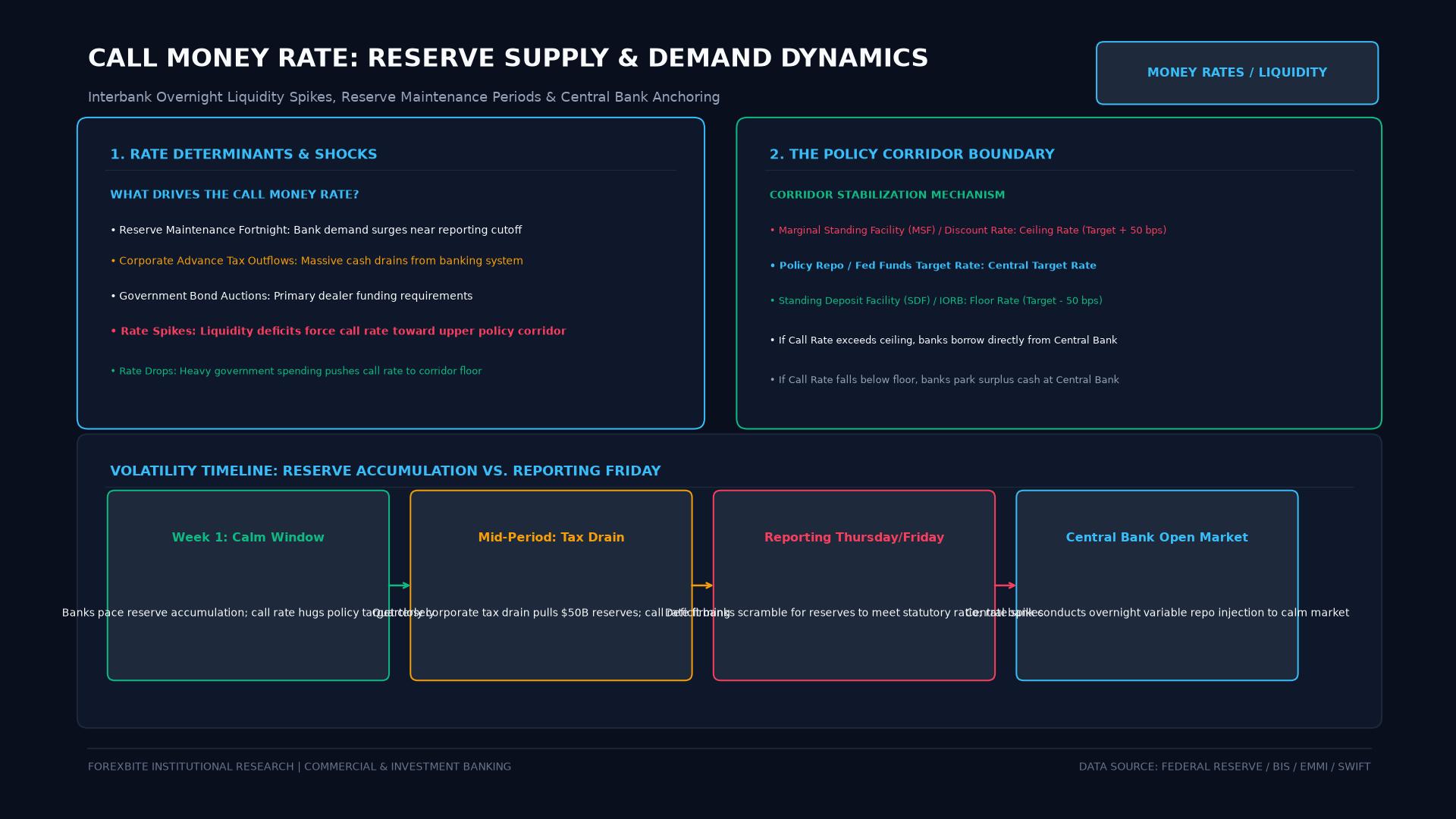 Figure: Interbank call rate mechanics within the central bank policy corridor: bound by standing deposit facility floor and marginal lending facility ceiling.
Technical Mechanics & The Policy Corridor Framework
Modern central banks steer the floating call money rate within a strictly bounded operating corridor defined by standing facilities:
$$\text{Floor Rate (SDF / RRP)} \le r_{\text{call}} \le \text{Ceiling Rate (MSF / Discount Window)}$$
Where:
- Corridor Floor (Standing Deposit Facility): No commercial bank will lend call money in the private interbank market below this rate, because it can earn this return risk-free by depositing excess funds directly with the central bank.
- Corridor Ceiling (Marginal Standing Facility): No commercial bank will borrow call money in the interbank market above this rate, because it can borrow directly from the central bank’s standing lending window against eligible collateral.
The Broker Margin Rate Formula
For retail equity and forex traders operating on margin, the Broker Call Rate establishes the foundational base for retail borrowing costs:
$$\text{Retail Margin Rate} = \text{Broker Call Rate} + \text{Broker Financing Spread}$$
If the broker call loan rate is 6.50% and the brokerage firm levies an account financing spread of 2.50%, the retail trader incurs an annualized borrowing drag of 9.00% on leveraged positions.
Comparative Matrix: Benchmark Short-Term Rates
| Benchmark Rate | Market Mechanism | Collateral Requirement | Tenor | Core Function |
|---|---|---|---|---|
| Call Money Rate | Free interbank market bidding | Uncollateralized | Overnight | Real-time interbank cash equilibrium |
| Central Bank Repo Rate | Central bank statutory decree | Fully secured (Treasuries) | Overnight to 14 days | Official policy anchor rate |
| SOFR (US) | Transaction-backed Treasury repo | Fully secured (Treasuries) | Overnight | Wholesale dollar debt benchmark |
| Broker Call Rate | Bank-to-broker institutional loan | Secured (Customer equities) | On demand | Financing retail margin debit balances |
Real-World Case Study: The Lehman Brothers Collapse & Call Rate Freeze (September 2008)
The catastrophic risk of counterparty uncertainty in uncollateralized lending was demonstrated during the bankruptcy of Lehman Brothers on September 15, 2008.
Anatomy of an Interbank Rate Shock:
1. The Default: Lehman Brothers filed for Chapter 11 bankruptcy with over $600 billion in debt, sparking global panic regarding the solvency of other major financial institutions.
2. The Trust Breakdown: Commercial banks could no longer verify which counterparties held toxic subprime exposure. Uncollateralized overnight lending completely froze.
3. The Rate Explosion: Despite the Federal Reserve having cut its target Fed Funds rate, interbank call money and overnight London interbank rates spiked by hundreds of basis points above the policy target corridor.
4. Liquidity Hoarding: Banks with massive excess cash balances refused to lend call money, parking trillions of dollars in central bank deposit facilities at zero return rather than lending to peer institutions overnight.
The paralysis forced the Federal Reserve, European Central Bank, and Bank of England to inject trillions of dollars in emergency liquidity and transition permanently from reserve-scarce to reserve-abundant operating frameworks.
Frequently Asked Questions (FAQ)
What causes the call money rate to spike unexpectedly during a trading session?
The call money rate spikes when unexpected systemic cash drains occur across the banking system. Common triggers include major corporate quarterly tax payment deadlines (where large cash deposits are drained from commercial banks into the treasury account), heavy primary sovereign bond auction settlements, or severe market disruptions where banks hoard cash to cover unexpected derivative variation margin calls.
How does the call money rate differ from the policy repo rate?
The repo rate is a fixed policy rate administratively determined and published by the central bank at scheduled monetary policy committee meetings. The call money rate, by contrast, is a market-driven, floating rate determined by continuous supply and demand among commercial banks. The central bank uses open-market repo operations specifically to keep the market-determined call money rate trading as close as possible to the official policy repo rate.
How does the Broker Call Loan Rate impact foreign exchange (forex) traders?
In foreign exchange trading, currency positions held past 17:00 New York time are subject to overnight rollover (swap) financing. These swap debits and credits are directly derived from the overnight interbank call money rates of the two currencies comprising the currency pair. If the overnight call rate of the base currency exceeds that of the quote currency, traders holding long positions typically receive positive swap credits, while holding the reverse incurs daily interest debits.
Ready to trade forex?
Open a free demo account with a regulated broker. Practice with virtual funds before risking real money.