Repo Rate
The repo rate is the annualized interest rate at which commercial banks borrow short-term funds from a central bank by pledging government securities as collateral under a repurchase agreement.
What Is the Repo Rate?
The repo rate (short for repurchase agreement rate) is the benchmark interest rate at which a sovereign central bank lends short-term cash to commercial banking institutions against eligible financial collateral—most commonly sovereign government treasury bills and bonds.
In modern central banking, the repo rate is the primary valve of monetary policy. When commercial banks experience temporary liquidity shortfalls, they sell government securities to the central bank with a binding legal agreement to repurchase those identical securities at a predetermined higher price on a future date (frequently overnight or within 14 days). The annualized percentage difference between the initial cash received and the repurchase price constitutes the repo rate.
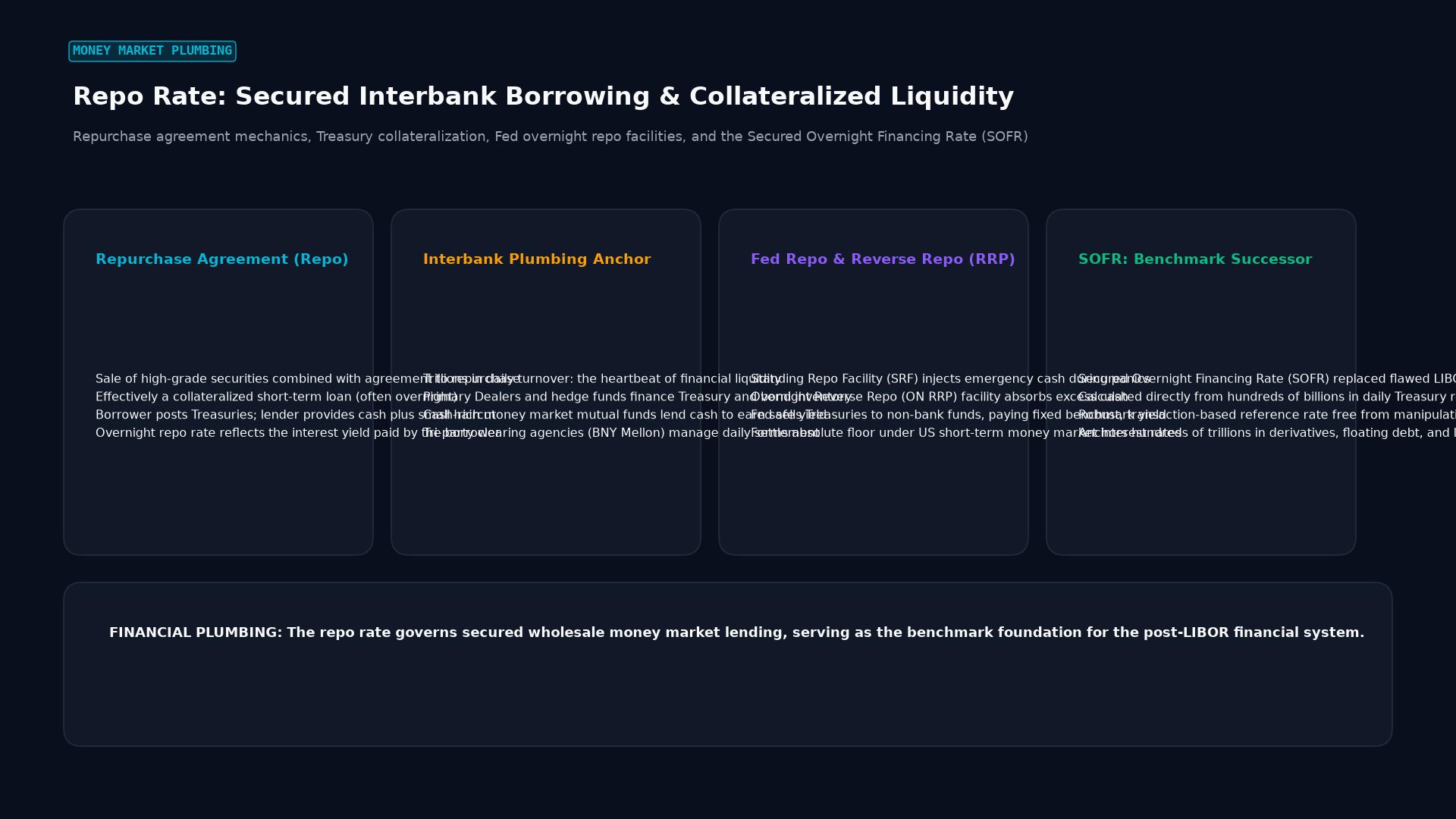 Figure: Repurchase agreement mechanics, Treasury collateralization, Fed overnight repo facilities, and the Secured Overnight Financing Rate (SOFR)
Technical Mechanics & Mathematical Formulation
A repurchase agreement is economically equivalent to a collateralized, interest-bearing loan.
Annualized Repo Rate Equation
Given the initial sale price of the collateral ($P_{\text{sale}}$) and the agreed forward repurchase price ($P_{\text{repurchase}}$) over a tenor of $N$ days, the annualized repo rate ($r_{\text{repo}}$) under the standard money-market day-count convention (Actual/360) is:
$$r_{\text{repo}} = \left( \frac{P_{\text{repurchase}} - P_{\text{sale}}}{P_{\text{sale}}} \right) \times \left( \frac{360}{N} \right) \times 100$$
Haircuts and Overcollateralization
To insulate the central bank against market volatility in the underlying collateral’s price, the central bank applies a collateral haircut ($h$):
$$\text{Cash Borrowing Amount} = \text{Market Value of Securities} \times (1 - h)$$
Where: $$h = \left( 1 - \frac{\text{Cash Loan Extended}}{\text{Market Value of Collateral}} \right) \times 100$$
If a commercial bank pledges $100 million in Treasury bonds and the central bank applies a 2% haircut ($h = 0.02$), the bank receives a maximum cash loan of $98 million.
Comparative Matrix: Central Bank Monetary Instruments
| Instrument | Direction of Cash Flow | Collateral Required | Primary Policy Objective | Typical Duration |
|---|---|---|---|---|
| Repo Rate | Central Bank $\to$ Commercial Banks | High-quality sovereign debt | Injecting interbank liquidity | Overnight to 14 days |
| Reverse Repo Rate | Commercial Banks $\to$ Central Bank | High-quality sovereign debt | Absorbing excess systemic cash | Overnight |
| Bank / Discount Rate | Central Bank $\to$ Depository Banks | Eligible commercial bills / bonds | Emergency discount window lending | Overnight |
| Standing Deposit Rate | Commercial Banks $\to$ Central Bank | Uncollateralized | Setting floor on interbank rates | Overnight |
Real-World Case Study: The US Overnight Repo Spike (September 2019)
The systemic centrality of the repo market to modern financial architecture was exposed in September 2019, when the US dollar overnight repo market seized up unexpectedly.
Anatomy of the September 2019 Repo Shock:
1. The Squeeze: On September 16-17, 2019, two liquidity drains collided: US corporate quarterly corporate tax payments drained $100 billion from bank deposits, while the US Treasury settled $78 billion in new debt issuance.
2. The Cash Freeze: Commercial banks, constrained by Basel III liquidity regulations (LCR) and post-crisis reserve limits, refused to lend cash in the private repo market.
3. The Rate Explosion: Overnight general collateral repo rates exploded from their typical range of 2.10%–2.20% to an unprecedented intraday high of 10.00% (nearly five times the Fed's target rate).
4. Fed Intervention: The Federal Reserve was forced to step in immediately, conducting emergency overnight repo operations of $75 billion per day and expanding its balance sheet by purchasing $60 billion in Treasury bills monthly to permanently re-liquefy interbank cash reserves.
The crisis demonstrated that even in the world’s deepest capital market, a sudden shortage of cash reserves relative to Treasury collateral can cause short-term rates to skyrocket overnight.
Frequently Asked Questions (FAQ)
How does a change in the central bank repo rate affect consumer interest rates?
The repo rate serves as the foundational benchmark for the entire domestic yield curve. When a central bank increases its repo rate, commercial banks face higher borrowing costs to obtain overnight liquidity. To protect their net interest margins, banks immediately raise their prime lending rates for corporate borrowers, mortgages, auto loans, and revolving credit cards. Conversely, cutting the repo rate lowers wholesale funding costs, reducing consumer loan rates and encouraging credit expansion.
What is the difference between a Repo and a Reverse Repo?
The difference is entirely one of transaction perspective:
- In a Repo (Repurchase Agreement), the central bank buys securities from a commercial bank and lends cash, thereby injecting liquidity into the banking system.
- In a Reverse Repo, the central bank sells securities to commercial banks and absorbs cash, thereby draining excess liquidity out of the financial system to prevent overnight interest rates from falling below the central bank’s target floor.
How does the repo rate influence a nation’s currency in forex trading?
In foreign exchange markets, an increase in a country’s repo rate typically strengthens its domestic currency. Higher policy interest rates expand the interest rate differential (carry) relative to foreign currencies, attracting yield-seeking international capital inflows. However, if a central bank hikes the repo rate into a deeply decelerating economy, the currency may weaken if foreign exchange traders conclude that high borrowing costs will trigger corporate defaults and a sharp recession.
Ready to trade forex?
Open a free demo account with a regulated broker. Practice with virtual funds before risking real money.