Cash Reserve Ratio (CRR)
The Cash Reserve Ratio (CRR) is a statutory monetary policy requirement mandated by a central bank specifying the minimum percentage of a commercial bank's net demand and time liabilities that must be maintained as unencumbered cash reserves at the central bank.
What Is the Cash Reserve Ratio (CRR)?
The Cash Reserve Ratio (CRR) is a statutory regulatory requirement established by a nation’s central bank (such as the Reserve Bank of India, Bank of England, or People’s Bank of China) mandating the minimum percentage of a commercial bank’s total customer deposits that must be held in the form of unencumbered, non-interest-bearing cash balances maintained directly inside the central bank’s vaults.
As a cornerstone of fractional reserve banking, the CRR fulfills two vital economic mandates:
- Prudential Solvency & Depositor Safety: Ensures that commercial banks do not lend out 100% of their deposited capital, maintaining an immediate liquid cash reserve to honor sudden, unexpected depositor withdrawals.
- Quantitative Monetary Control: Serves as a direct, blunt macroeconomic lever to regulate systemic credit creation, modulate the national money supply, and curb demand-pull inflation without relying solely on interest rate adjustments.
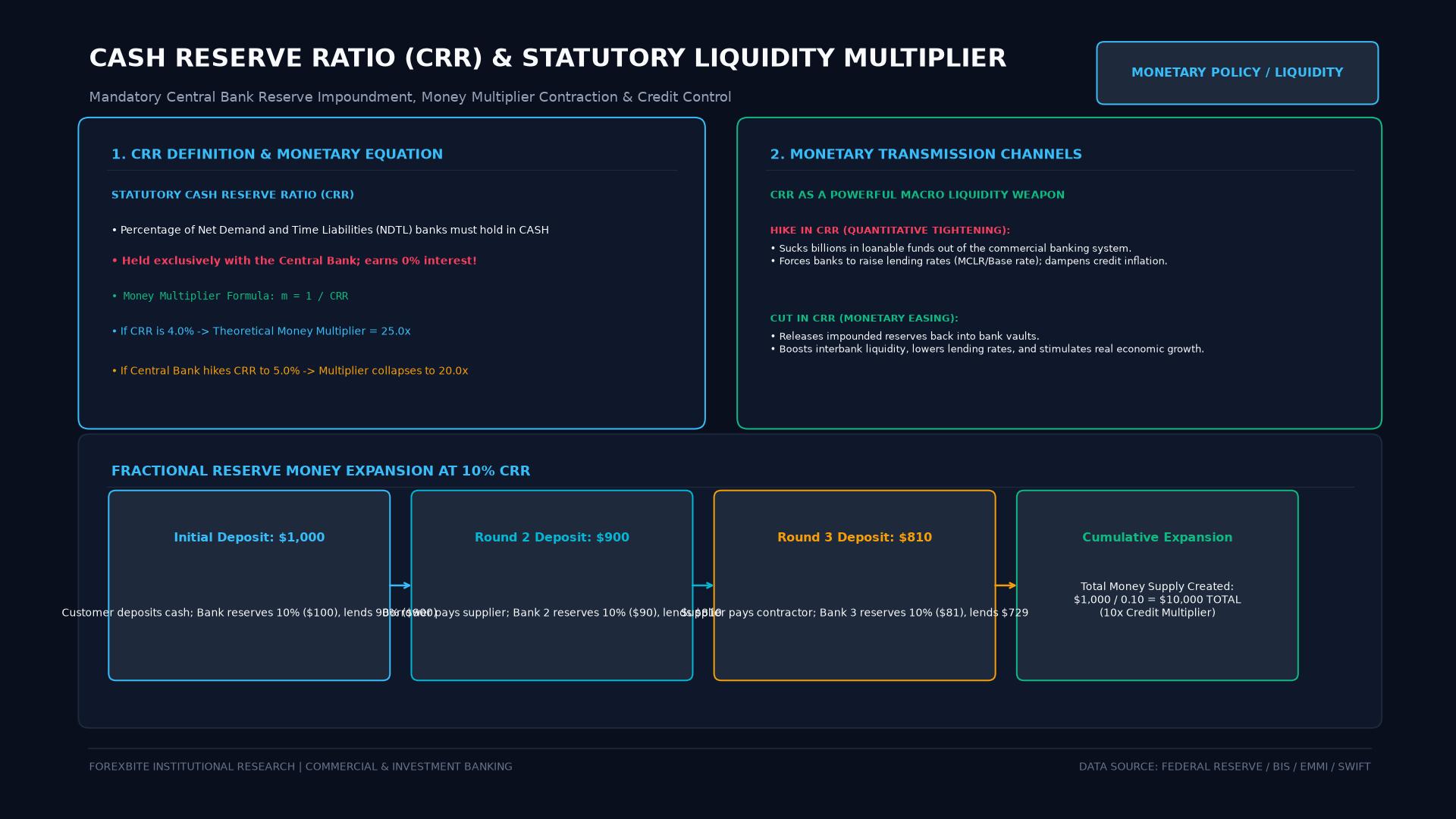 Figure: Central bank statutory reserve requirement: primary cash containment, money multiplier contraction, and systemic liquidity drainage mechanics.
Technical Mechanics & The Money Multiplier Framework
In monetary economics, the Cash Reserve Ratio dictates the theoretical maximum volume of broad money ($M$) that commercial banks can create from a given base of primary reserves:
The Theoretical Money Multiplier Formula
$$\text{Theoretical Money Multiplier } (m) = \frac{1}{\text{CRR}}$$
$$\text{Total Systemic Deposit Expansion } (\Delta M) = \text{Initial Deposit} \times \left( \frac{1}{\text{CRR}} \right)$$
If the central bank sets the CRR at 4.0% ($0.04$):
$$m = \frac{1}{0.04} = 25$$
Every $1.00 of newly deposited cash can support up to $25.00 of total broad money through iterative loan creation.
Quantitative Liquidity Impact of CRR Adjustments
In countries like India, the CRR is calculated as a percentage of a bank’s Net Demand and Time Liabilities (NDTL):
$$\text{Required Central Bank Cash Reserve} = \text{NDTL} \times \text{CRR}$$
Unlike repo rate changes—which adjust the cost of borrowing—a 50-basis-point ($0.50%$) hike in the CRR instantly sucks billions of dollars in loanable cash out of the private banking sector overnight:
$$\Delta \text{Systemic Liquidity} = -\Delta \text{CRR} \times \sum_{i=1}^{n} \text{NDTL}_i$$
Comparative Matrix: Central Bank Reserve Requirements
| Regulatory Metric | Reserve Medium | Location Held | Primary Objective | Yield / Interest Paid |
|---|---|---|---|---|
| Cash Reserve Ratio (CRR) | Physical Cash / Electronic Central Reserves | Central Bank Vault / RTGS Account | Controlling money supply & credit creation | Zero (0.0% interest) |
| Statutory Liquidity Ratio (SLR) | Sovereign Gold, T-Bills, Approved Bonds | Retained by commercial bank internally | Securing government bond auction demand | Earns coupon yield of underlying bonds |
| Basel III Liquidity Coverage (LCR) | High-Quality Liquid Assets (HQLA) | Bank treasury portfolio | Surviving 30-day acute liquidity stress run | Market yield |
Real-World Case Study: The 100% Incremental CRR Shock in India (November 2016)
The ultimate demonstration of the CRR’s speed as a liquidity-absorbing weapon occurred during India’s Demonetization crisis in November 2016.
Anatomy of an Emergency CRR Intervention:
1. The Shock: On November 8, 2016, the Indian government demonetized 86% of the nation's currency notes (₹500 and ₹1,000 banknotes).
2. The Cash Avalanche: Citizens flooded the banking system to deposit demonetized cash. Commercial bank deposits expanded by an unprecedented ₹8.2 trillion ($120 billion) in three weeks.
3. The Threat: Commercial banks faced massive excess liquidity, threatening to collapse short-term interbank call money rates to near zero, sparking uncontrollable credit inflation and currency volatility.
4. The RBI Countermeasure: On November 26, 2016, Reserve Bank of India Governor Urjit Patel imposed an emergency 100% Incremental Cash Reserve Ratio (I-CRR) on all net deposits accumulated between September 16 and November 11.
5. The Result: The 100% I-CRR instantly impounded over ₹3.2 trillion ($47 billion) in excess liquidity, stabilizing overnight call rates within the RBI's policy corridor before being phased out.
Frequently Asked Questions (FAQ)
Why do central banks pay zero interest on Cash Reserve Ratio balances?
Central banks intentionally pay zero interest on statutory CRR balances to preserve the effectiveness of monetary policy and prevent commercial banks from using central bank reserve deposits as an easy risk-free profit engine. Because holding reserves at 0% yield represents an “implicit tax” on commercial banks, banks are incentivized to maintain tight reserve discipline and deploy remaining loanable funds efficiently into the productive economy.
How does hiking the CRR help combat domestic inflation?
When a central bank increases the CRR, commercial banks are legally mandated to lock away a larger fraction of their customer deposits with the central bank. This directly shrinks the pool of loanable funds available for business investment, auto loans, and retail mortgages. With less commercial credit circulating through the economy, aggregate consumer demand cools, business borrowing slows, and upward pressure on the Consumer Price Index (CPI) decelerates.
What penalties do banks face if they fail to meet daily CRR requirements?
In jurisdictions like India, commercial banks must maintain at least 90% of their mandatory CRR on a daily basis, and 100% on average over a fortnightly reporting cycle. If a bank experiences a CRR shortfall, the central bank levies heavy statutory penalties—typically the bank rate plus 3.0% for the first day of default, and the bank rate plus 5.0% for subsequent consecutive days of non-compliance, accompanied by public regulatory censure.
Ready to trade forex?
Open a free demo account with a regulated broker. Practice with virtual funds before risking real money.