Call Ratio Backspread
A call ratio backspread is an advanced, asymmetric options trading strategy constructed by selling a smaller number of lower-strike in-the-money or at-the-money call options to finance the purchase of a greater number of higher-strike out-of-the-money call options, benefiting from sharp upside breakouts and volatility expansion.
What Is a Call Ratio Backspread?
A call ratio backspread is an asymmetric, net-volatility options trading strategy deployed when a trader anticipates an explosive, high-momentum upward movement in the underlying asset’s price, accompanied by an expansion in implied volatility.
Unlike standard vertical bull spreads (which cap upside profitability at the short strike), a call ratio backspread is structured with more long calls than short calls. Typically constructed in a 2:1 ratio (or 3:2 ratio), the trader sells a lower-strike in-the-money (ITM) or at-the-money (ATM) call option and uses the collected premium to fully or partially fund the purchase of two higher-strike out-of-the-money (OTM) call options.
The strategy delivers unlimited upside profit potential while limiting downside risk if the underlying asset collapses, though it carries a defined risk “valley” if the asset closes precisely at the higher strike price upon expiration.
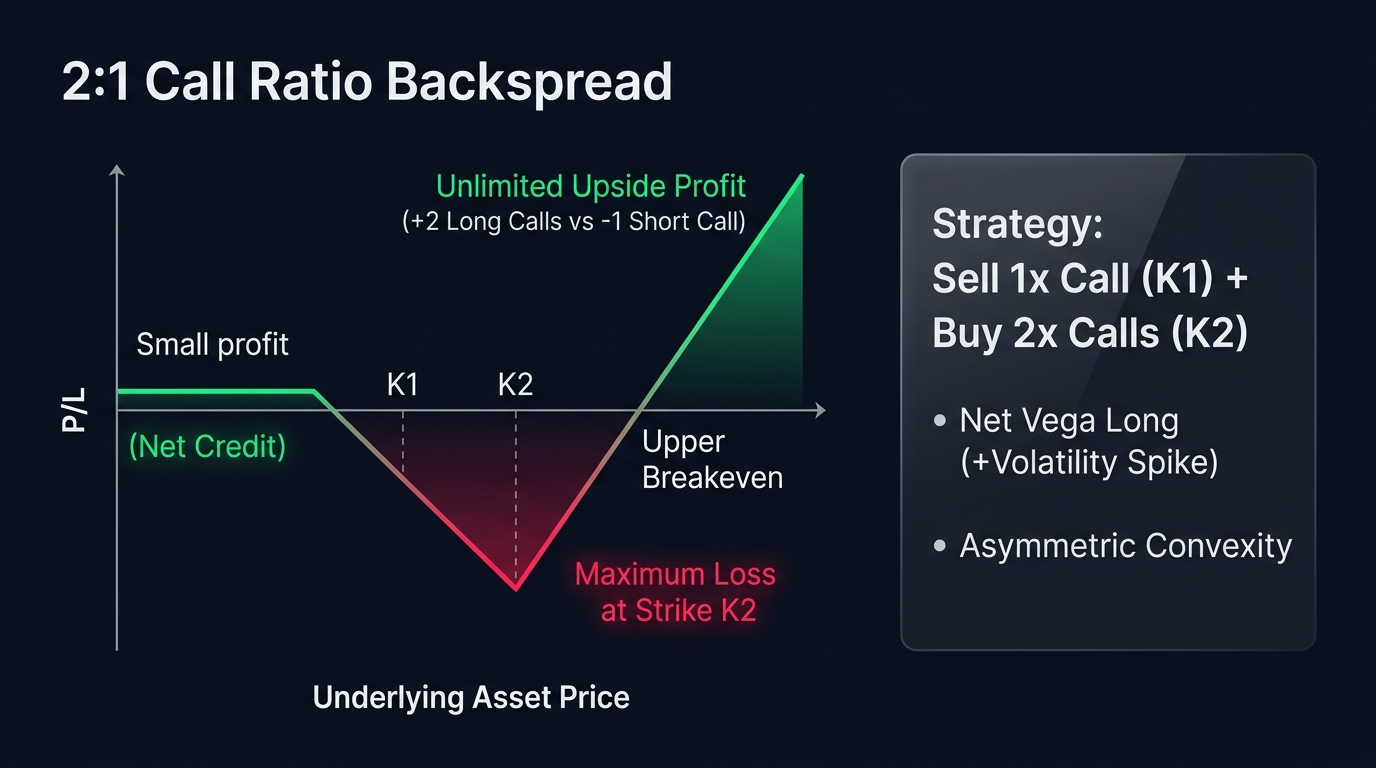
+-----------------------------------------------------------------------+
|                    CALL RATIO BACKSPREAD (2:1) PAYOFF                 |
+-----------------------------------------------------------------------+
|  Profit / Loss ($)                                                    |
|  ^                                                / UNLIMITED UPSIDE  |
|  |                                               /  PROFIT (2 Longs   |
|  |                                              /   beat 1 Short)     |
|  |  SMALL GAIN (Net Credit)                   /                      |
|  |  +---------------------+                 /                         |
|  0 -+---------------------\---------------+------------------------>  |
|  |                         \             /   Upper Break-Even         |
|  |                          \           /                             |
|  |                           \         /                              |
|  |                            \       /                               |
|  |                             +-----+ MAXIMUM LOSS AT K2             |
|  +-----------------------------------------------------------------+  |
|     (Underlying Drops)     K1 (Short Call)   K2 (Long Calls)   SPOT   |
+-----------------------------------------------------------------------+
Technical Mechanics & Expiration Payoff Equations
Consider a standard 2:1 call ratio backspread:
- Sell 1 Call at lower strike $K_1$ for premium $C_1$.
- Buy 2 Calls at higher strike $K_2$ for premium $C_2$ each (where $K_1 < K_2$).
- Net Cash Flow ($N$): $N = C_1 - 2 C_2$. (Ideally opened for a net credit $N > 0$ or small debit $N < 0$).
Mathematical Payoff Scenarios at Expiration ($S_T$)
-
Downside Collapse ($S_T \le K_1$): All three call options expire out-of-the-money and completely worthless. $$\Pi(S_T) = N \quad (\text{Trader retains net upfront credit})$$
-
The Maximum Loss Valley ($S_T = K_2$): The two long calls at $K_2$ expire worthless. The short call at $K_1$ is fully in-the-money: $$\text{Max Loss} = (K_2 - K_1) - N$$
-
Explosive Upside Rally ($S_T > K_2$): Both long calls and the single short call are in-the-money. The net delta becomes $+1.0$: $$\Pi(S_T) = 2(S_T - K_2) - (S_T - K_1) + N = S_T - (2 K_2 - K_1) + N$$
Upper Breakeven Point
The price point above which the trade enters pure, unlimited profitability:
$$\text{Upper Breakeven} = K_2 + \text{Max Loss} = 2 K_2 - K_1 - N$$
Greek Sensitivity Profile: The Volatility Engine
| Option Greek | Position Sign | Portfolio Implication |
|---|---|---|
| Delta ($\Delta$) | Dynamic (Starts near 0, shifts to $+1.0$) | Becomes aggressively bullish as underlying price surpasses $K_2$ |
| Gamma ($\Gamma$) | Positive ($\Gamma > 0$) | Position delta expands favorably as price rallies; accelerates upside gains |
| Vega ($\nu$) | Positive ($\nu > 0$) | Long 2 contracts vs. short 1 contract makes position net long volatility |
| Theta ($\Theta$) | Negative ($\Theta < 0$) | Time decay erodes value if the asset remains pinned near $K_2$ |
Because the trade holds net positive Vega ($\nu_{\text{net}} = 2 \nu_{K_2} - \nu_{K_1} > 0$), any sudden expansion in the volatility skew directly expands the unrealized mark-to-market value of the position prior to expiration.
Comparative Matrix: Bullish Derivative Strategies
| Strategy | Construction | Upside Potential | Downside Risk | Volatility Preference |
|---|---|---|---|---|
| Call Ratio Backspread | Sell 1 ITM Call, Buy 2 OTM Calls | Unlimited | Strictly defined (or small gain) | Long Volatility (Rising IV) |
| Long Call | Buy 1 ATM Call | Unlimited | 100% of premium paid | Long Volatility |
| Bull Call Spread | Buy 1 ATM Call, Sell 1 OTM Call | Capped at short strike | 100% of net debit | Neutral to falling volatility |
| Long Straddle | Buy 1 ATM Call, Buy 1 ATM Put | Unlimited | 100% of combined premiums | Extreme Long Volatility |
Real-World Case Study: Trading Binary Biotech Catalyst Surges
The call ratio backspread is a favored strategy among quantitative hedge funds trading high-volatility event catalysts, such as FDA drug approval announcements or semiconductor earnings releases.
Anatomy of an FDA Approval Trade:
- Underlying: Clinical-stage biotechnology stock trading at $50.00.
- The Setup: FDA Phase 3 clinical trial readout due in 30 days. If approved, the stock could surge to $80+; if rejected, the stock will collapse to $35.
- The Trade (2:1 Ratio Backspread):
  * Sell 1x $50 Call at $6.00 premium.
  * Buy 2x $60 Calls at $2.80 each ($5.60 total cost).
  * Net Credit: +$0.40 ($40 per spread).
- Scenario A (Rejection -> Stock collapses to $35):
  All calls expire worthless. Trader keeps the $0.40 net credit ($40 profit).
- Scenario B (Stagnation -> Stock pins at $60):
  The short $50 call is in-the-money by $10. Long calls expire worthless. Trader loses $10 - $0.40 = -$9.60 (Max Loss).
- Scenario C (Approval -> Stock skyrockets to $85):
  Short $50 call loses $35; 2 long $60 calls gain $50 ($25 each). Net Profit = $50 - $35 + $0.40 = +$15.40 ($1,540 per spread).
The strategy enabled the fund to capture massive upside while ensuring that a negative trial outcome resulted in a small cash gain rather than a catastrophic loss.
Frequently Asked Questions (FAQ)
When should a trader deploy a call ratio backspread instead of a standard long call?
A call ratio backspread is preferred when the trader wants to eliminate the downside penalty of being wrong on direction. If a trader buys a standard call option and the stock crashes, they lose 100% of the invested premium. With a call ratio backspread established for a net credit, if the underlying asset drops significantly, all options expire worthless and the trader keeps the initial cash credit, completely eliminating downside loss.
What is the primary risk of a call ratio backspread?
The primary risk is that the underlying asset experiences a modest, gradual rally and closes exactly at the higher long strike ($K_2$) at expiration. In this scenario, the short lower-strike call is fully in-the-money, while the two higher-strike long calls expire worthless, forcing the trader to realize the maximum theoretical loss on the position.
Can a call ratio backspread be structured using different ratios, like 3:2?
Yes. While the 2:1 ratio is the most common, quantitative traders frequently utilize a 3:2 ratio (selling 2 lower-strike calls to buy 3 higher-strike calls). A 3:2 ratio generates a larger upfront credit, reducing the capital required to enter the trade, but it shifts the upper breakeven point higher and widens the maximum loss valley between the two strikes.
Ready to trade forex?
Open a free demo account with a regulated broker. Practice with virtual funds before risking real money.